

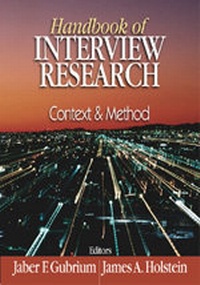
Handbook of Interview Research
Context and Method
1st Edition
Published on 5. September 2001
Book
Hardback
1000 pages
978-0-7619-1951-3 (ISBN)
Description
The Handbook of Interview Research is the most ambitious attempt yet at examining the place of the interview in contemporary society. Interviewing is the predominant mode of research in the social sciences. It's also the stock-in-trade of information seekers in organizations and institutions of all kinds, as well as in the mass media. Across the board, interviews provide today's leading window on the world of experience.
The Handbook offers a comprehensive examination of the interview at the cutting edge of information technology. Drawing upon leading experts from a wide range of professional disciplines, this book addresses conceptual and technical challenges that confront both academic researchers and interviewers with more applied goals. From interview theory to the nuts-and-bolts of the interview process, the coverage is impressively broad and authoritative.
The Handbook of Interview Research is both encyclopedic and thematic. As an encyclopedia, it provides extensive discussions of the methodological issues now surrounding interview practice, offering a multi-faceted assessment of what has become the method of choice for obtaining personal information in today's society. But the Handbook also is a story, which spins a particular tale of interviewing, one that moves from the commonly recognized individual interview to what is called `the interview society'. The gist of the presentation is that we can no longer regard the interview as simply an instrument for gathering data, but must now also view it an integral part of society.
The Handbook offers a comprehensive examination of the interview at the cutting edge of information technology. Drawing upon leading experts from a wide range of professional disciplines, this book addresses conceptual and technical challenges that confront both academic researchers and interviewers with more applied goals. From interview theory to the nuts-and-bolts of the interview process, the coverage is impressively broad and authoritative.
The Handbook of Interview Research is both encyclopedic and thematic. As an encyclopedia, it provides extensive discussions of the methodological issues now surrounding interview practice, offering a multi-faceted assessment of what has become the method of choice for obtaining personal information in today's society. But the Handbook also is a story, which spins a particular tale of interviewing, one that moves from the commonly recognized individual interview to what is called `the interview society'. The gist of the presentation is that we can no longer regard the interview as simply an instrument for gathering data, but must now also view it an integral part of society.
Reviews / Votes
"A shrewd and sensitive overview . . . The book is a really useful and innovative approach to the quite large issue of what interviewing is and where it can be used as well as the cautions that need to be considered when interviewing in various settings. The selections offer a shrewd and sensitive overview to the problem of placing the interviewer in the setting and allowing for the interaction between the informant and the interviewer as part of the analysis. I think the book would be EXCELLENT for graduate classes." -- Arlene Kaplan Daniels "A sourcebook that any researcher should have in her/his reference library. The chapters cover virtually every conceivable interviewing situation as well as discuss larger 'meta-issues' that face the survey researcher. The volume also tells a story: The editors have created a volume that tries to link each chapter by threading a theme through each chapter. That theme is the argument that interview situations are social situations and should be viewed as such. This is an important way to contextualize what would otherwise be merely guidelines for technique and methodological points." -- Jeffrey Chin "The editors' vision and effort makes HANDBOOK OF INTERVIEW RESEARCH: CONTEXT AND METHOD a volume of exceptional breadth and depth. To the editors' credit, the volume addresses the interview as both a tool and topic of social analysis." -- Mel PollnerThe Handbook is a stunning accomplishment. Congratulations to Gubrium and Holstein, to their contributors, and to the visionaries at Sage! With this work you have totally transformed the field of qualitative inquiry. -- Norman K. Denzin ". . .serving students who are preparing for a degree or training in a field in which interviewing is an important skill, this is an instrumental addition." -- L. Wolfer "The Handbook of Interview Research offers a comprehensive examination of the interview at the cutting edge of information technology in the context of a challenging postmodern environment. Encyclopedic in its breadth, the book provides extensive discussions of the conceptual and methodological issues surrounding interview practice" -- Family Therapy
More details
Edition
First Edition
Language
English
Place of publication
Thousand Oaks
United States
Target group
Professional and scholarly
Dimensions
Height: 254 mm
Width: 178 mm
Weight
1871 gr
ISBN-13
978-0-7619-1951-3 (9780761919513)
Copyright in bibliographic data and cover images is held by Nielsen Book Services Limited or by the publishers or by their respective licensors: all rights reserved.
Schweitzer Classification
Other editions
New editions
Jaber F. Gubrium | James A. Holstein | Amir Marvasti
The SAGE Handbook of Interview Research
The Complexity of the Craft
Book
04/2012
2nd Edition
SAGE Publications Inc
€245.53
Shipment within 10-20 days
Persons
Jaber F. Gubrium is professor and chair of sociology at the University of Missouri. He has an extensive record of research on the social organization of care in human service institutions. His publications include numerous books and articles on aging, family, the life course, medicalization, and representational practice in therapeutic context. James A. Holstein is professor of sociology in the Department of Social and Cultural Sciences at Marquette University. His research and writing projects have addressed social problems, deviance and social control, mental health and illness, family, and the self, all approached from an ethnomethodologically- informed, constructionist perspective.
Content
Introduction
From the Individual Interview to the Interview Society - Jaber F Gubrium and James A Goldstein
The History of the Interview - Jennifer Platt
PART ONE: FORMS OF INTERVIEWING
Survey Interviewing - Royce A Singleton and Bruce C Straits
Qualitative Interviewing - Carol A B Warren
In-Depth Interviewing - John M Johnson
The Life Story Interview - Robert Atkinson
Focus Group Interviewing - David L Morgan
Postmodern Trends in Interviewing - Andrea Fontana
PART TWO: DISTINCTIVE RESPONDENTS
Interviewing Children and Adolescents - Donna Eder and Laura Fingerson
Interviewing Men - Michael L Schwalbe and Michelle Wolkomir
Interviewing Women - Shulamit Reinharz and Susan E Chase
Queering the Interview - Travis Kong, Dan Mahoney, and Ken Plummer
Interviewing Older People - G. Clare Wenger
Race, Subjectivity, and the Interview Process - Christopher Dunbar Jr, Dalia Rodriguez and Laurence Parker
Interviewing Elites - Teresa Odendahl and Aileen M. Shaw
Interviewing the Ill - Janice M Morse
PART THREE: AUSPICES OF INTERVIEWING
Cross-Cultural Interviewing - Anne Ryen
Interviewing in Medical Settings - Kathy Zoppi and Ronald M. Epstein
Therapy Interviewing - Gale Miller, Steve de Shazer, and Peter de Jong
Journalistic Interviewing - David L Altheide
Forensic Investigative Interviewing - Ian K. Mckenzie
Interviewing in Education - William G Tierney and Patrick Dilley
Context and the Employment Interview - Gary P Latham and Zeeva Millman
PART FOUR: TECHNICAL ISSUES
Elicitation Techniques for Interviewing - Jeffery C Johnson and Susan C Weller
The Reluctant Respondent - Patricia A Adler and Peter Adler
In Person versus Telephone Interviewing - Roger W Shuy
Computer-Assisted Interviewing - Mick P. Couper and Sue Ellen Hansen
Standardization and Interaction in the Survey Interview - Nora Cate Shaeffer and Douglas Maynard
Internet Interviewing - Chris Mann and Fiona Stewart
Transcription Quality - Blake D Poland
Computer-Assisted Analysis of Qualitative Interview Data - Clive F Seale
PART FIVE: ANALYTICAL STRATEGIES
Qualitative Interviewing and Grounded Theory Analysis - Kathy Charmaz
Analysis of Personal Narratives - Catherine Kohler Riessman
Analytic Strategies for Oral History Interviews - Richard Candida Smith
Narrative, Interviews and Organizations - Barbara Czarniawska
Institutional Ethnography: Using Interviews to Investigate Ruling Relations - Marjorie L DeVault and Liza McCoy
Ethnomethodological Analyses of Interviews - Carolyn D Baker
PART SIX: REFLECTION AND REPRESENTATION
Revisiting the Relationship Between Participant Observation and Interviewing - Paul Atkinson and Amanda Coffey
Personal and Folk Narrative as Cultural Representation - Kirin Narayan and Kenneth M George
The Cinematic Society and the Reflexive Interview - Norman K Denzin
Their Story/My Story/Our Story: Including the Researchers Experience in Interview Research - Carolyn Ellis and Leigh Berger
Poetic Representation of Interviews - Laurel Richardson
Interviewing at the Border of Fact and Fiction - Paul C Rosenblatt
Interviewing, Power//Knowledge and Social Inequality - Charles L Briggs
Author Index
Subject Index
About the Editors
About the Contributors
From the Individual Interview to the Interview Society - Jaber F Gubrium and James A Goldstein
The History of the Interview - Jennifer Platt
PART ONE: FORMS OF INTERVIEWING
Survey Interviewing - Royce A Singleton and Bruce C Straits
Qualitative Interviewing - Carol A B Warren
In-Depth Interviewing - John M Johnson
The Life Story Interview - Robert Atkinson
Focus Group Interviewing - David L Morgan
Postmodern Trends in Interviewing - Andrea Fontana
PART TWO: DISTINCTIVE RESPONDENTS
Interviewing Children and Adolescents - Donna Eder and Laura Fingerson
Interviewing Men - Michael L Schwalbe and Michelle Wolkomir
Interviewing Women - Shulamit Reinharz and Susan E Chase
Queering the Interview - Travis Kong, Dan Mahoney, and Ken Plummer
Interviewing Older People - G. Clare Wenger
Race, Subjectivity, and the Interview Process - Christopher Dunbar Jr, Dalia Rodriguez and Laurence Parker
Interviewing Elites - Teresa Odendahl and Aileen M. Shaw
Interviewing the Ill - Janice M Morse
PART THREE: AUSPICES OF INTERVIEWING
Cross-Cultural Interviewing - Anne Ryen
Interviewing in Medical Settings - Kathy Zoppi and Ronald M. Epstein
Therapy Interviewing - Gale Miller, Steve de Shazer, and Peter de Jong
Journalistic Interviewing - David L Altheide
Forensic Investigative Interviewing - Ian K. Mckenzie
Interviewing in Education - William G Tierney and Patrick Dilley
Context and the Employment Interview - Gary P Latham and Zeeva Millman
PART FOUR: TECHNICAL ISSUES
Elicitation Techniques for Interviewing - Jeffery C Johnson and Susan C Weller
The Reluctant Respondent - Patricia A Adler and Peter Adler
In Person versus Telephone Interviewing - Roger W Shuy
Computer-Assisted Interviewing - Mick P. Couper and Sue Ellen Hansen
Standardization and Interaction in the Survey Interview - Nora Cate Shaeffer and Douglas Maynard
Internet Interviewing - Chris Mann and Fiona Stewart
Transcription Quality - Blake D Poland
Computer-Assisted Analysis of Qualitative Interview Data - Clive F Seale
PART FIVE: ANALYTICAL STRATEGIES
Qualitative Interviewing and Grounded Theory Analysis - Kathy Charmaz
Analysis of Personal Narratives - Catherine Kohler Riessman
Analytic Strategies for Oral History Interviews - Richard Candida Smith
Narrative, Interviews and Organizations - Barbara Czarniawska
Institutional Ethnography: Using Interviews to Investigate Ruling Relations - Marjorie L DeVault and Liza McCoy
Ethnomethodological Analyses of Interviews - Carolyn D Baker
PART SIX: REFLECTION AND REPRESENTATION
Revisiting the Relationship Between Participant Observation and Interviewing - Paul Atkinson and Amanda Coffey
Personal and Folk Narrative as Cultural Representation - Kirin Narayan and Kenneth M George
The Cinematic Society and the Reflexive Interview - Norman K Denzin
Their Story/My Story/Our Story: Including the Researchers Experience in Interview Research - Carolyn Ellis and Leigh Berger
Poetic Representation of Interviews - Laurel Richardson
Interviewing at the Border of Fact and Fiction - Paul C Rosenblatt
Interviewing, Power//Knowledge and Social Inequality - Charles L Briggs
Author Index
Subject Index
About the Editors
About the Contributors