

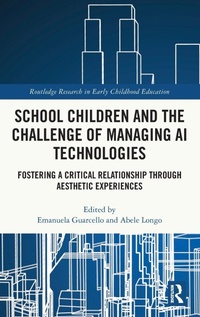
School Children and the Challenge of Managing AI Technologies
Fostering a Critical Relationship through Aesthetic Experiences
1st Edition
Published on 14. June 2024
Book
Hardback
290 pages
978-1-032-67809-2 (ISBN)
Description
This edited volume recognises the need to cultivate a critical and acute understanding of AI technologies amongst primary and elementary school children, enabling them to meet the challenge of a human- and ethically oriented management of AI technologies.
Focusing on school settings from both the national and international level to form comparative case studies, chapters present a robust conceptual and foundational framework within a global context as the idea of AI and our relationship to it advances apace. The book uses research garnered from interviews and observational data, qualitative and quantitative research, and theoretical findings gathered from single schools or institutions across the world. Providing an innovative perspective in promoting the importance of a critical, creative and ethical orientation based on aesthetic experiences, the book focuses on development in areas like visual arts, literature, environmental education, robotics, photography and screen education, movement and play.
Ultimately, the book responds to an urgent and time-sensitive call to provide guidance on AI to primary education researchers and will be of interest to academics, scholars and researchers in the fields of primary and elementary education, technology in education, children's rights education, and moral and values education more broadly.
The Open Access version of this book, available at http://www.taylorfrancis.com, has been made available under a Creative Commons [Attribution-Non Commercial-No Derivatives (CC BY-NC-ND)] 4.0 license.
Focusing on school settings from both the national and international level to form comparative case studies, chapters present a robust conceptual and foundational framework within a global context as the idea of AI and our relationship to it advances apace. The book uses research garnered from interviews and observational data, qualitative and quantitative research, and theoretical findings gathered from single schools or institutions across the world. Providing an innovative perspective in promoting the importance of a critical, creative and ethical orientation based on aesthetic experiences, the book focuses on development in areas like visual arts, literature, environmental education, robotics, photography and screen education, movement and play.
Ultimately, the book responds to an urgent and time-sensitive call to provide guidance on AI to primary education researchers and will be of interest to academics, scholars and researchers in the fields of primary and elementary education, technology in education, children's rights education, and moral and values education more broadly.
The Open Access version of this book, available at http://www.taylorfrancis.com, has been made available under a Creative Commons [Attribution-Non Commercial-No Derivatives (CC BY-NC-ND)] 4.0 license.
Reviews / Votes
"I really appreciated the book because it presents an innovative approach to education, based on aesthetic experiences, to facilitate a critical and constructive relationship between natural and artificial intelligence. This method proves particularly effective as it engages young people in a creative and emotional way, stimulating deep reflection on the ways in which AI can influence their lives and society as a whole."Barbara Bruschi is full professor of technology for education at the University of Turin. "I really appreciated the book because it presents an innovative approach to education, based on aesthetic experiences, to facilitate a critical and constructive relationship between natural and artificial intelligence. This method proves particularly effective as it engages young people in a creative and emotional way, stimulating deep reflection on the ways in which AI can influence their lives and society as a whole."
Barbara Bruschi is full professor of technology for education at the University of Turin.
More details
Series
Language
English
Place of publication
London
United Kingdom
Publishing group
Taylor & Francis Ltd
Target group
College/higher education
Professional and scholarly
Academic and Postgraduate
Illustrations
7 s/w Abbildungen, 3 s/w Photographien bzw. Rasterbilder, 4 s/w Zeichnungen, 8 s/w Tabellen
8 Tables, black and white; 4 Line drawings, black and white; 3 Halftones, black and white; 7 Illustrations, black and white
Dimensions
Height: 240 mm
Width: 161 mm
Thickness: 21 mm
Weight
619 gr
ISBN-13
978-1-032-67809-2 (9781032678092)
Copyright in bibliographic data and cover images is held by Nielsen Book Services Limited or by the publishers or by their respective licensors: all rights reserved.
Schweitzer Classification
Other editions
Additional editions
Emanuela Guarcello | Abele Longo
School Children and the Challenge of Managing AI Technologies
Fostering a Critical Relationship through Aesthetic Experiences
Book
10/2025
1st Edition
Routledge
€62.90
Shipment within 10-20 days
Emanuela Guarcello | Abele Longo
School Children and the Challenge of Managing AI Technologies
Fostering a Critical Relationship through Aesthetic Experiences
E-Book
06/2024
1st Edition
Routledge
€0.00
Available for download
Emanuela Guarcello | Abele Longo
School Children and the Challenge of Managing AI Technologies
Fostering a Critical Relationship through Aesthetic Experiences
E-Book
06/2024
1st Edition
Routledge
€0.00
Available for download
Persons
Emanuela Guarcello is Professor in Childhood and Primary Teachers Education, Department of Philosophy and Sciences of Education, University of Turin, Italy.
Abele Longo is Senior Lecturer in Translation Studies, Department of Education, Middlesex University, UK.
Abele Longo is Senior Lecturer in Translation Studies, Department of Education, Middlesex University, UK.
Content
Introduction
Part 1. The relationship between new generations and AI technologies
1 The "compound" act of transformation: the case of AI
2 Fostering intellectual and ethical virtues in the age of Artificial Intelligence. The need for educators-in-the-loop
3 Artificial Intelligence and new perspectives for teaching/learning processes
4 Leading engagement and learning in, out and between digital and non-digital environments. Hybrid-transitions as a space for children's agency
5 The dystopian threat of AI in primary education: looking towards a utopian postdigital ecopedagogy
6 Bolts or Brains: how elementary school children conceptualize A.I. and reason about issues of personal disclosure and privacy
7 The challenges of managing AItech: new educational needs for new generations
Part 2. Fostering a critical relationship with AI technologies through aesthetic experiences
8 Aesthetic and techno-aesthetic experiences to educate school children in critical sensitivity and judgement
9 The contribution of visual aesthetic experiences conducted through AITech to educate critical and creative thinking in the primary school: the field of visual arts
10 AI, new forms of reading and agential children's literature
11 Aesthetic experiences as a space of possibility
12 Towards a postmedia literacy: AI photographic filters, education, and self-representation
13 AI and robotics in education: catalysts and complexities
14 The use of artificial intelligence in various artistic researches on the problematization of physical space in relation to virtual space as a platformfor education
15 Educating through creativity with AI, with a view to the development of critical thinking
Part 3. Educational projects in primary school
16 The Child -AI R?lationship: the CAIR? research project educational experience
17 International call for AI Ethics: children draft their Ethical Charter on AI
18. Aesthetic experiences and immersive virtual environments: the IVE4Thinking educational project
19 Teaching the principles of artificial intelligence to Generation Z: the SMaILE-App mobile game application
20 The social robot Nao as an Intelligent Tutoring Robot: conducting the TCR test in primary schools
21 The VR research on educational contexts in Mexico, a critical review of the literature
22 Designing an artificial intelligence curriculum for primary schooling
Conclusion. From experiences to educational practices: lead project for promoting a critical management of AItech
Part 1. The relationship between new generations and AI technologies
1 The "compound" act of transformation: the case of AI
2 Fostering intellectual and ethical virtues in the age of Artificial Intelligence. The need for educators-in-the-loop
3 Artificial Intelligence and new perspectives for teaching/learning processes
4 Leading engagement and learning in, out and between digital and non-digital environments. Hybrid-transitions as a space for children's agency
5 The dystopian threat of AI in primary education: looking towards a utopian postdigital ecopedagogy
6 Bolts or Brains: how elementary school children conceptualize A.I. and reason about issues of personal disclosure and privacy
7 The challenges of managing AItech: new educational needs for new generations
Part 2. Fostering a critical relationship with AI technologies through aesthetic experiences
8 Aesthetic and techno-aesthetic experiences to educate school children in critical sensitivity and judgement
9 The contribution of visual aesthetic experiences conducted through AITech to educate critical and creative thinking in the primary school: the field of visual arts
10 AI, new forms of reading and agential children's literature
11 Aesthetic experiences as a space of possibility
12 Towards a postmedia literacy: AI photographic filters, education, and self-representation
13 AI and robotics in education: catalysts and complexities
14 The use of artificial intelligence in various artistic researches on the problematization of physical space in relation to virtual space as a platformfor education
15 Educating through creativity with AI, with a view to the development of critical thinking
Part 3. Educational projects in primary school
16 The Child -AI R?lationship: the CAIR? research project educational experience
17 International call for AI Ethics: children draft their Ethical Charter on AI
18. Aesthetic experiences and immersive virtual environments: the IVE4Thinking educational project
19 Teaching the principles of artificial intelligence to Generation Z: the SMaILE-App mobile game application
20 The social robot Nao as an Intelligent Tutoring Robot: conducting the TCR test in primary schools
21 The VR research on educational contexts in Mexico, a critical review of the literature
22 Designing an artificial intelligence curriculum for primary schooling
Conclusion. From experiences to educational practices: lead project for promoting a critical management of AItech