

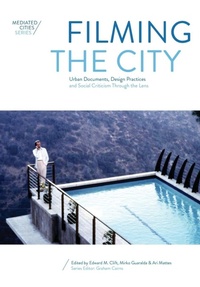
Filming the City
Urban Documents, Design Practices and Social Criticism through the Lens
Published on 1. May 2016
Book
Paperback/Softback
280 pages
978-1-78320-554-7 (ISBN)
Description
Filming the City brings together the work of filmmakers, architects, designers, video artists and media specialists to provide three distinct prisms through which to examine the medium of film in the context of the city. The book presents commentaries on particular films and their social and urban relevance, offering contemporary criticisms of both film and urbanism from conflicting perspectives, and documenting examples of how to actively use the medium of film in the design of our cities, spaces and buildings. Bringing a diverse set of contributors to the collection, editors Edward M. Clift, Mirko Guaralda and Ari Mattes offer readers a new approach to understanding the complex, multi-layered interaction of urban design and film.
More details
Series
Language
English
Place of publication
United Kingdom
Publishing group
Intellect
Target group
Professional and scholarly
Dimensions
Height: 244 mm
Width: 170 mm
Thickness: 15 mm
Weight
488 gr
ISBN-13
978-1-78320-554-7 (9781783205547)
Copyright in bibliographic data and cover images is held by Nielsen Book Services Limited or by the publishers or by their respective licensors: all rights reserved.
Schweitzer Classification
Other editions
Additional editions
Mirko Guaralda | Ari Mattes | Edward M. Clift
Filming the City
Urban Documents, Design Practices and Social Criticism through the Lens
E-Book
06/2016
1st Edition
Intellect Books
€40.49
Available for download
Persons
Edward M. Clift is president of Brooks Institute in Ventura, California.
Mirko Guaralda is a senior lecturer in architecture at the Queensland University of Technology.
Ari Mattes is a lecturer in media studies at the University of Notre Dame, Australia.
Graham Cairns is a visiting scholar in architecture and design at both Florida State University and Ravensbourne, UK.
Mirko Guaralda is a senior lecturer in architecture at the Queensland University of Technology.
Ari Mattes is a lecturer in media studies at the University of Notre Dame, Australia.
Graham Cairns is a visiting scholar in architecture and design at both Florida State University and Ravensbourne, UK.
Content
Forward
Graham Cairns
Introduction
Edward M. Clift
Section One: Film as Spatial Theory
Various
Chapter One: Unlawful entry: The imbrication of suburban space and police repression in Jonathan Kaplan's Los Angeles
Ari Mattes
Chapter Two: Blockbuster realism: Mapping Gotham in the Dark Knight films
Jarrad Cogle
Chapter Three: (Re-) Framing urbanity: Contestation, the moving image and the right to the city
Joern W. Langhorst
Chapter Four: Architects of Playtime: Cities as social media in the work of Jaques Tati
Lisa Landrum
Chapter Five: Film and the urban nightmare: Pier Vittorio Aureli's cityarchipelagos as urbanities woven from media images in Pete Travis's Dredd and Christopher Nolan's The Dark Knight Rises
Maciej Stasiowski
Section Two: Film as Spatial Research and Experiment
Various
Chapter Six: Hollywood menace: Los Angeles and mid-century modern dens of vice
Gabriel Solomons
Chapter Seven: A second life for a second city: Tradition and modernity in Guadalajara in the Summer
Carmen Elisa Gomez-Gomez
Chapter Eight: The cinematic image as an architectural conductor: A mediated hint from future architecture
Ayseguel Akcay Kavakoglu
Chapter Nine: Berlin on film: A mediated and reconstructed city
Graham Cairns
Section Three: Film as Spatial Practice
Various
Chapter Ten: The grey area between reality and representation: The practices of architects and film-makers
Gemma Barton
Chapter Eleven: Electric Signs revisited
Alice Arnold
Chapter Twelve: Public and urban humanities: Beyond the ideal city
Luisa Bravo
Chapter Thirteen: The mediating city: Towards a mise-en-scene for interaction online
Benjamin Koslowski
Epilogue
Ari Mattes and Mirko Guaralda
Graham Cairns
Introduction
Edward M. Clift
Section One: Film as Spatial Theory
Various
Chapter One: Unlawful entry: The imbrication of suburban space and police repression in Jonathan Kaplan's Los Angeles
Ari Mattes
Chapter Two: Blockbuster realism: Mapping Gotham in the Dark Knight films
Jarrad Cogle
Chapter Three: (Re-) Framing urbanity: Contestation, the moving image and the right to the city
Joern W. Langhorst
Chapter Four: Architects of Playtime: Cities as social media in the work of Jaques Tati
Lisa Landrum
Chapter Five: Film and the urban nightmare: Pier Vittorio Aureli's cityarchipelagos as urbanities woven from media images in Pete Travis's Dredd and Christopher Nolan's The Dark Knight Rises
Maciej Stasiowski
Section Two: Film as Spatial Research and Experiment
Various
Chapter Six: Hollywood menace: Los Angeles and mid-century modern dens of vice
Gabriel Solomons
Chapter Seven: A second life for a second city: Tradition and modernity in Guadalajara in the Summer
Carmen Elisa Gomez-Gomez
Chapter Eight: The cinematic image as an architectural conductor: A mediated hint from future architecture
Ayseguel Akcay Kavakoglu
Chapter Nine: Berlin on film: A mediated and reconstructed city
Graham Cairns
Section Three: Film as Spatial Practice
Various
Chapter Ten: The grey area between reality and representation: The practices of architects and film-makers
Gemma Barton
Chapter Eleven: Electric Signs revisited
Alice Arnold
Chapter Twelve: Public and urban humanities: Beyond the ideal city
Luisa Bravo
Chapter Thirteen: The mediating city: Towards a mise-en-scene for interaction online
Benjamin Koslowski
Epilogue
Ari Mattes and Mirko Guaralda