

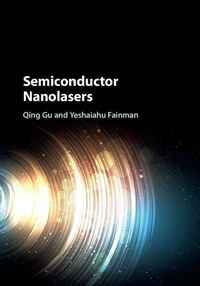
Semiconductor Nanolasers
Published on 16. February 2017
Book
Hardback
332 pages
978-1-107-11048-9 (ISBN)
Description
This unique resource explains the fundamental physics of semiconductor nanolasers, and provides detailed insights into their design, fabrication, characterization, and applications. Topics covered range from the theoretical treatment of the underlying physics of nanoscale phenomena, such as temperature dependent quantum effects and active medium selection, to practical design aspects, including the multi-physics cavity design that extends beyond pure electromagnetic consideration, thermal management and performance optimization, and nanoscale device fabrication and characterization techniques. The authors also discuss technological applications of semiconductor nanolasers in areas such as photonic integrated circuits and sensing. Providing a comprehensive overview of the field, detailed design and analysis procedures, a thorough investigation of important applications, and insights into future trends, this is essential reading for graduate students, researchers, and professionals in optoelectronics, applied photonics, physics, nanotechnology, and materials science.
Reviews / Votes
'For many years, photonics has sought to emulate the enormous success of electronics in miniaturizing devices - specifically with the aim of creating photonic integrated circuits. Nanolasers are strong potential candidates for the role of optical source in photonic integrated circuits. This excellent book provides the first in-depth description of the challenges faced in creating such lasers ... It is anticipated that this book will help accelerate the creation of photonic integrated circuits and sensors based on nanolasers.' K. Alan Shore, Optics and Photonics News 'This introduction to the growing literature on nanolaser is self-contained, and sufficiently user-friendly. ... Although not conceived as a textbook, parts of the monograph would be suitable for courses in photonics or quantum electronics. ... The authors are experts in this topical area and also have produced a substantial body of collaborative work. That history may well be at the heart of the impressive thematic, conceptual, and editorial coherence of the text.' Richard F. Haglund, Jr, MRS BulletinMore details
Language
English
Place of publication
Cambridge
United Kingdom
Target group
Professional and scholarly
Illustrations
14 Tables, black and white; 96 Halftones, black and white; 98 Line drawings, black and white
Dimensions
Height: 250 mm
Width: 175 mm
Thickness: 23 mm
Weight
757 gr
ISBN-13
978-1-107-11048-9 (9781107110489)
Copyright in bibliographic data and cover images is held by Nielsen Book Services Limited or by the publishers or by their respective licensors: all rights reserved.
Schweitzer Classification
Other editions
Additional editions
Qing Gu
Semiconductor Nanolasers
E-Book
02/2017
Cambridge University Press
€105.99
Available for download
Qing Gu | Yeshaiahu Fainman
Semiconductor Nanolasers
E-Book
02/2017
Cambridge University Press
€124.99
Available for download
Persons
Qing Gu is Assistant Professor of Electrical Engineering at the University of Texas, Dallas, where she directs research in the Nanophotonics Laboratory. Her research interests include the experimental investigation of miniature semiconductor lasers and other nanophotonic devices, novel light-emitting materials, quantum behavior in nanostructures, and integrated photonic circuits. Yeshaiahu Fainman is Cymer Professor of Advanced Optical Technologies and Distinguished Professor in Electrical and Computer Engineering at the University of California, San Diego. He directs research in the Ultrafast and Nanoscale Optics Group. He is a Fellow of the OSA, the IEEE, and SPIE.
Content
1. Introduction; 2. Photonic mode metal-dielectric-metal based nanolasers; 3. Purcell effect and the evaluation of Purcell and spontaneous emission factors; 4. Plasmonic mode metal-dielectric-metal based nanolasers; 5. Antenna-inspired nano-patch lasers; 6. Active medium for semiconductor nanolasers: MQW vs. bulk gain; 7. Electrically pumped nanolasers; 8. Multi-physics design for nanolasers; 9. Cavity-free nanolaser; 10. Beyond nanolasers: inversionless exciton-polariton microlaser; 11. Application of nanolasers: photonic integrated circuits and other applications.