

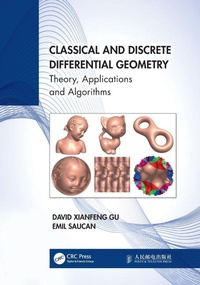
Classical and Discrete Differential Geometry
Theory, Applications and Algorithms
1st Edition
Published on 4. October 2024
Book
Paperback/Softback
568 pages
978-1-032-39620-0 (ISBN)
Description
This book introduces differential geometry and cutting-edge findings from the discipline by incorporating both classical approaches and modern discrete differential geometry across all facets and applications, including graphics and imaging, physics and networks.
With curvature as the centerpiece, the authors present the development of differential geometry, from curves to surfaces, thence to higher dimensional manifolds; and from smooth structures to metric spaces, weighted manifolds and complexes, and to images, meshes and networks. The first part of the book is a differential geometric study of curves and surfaces in the Euclidean space, enhanced while the second part deals with higher dimensional manifolds centering on curvature by exploring the various ways of extending it to higher dimensional objects and more general structures and how to return to lower dimensional constructs. The third part focuses on computational algorithms in algebraic topology and conformal geometry, applicable for surface parameterization, shape registration and structured mesh generation.
The volume will be a useful reference for students of mathematics and computer science, as well as researchers and engineering professionals who are interested in graphics and imaging, complex networks, differential geometry and curvature.
With curvature as the centerpiece, the authors present the development of differential geometry, from curves to surfaces, thence to higher dimensional manifolds; and from smooth structures to metric spaces, weighted manifolds and complexes, and to images, meshes and networks. The first part of the book is a differential geometric study of curves and surfaces in the Euclidean space, enhanced while the second part deals with higher dimensional manifolds centering on curvature by exploring the various ways of extending it to higher dimensional objects and more general structures and how to return to lower dimensional constructs. The third part focuses on computational algorithms in algebraic topology and conformal geometry, applicable for surface parameterization, shape registration and structured mesh generation.
The volume will be a useful reference for students of mathematics and computer science, as well as researchers and engineering professionals who are interested in graphics and imaging, complex networks, differential geometry and curvature.
More details
Language
English
Place of publication
London
United Kingdom
Publishing group
Taylor & Francis Ltd
Target group
College/higher education
Professional and scholarly
Academic, Postgraduate, Professional, Undergraduate Advanced, and Undergraduate Core
Illustrations
290 s/w Abbildungen, 112 s/w Photographien bzw. Rasterbilder, 178 s/w Zeichnungen
178 Line drawings, black and white; 112 Halftones, black and white; 290 Illustrations, black and white
Dimensions
Height: 254 mm
Width: 178 mm
Thickness: 31 mm
Weight
1094 gr
ISBN-13
978-1-032-39620-0 (9781032396200)
Copyright in bibliographic data and cover images is held by Nielsen Book Services Limited or by the publishers or by their respective licensors: all rights reserved.
Schweitzer Classification
Other editions
Additional editions
David Xianfeng Gu | Emil Saucan
Classical and Discrete Differential Geometry
Theory, Applications and Algorithms
E-Book
01/2023
1st Edition
CRC Press
€63.49
Available for download

David Xianfeng Gu | Emil Saucan
Classical and Discrete Differential Geometry
Theory, Applications and Algorithms
Book
01/2023
1st Edition
CRC Press
€147.40
Shipment within 10-20 days
David Xianfeng Gu | Emil Saucan
Classical and Discrete Differential Geometry
Theory, Applications and Algorithms
E-Book
01/2023
1st Edition
CRC Press
€63.49
Available for download
Persons
David Xianfeng Gu is a SUNY Empire Innovation Professor of Computer Science and Applied Mathematics at State University of New York at Stony Brook, USA. His research interests focus on generalizing modern geometry theories to discrete settings and applying them in engineering and medical fields and recently on geometric views of optimal transportation theory. He is one of the major founders of an interdisciplinary field, Computational Conformal Geometry.
Emil Saucan is Associate Professor of Applied Mathematics at Braude College of Engineering, Israel. His main research interest is geometry in general (including Geometric Topology), especially Discrete and Metric Differential Geometry and their applications to Imaging and Geometric Design, as well as Geometric Modeling. His recent research focuses on various notions of discrete Ricci curvature and their practical applications.
Emil Saucan is Associate Professor of Applied Mathematics at Braude College of Engineering, Israel. His main research interest is geometry in general (including Geometric Topology), especially Discrete and Metric Differential Geometry and their applications to Imaging and Geometric Design, as well as Geometric Modeling. His recent research focuses on various notions of discrete Ricci curvature and their practical applications.
Content
Section I Differential Geometry, Classical and Discrete 1. Curves 2. Surfaces: Gauss Curvature - First Definition 3. Metrization of Gauss Curvature 4. Gauss Curvature and Theorema Egregium 5. The Mean and Gauss Curvature Flows 6. Geodesics 7. Geodesics and Curvature 8. The Equations of Compatibility 9. The Gauss-Bonnet Theorem and the Poincare Index Theorem 10. Higher Dimensional Curvatures 11. Higher Dimensional Curvatures 12. Discrete Ricci Curvature and Flow 13. Weighted Manifolds and Ricci Curvature Revisited Section II Differential Geometry, Computational Aspects 14. Algebraic Topology 15. Homology and Cohomology Group 16. Exterior Calculus and Hodge Decomposition 17. Harmonic Map 18. Riemann Surface 19. Conformal Mapping 20. Discrete Surface Curvature Flows 21. Mesh Generation Based on Abel-Jacobi Theorem Section III Appendices 22. Appendix A 23. Appendix B 24. Appendix C