

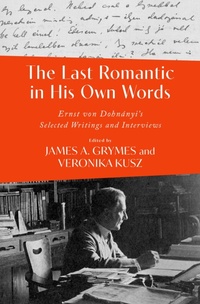
The Last Romantic in His Own Words
Ernst von Dohnanyi's Selected Writings and Interviews
Published on 3. February 2025
Book
Hardback
320 pages
978-0-19-776921-8 (ISBN)
Description
The Last Romantic in His Own Words combines carefully curated personal and professional letters with reminiscences, pedagogical essays, and statements on public affairs that Hungarian musician Ernst von Dohnanyi (1877-1960) wrote throughout his lengthy career. Also included are a selection of interviews he gave in various capacities: as a celebrated and versatile performer, as the composer of beloved masterworks, as an internationally respected pedagogue, and as a leader in Hungary's leading musical institutions. These texts--many of which have never appeared in English--shed new light on Dohnanyi's singular aesthetics, as well as on his career as a charismatic and at times controversial public figure who was one of the most influential musicians of the twentieth century, particularly in Hungary.
The result of twenty-five years of archival research in England, Hungary, and the United States, the documents outline the major chapters in Dohnanyi's long and fascinating life, from his joyful childhood in Hungary, through a globetrotting career that witnessed the advent of the radio as well as air travel, and ultimately to his final years in political exile. Along the way, readers will gain valuable insights into not only Dohnanyi's musical influences and personal philosophies as a performer, music educator, and composer, but more broadly musical life and the dissemination of musical knowledge and public taste in the first half of the twentieth century. The documents facilitate a much-needed reevaluation of a public figure and private individual caught up in the web of twentieth-century politics, resulting in a picture that is more complete than ever of one of the most elusive musicians of the twentieth century.
The result of twenty-five years of archival research in England, Hungary, and the United States, the documents outline the major chapters in Dohnanyi's long and fascinating life, from his joyful childhood in Hungary, through a globetrotting career that witnessed the advent of the radio as well as air travel, and ultimately to his final years in political exile. Along the way, readers will gain valuable insights into not only Dohnanyi's musical influences and personal philosophies as a performer, music educator, and composer, but more broadly musical life and the dissemination of musical knowledge and public taste in the first half of the twentieth century. The documents facilitate a much-needed reevaluation of a public figure and private individual caught up in the web of twentieth-century politics, resulting in a picture that is more complete than ever of one of the most elusive musicians of the twentieth century.
Reviews / Votes
The Last Romantic is a valuable addition to the Dohnanyi literature, providing in a reliable translation some of the most important writings and interviews the composer produced. It serves as an excellent starting point for readers interested in the captivating figure that is Ernst von Dohnanyi. * Martin Elek, MUSICJ *More details
Language
English
Place of publication
New York
United States
Target group
Professional and scholarly
Product notice
sewn/stitched
Cloth over boards
Illustrations
40
Dimensions
Height: 238 mm
Width: 168 mm
Thickness: 27 mm
Weight
612 gr
ISBN-13
978-0-19-776921-8 (9780197769218)
Copyright in bibliographic data and cover images is held by Nielsen Book Services Limited or by the publishers or by their respective licensors: all rights reserved.
Schweitzer Classification
Other editions
Additional editions
James A. Grymes | Veronika Kusz
The Last Romantic in His Own Words
Ernst von Dohnányi Selected Writings and Interviews
E-Book
11/2024
OUP eBook
€53.99
Available for download
James A. Grymes | Veronika Kusz
The Last Romantic in His Own Words
Ernst von Dohnányi Selected Writings and Interviews
E-Book
11/2024
OUP eBook
€53.99
Available for download
Persons
James A. Grymes is the author/editor of Ernst von Dohnanyi: A Bio-Bibliography, Ernst von Dohnanyi: A Song of Life and Perspectives on Ernst von Dohnanyi, as well as the author of Violins of Hope: Violins of the Holocaust--Instruments of Hope and Liberation in Mankind's Darkest Hour. He is Professor of Musicology at the University of North Carolina at Charlotte.
Veronika Kusz is the author of A Wayfaring Stranger: Ernst von Dohnanyi's American Years, 1949-1960 and the editor of Dohnanyi Erno: Valogatott irasok es nyilatkozatok [Erno Dohnanyi: Selected writings and interviews]. She is a Senior Research Fellow at the Institute for Musicology of the Hungarian Research Centre for the Humanities and curator of the Dohnanyi Collection there.
Veronika Kusz is the author of A Wayfaring Stranger: Ernst von Dohnanyi's American Years, 1949-1960 and the editor of Dohnanyi Erno: Valogatott irasok es nyilatkozatok [Erno Dohnanyi: Selected writings and interviews]. She is a Senior Research Fellow at the Institute for Musicology of the Hungarian Research Centre for the Humanities and curator of the Dohnanyi Collection there.
Content
Acknowledgements
Preface
Part I: A Path to Success
Childhood
1. Dohnanyi, "From My Memoirs," Hungarian Radio Budapest, January 30, 1944.
At the Academy of Music in Budapest
2. Dohnanyi (Budapest, Hungary), letter to Friedrich von Dohnanyi (Pozsony, Hungary), September 14, 1894.
The Beginnings of International Fame
3. "About Dohnanyi: The Latest and Youngest Star Pianist," The Daily Chronicle (London, England), December 3, 1898.
A Professorship in Berlin Rather Than Budapest
4. Dohnanyi (Vienna, Austria), letter to OEdoen Mihalovich (Budapest), April 22, 1905.
The Touring Virtuoso
5. "About Dohnanyi," Orebladet (Kristiania, Norway), October 10, 1906.
Remaining Abroad
6. "Dohnanyi on the Opera: A Conversation with the Artist," Arad es Videke (Arad, Hungary), January 27, 1911.
The Gathering Storm
7. Dohnanyi (Berlin, Germany), letter to Maria Dohnanyi Kovats (Budapest), September 28, 1914.
Part II: World War I and Its Aftermath
War in Europe, Peace at Home
1. Dohnanyi (Budapest), letter to Maria Dohnanyi Kovats (Budapest), January 13, 1917.
Reform Plan for the Budapest Academy of Music
2. Dohnanyi (Budapest), memorandum to OEdoen Mihalovich (Budapest), November 12, 1917.
Revolution at the Academy of Music
3. "Hubay Wants to Leave the Music Academy: Dohnanyi's Statement Concerning the Reorganization of the Music College and Hubay's Role," Az Est (Budapest), February 20, 1919.
4. "The New Era at the Academy of Music: Erno Dohnanyi on the Reform Plans," Szinhazi Elet (Budapest), March 16-22, 1919.
Suspension
5. Gyoergy Simonka, "Erno Dohnanyi has been Suspended: A Conversation with the Artist," Az Ujsag (Budapest), October 10, 1919.
6. Laszlo Fenyes, "Conversation with Erno Dohnanyi," Fenyes Laszlo hetilapja (Budapest), October 16, 1919.
7. Dohnanyi (Budapest), Testimony on Behalf of Zoltan Kodaly to the Academy of Music Disciplinary Board, January 28, 1920.
The Master Pedagogue
8. "Freedom in Music Teaching Methods," The Etude, July 1921.
9. "Hungary's Undying Love for Music," The Etude, April 1926.
10. "Erno von Dohnanyi: Technical Material Discussed," in Harriette Brower, Modern Masters of the Keyboard (New York: Frederick A. Stokes, 1926).
11. Dohnanyi, Preface to Essential Finger Exercises for Obtaining a Sure Piano Technique (Budapest: Rozsavoelgyi, 1929).
The Celebrated Performer
12. "Young Boswell Interviews Dohnanyi," New-York Tribune, April 9, 1923.
13. Laszlo Raskay, "'America is Preparing to Conquer Music . . .': About Erno Dohnanyi's American Tour and European Plans," Pesti Naplo (Budapest), March 5, 1926.
14. Miklos Guttmann, "Erno Dohnanyi: A Nagyvarad Interview," Zenei Szemle (Timisoara, Romania), June 1926.
Part III: The Musical Leader
President-Conductor of the Budapest Philharmonic Society
1. "The European Tour and the 75th Anniversary of the Philharmonic Society: A Statement from Erno Dohnanyi," Pesti Hirlap (Budapest), April 12, 1928.
2. Rudolf Pollak, "Dohnanyi: The Conductor of the Budapest Philharmonic," Het Vaderland (The Hague, Netherlands), June 22, 1928.
3. Dohnanyi, "Program Plans for the Coming Season," in Yearbook of the Philharmonic Society Formed from the Orchestra of the Royal Hungarian Opera House, 1935-1936 (Budapest: Filharmoniai Tarsasag, 1936).
Music Director of the Hungarian Radio
4. "Erno Dohnanyi and the Radio (Conversation with the Maestro)," Radioelet (Budapest), October 11, 1929.
5. "Dr. Erno Dohnanyi Talks to Radioelet about His Post, His Plans, and the Radio," Radioelet, January 30, 1931.
6. "Gypsy Music and the Radio: Erno Dohnanyi, Music Director-in-Chief of the Radio, On Gypsy Music," Radioelet, June 19, 1931.
Director of the Franz Liszt Academy of Music
7. Dohnanyi, Opening Address for the Academic Year at the Liszt Academy of Music, September 20, 1934.
8. J.V.E., "'We Must Bring Home Franz Liszt's Remains,' Declares Erno Dohnanyi-The Director of the Academy of Music Has Recovered from His Serious Illness and Declares His New Plans," Budapesti Hirlap (Budapest), February 24, 1935.
9. Dohnanyi (Budapest), letter nominating Bela Bartok for the Greguss Medal, October 23, 1935.
Conflicts
10. "Emil Sauer Quit the Jury of the International Franz Liszt Competition," Pesti Hirlap, May 14, 1933.
11. "Erno Dohnanyi on the Franz Liszt Competition," Pesti Hirlap, May 25, 1933.
12. Dohnanyi, "On Radio Programs and a Certain Radio Program," July 1936.
13. Dohnanyi (Budapest), memorandum to Hungarian Minister of Religion and Public Education Balint Homan (Budapest), January 22, 1941.
Part IV: World War II
A New Beginning
1. Dohnanyi (Budapest), letters to Ilona Zachar (Goedoello, Hungary), January 7-8 and 13, 1939.
Plans for Retirement
2. Aurel Schuschny, "A Conversation with Erno Dohnanyi about His Work, His Plans, and His Retirement," Film, Szinhaz, Irodalom (Budapest), April 25-May 1, 1941.
The Aging Maestro Speaks
3. Denes Szantho, "Conversation with Erno Dohnanyi," Magyar Nemzet (Budapest), March 8, 1942.
4. Dohnanyi, "The Message of Music," in Hungarian Creators, ed. Kalman Konkoly (Budapest: Singer es Wolfner Irodalmi Intezet, 1942).
5. Zoltan Egyed, "Erno Dohnanyi on the Eternal Impact of Music, Good and Bad Music, the Relationship of Master and Student, and the True Calling of Women," Film, Szinhaz, Irodalom, February 19-25, 1943.
6. Pal Taksonyi, "Today's Hungarian Folk Music Has Brought Nothing New into Modern Composition: Erno Dohnanyi Makes a Statement to the OEsszetartas," OEsszetartas (Budapest), November 12, 1943.
The War Reaches Budapest
7. Dohnanyi (Goedoello, Hungary), letter to Maria Dohnanyi Kovats (Budapest), July 7, 1944.
Part V: Exile
Flight
1. Dohnanyi (Neukirchen am Walde, Austria), letter to Maria Dohnanyi Kovats (Budapest), November 12, 1945.
Political Charges
2. Dohnanyi, Affidavit, November 26, 1948.
3. Dohnanyi, Statement about the Political Accusations, ca. 1949.
The New World
4. Dohnanyi (Tucuman, Argentina), letter to Karl Kuersteiner (Tallahassee, FL), August 3, 1949.
5. Betty Patterson, "Master Musician Joins FSU Faculty" Tallahassee Democrat (Tallahassee, FL), November 6, 1949.
Lectures
6. Dohnanyi, "Romanticism in Beethoven's Pianoforte Sonatas," December 9, 1948.
7. Dohnanyi, "Sight-Reading," December 10, 1948.
American Works
8. Dohnanyi, Program Note for American Rhapsody, op. 47, February 21, 1954.
9. Dohnanyi, Program Note for Stabat Mater, op. 46, January 16, 1956.
10. Dohnanyi (Tallahassee), letter to Donald Ferguson (Minneapolis, MN), February 17, 1957.
The "Youthful Oldster"
11. Clarence Jones, "Florida's Youthful Oldsters: Last of the Romantic Age Masters Not Slowing Down-At 81 the Dean of World's Leading Composers Plays with Spirit of Lad of 25," Florida Times-Union (Jacksonville, FL), October 5, 1958.
12. Roy Flynn, Radio Interview with Dohnanyi on His 82nd Birthday, WFSU (Tallahassee, FL), July 27, 1959.
Farewell
13. Dohnanyi, Radio Address, RIAS Berlin, July 27, 1957.
Appendix: List of Works
Source Notes
Bibliography
Index
Preface
Part I: A Path to Success
Childhood
1. Dohnanyi, "From My Memoirs," Hungarian Radio Budapest, January 30, 1944.
At the Academy of Music in Budapest
2. Dohnanyi (Budapest, Hungary), letter to Friedrich von Dohnanyi (Pozsony, Hungary), September 14, 1894.
The Beginnings of International Fame
3. "About Dohnanyi: The Latest and Youngest Star Pianist," The Daily Chronicle (London, England), December 3, 1898.
A Professorship in Berlin Rather Than Budapest
4. Dohnanyi (Vienna, Austria), letter to OEdoen Mihalovich (Budapest), April 22, 1905.
The Touring Virtuoso
5. "About Dohnanyi," Orebladet (Kristiania, Norway), October 10, 1906.
Remaining Abroad
6. "Dohnanyi on the Opera: A Conversation with the Artist," Arad es Videke (Arad, Hungary), January 27, 1911.
The Gathering Storm
7. Dohnanyi (Berlin, Germany), letter to Maria Dohnanyi Kovats (Budapest), September 28, 1914.
Part II: World War I and Its Aftermath
War in Europe, Peace at Home
1. Dohnanyi (Budapest), letter to Maria Dohnanyi Kovats (Budapest), January 13, 1917.
Reform Plan for the Budapest Academy of Music
2. Dohnanyi (Budapest), memorandum to OEdoen Mihalovich (Budapest), November 12, 1917.
Revolution at the Academy of Music
3. "Hubay Wants to Leave the Music Academy: Dohnanyi's Statement Concerning the Reorganization of the Music College and Hubay's Role," Az Est (Budapest), February 20, 1919.
4. "The New Era at the Academy of Music: Erno Dohnanyi on the Reform Plans," Szinhazi Elet (Budapest), March 16-22, 1919.
Suspension
5. Gyoergy Simonka, "Erno Dohnanyi has been Suspended: A Conversation with the Artist," Az Ujsag (Budapest), October 10, 1919.
6. Laszlo Fenyes, "Conversation with Erno Dohnanyi," Fenyes Laszlo hetilapja (Budapest), October 16, 1919.
7. Dohnanyi (Budapest), Testimony on Behalf of Zoltan Kodaly to the Academy of Music Disciplinary Board, January 28, 1920.
The Master Pedagogue
8. "Freedom in Music Teaching Methods," The Etude, July 1921.
9. "Hungary's Undying Love for Music," The Etude, April 1926.
10. "Erno von Dohnanyi: Technical Material Discussed," in Harriette Brower, Modern Masters of the Keyboard (New York: Frederick A. Stokes, 1926).
11. Dohnanyi, Preface to Essential Finger Exercises for Obtaining a Sure Piano Technique (Budapest: Rozsavoelgyi, 1929).
The Celebrated Performer
12. "Young Boswell Interviews Dohnanyi," New-York Tribune, April 9, 1923.
13. Laszlo Raskay, "'America is Preparing to Conquer Music . . .': About Erno Dohnanyi's American Tour and European Plans," Pesti Naplo (Budapest), March 5, 1926.
14. Miklos Guttmann, "Erno Dohnanyi: A Nagyvarad Interview," Zenei Szemle (Timisoara, Romania), June 1926.
Part III: The Musical Leader
President-Conductor of the Budapest Philharmonic Society
1. "The European Tour and the 75th Anniversary of the Philharmonic Society: A Statement from Erno Dohnanyi," Pesti Hirlap (Budapest), April 12, 1928.
2. Rudolf Pollak, "Dohnanyi: The Conductor of the Budapest Philharmonic," Het Vaderland (The Hague, Netherlands), June 22, 1928.
3. Dohnanyi, "Program Plans for the Coming Season," in Yearbook of the Philharmonic Society Formed from the Orchestra of the Royal Hungarian Opera House, 1935-1936 (Budapest: Filharmoniai Tarsasag, 1936).
Music Director of the Hungarian Radio
4. "Erno Dohnanyi and the Radio (Conversation with the Maestro)," Radioelet (Budapest), October 11, 1929.
5. "Dr. Erno Dohnanyi Talks to Radioelet about His Post, His Plans, and the Radio," Radioelet, January 30, 1931.
6. "Gypsy Music and the Radio: Erno Dohnanyi, Music Director-in-Chief of the Radio, On Gypsy Music," Radioelet, June 19, 1931.
Director of the Franz Liszt Academy of Music
7. Dohnanyi, Opening Address for the Academic Year at the Liszt Academy of Music, September 20, 1934.
8. J.V.E., "'We Must Bring Home Franz Liszt's Remains,' Declares Erno Dohnanyi-The Director of the Academy of Music Has Recovered from His Serious Illness and Declares His New Plans," Budapesti Hirlap (Budapest), February 24, 1935.
9. Dohnanyi (Budapest), letter nominating Bela Bartok for the Greguss Medal, October 23, 1935.
Conflicts
10. "Emil Sauer Quit the Jury of the International Franz Liszt Competition," Pesti Hirlap, May 14, 1933.
11. "Erno Dohnanyi on the Franz Liszt Competition," Pesti Hirlap, May 25, 1933.
12. Dohnanyi, "On Radio Programs and a Certain Radio Program," July 1936.
13. Dohnanyi (Budapest), memorandum to Hungarian Minister of Religion and Public Education Balint Homan (Budapest), January 22, 1941.
Part IV: World War II
A New Beginning
1. Dohnanyi (Budapest), letters to Ilona Zachar (Goedoello, Hungary), January 7-8 and 13, 1939.
Plans for Retirement
2. Aurel Schuschny, "A Conversation with Erno Dohnanyi about His Work, His Plans, and His Retirement," Film, Szinhaz, Irodalom (Budapest), April 25-May 1, 1941.
The Aging Maestro Speaks
3. Denes Szantho, "Conversation with Erno Dohnanyi," Magyar Nemzet (Budapest), March 8, 1942.
4. Dohnanyi, "The Message of Music," in Hungarian Creators, ed. Kalman Konkoly (Budapest: Singer es Wolfner Irodalmi Intezet, 1942).
5. Zoltan Egyed, "Erno Dohnanyi on the Eternal Impact of Music, Good and Bad Music, the Relationship of Master and Student, and the True Calling of Women," Film, Szinhaz, Irodalom, February 19-25, 1943.
6. Pal Taksonyi, "Today's Hungarian Folk Music Has Brought Nothing New into Modern Composition: Erno Dohnanyi Makes a Statement to the OEsszetartas," OEsszetartas (Budapest), November 12, 1943.
The War Reaches Budapest
7. Dohnanyi (Goedoello, Hungary), letter to Maria Dohnanyi Kovats (Budapest), July 7, 1944.
Part V: Exile
Flight
1. Dohnanyi (Neukirchen am Walde, Austria), letter to Maria Dohnanyi Kovats (Budapest), November 12, 1945.
Political Charges
2. Dohnanyi, Affidavit, November 26, 1948.
3. Dohnanyi, Statement about the Political Accusations, ca. 1949.
The New World
4. Dohnanyi (Tucuman, Argentina), letter to Karl Kuersteiner (Tallahassee, FL), August 3, 1949.
5. Betty Patterson, "Master Musician Joins FSU Faculty" Tallahassee Democrat (Tallahassee, FL), November 6, 1949.
Lectures
6. Dohnanyi, "Romanticism in Beethoven's Pianoforte Sonatas," December 9, 1948.
7. Dohnanyi, "Sight-Reading," December 10, 1948.
American Works
8. Dohnanyi, Program Note for American Rhapsody, op. 47, February 21, 1954.
9. Dohnanyi, Program Note for Stabat Mater, op. 46, January 16, 1956.
10. Dohnanyi (Tallahassee), letter to Donald Ferguson (Minneapolis, MN), February 17, 1957.
The "Youthful Oldster"
11. Clarence Jones, "Florida's Youthful Oldsters: Last of the Romantic Age Masters Not Slowing Down-At 81 the Dean of World's Leading Composers Plays with Spirit of Lad of 25," Florida Times-Union (Jacksonville, FL), October 5, 1958.
12. Roy Flynn, Radio Interview with Dohnanyi on His 82nd Birthday, WFSU (Tallahassee, FL), July 27, 1959.
Farewell
13. Dohnanyi, Radio Address, RIAS Berlin, July 27, 1957.
Appendix: List of Works
Source Notes
Bibliography
Index