

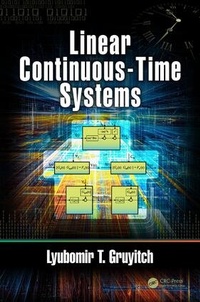
Linear Continuous-Time Systems
1st Edition
Published on 26. May 2017
Book
Hardback
496 pages
978-1-138-03950-6 (ISBN)
Description
This book aims to help the reader understand the linear continuous-time time-invariant dynamical systems theory and its importance for systems analysis and design of the systems operating in real conditions, i.e., in forced regimes under arbitrary initial conditions. The text completely covers IO, ISO and IIO systems. It introduces the concept of the system full matrix P(s) in the complex domain and establishes its link with the also newly introduced system full transfer function matrix F(s). The text establishes the full block diagram technique based on the use of F(s), which incorporates the Laplace transform of the input vector and the vector of all initial conditions. It explores the direct relationship between the system full transfer function matrix F(s) and the Lyapunov stability concept, definitions and conditions, as well as with the BI stability concept, definitions, and conditions. The goal of the book is to unify the study and applications of all three classes of the of the linear continuous-time time-invariant systems, for short systems.
More details
Language
English
Place of publication
London
United Kingdom
Publishing group
Taylor & Francis Ltd
Target group
Professional and scholarly
Academic and Professional Practice & Development
Illustrations
45 s/w Zeichnungen
45 Line drawings, black and white
Dimensions
Height: 234 mm
Width: 156 mm
Weight
856 gr
ISBN-13
978-1-138-03950-6 (9781138039506)
Copyright in bibliographic data and cover images is held by Nielsen Book Services Limited or by the publishers or by their respective licensors: all rights reserved.
Schweitzer Classification
Other editions
Additional editions
Lyubomir T. Gruyitch
Linear Continuous-Time Systems
E-Book
07/2017
CRC Press
€225.99
Available for download
Lyubomir T. Gruyitch
Linear Continuous-Time Systems
E-Book
07/2017
1st Edition
CRC Press
€225.99
Available for download
Person
Lyubomir T. Gruyitch is Certified Mechanical Engineer (Dipl. M. Eng.), Master of Electrical Engineering Sciences (M. E. E. Sc.), and Doctor of Engineering Sciences (D. Sc.) (all with the University of Belgrade -UB, Serbia). Dr. Gruyitch was a leading contributor to the creation of the research Laboratory of Automatic Control, Mechatronics, Manufacturing Engineering and Systems Engineering of the National School of Engineers (Belfort, France), and a founder of the educational division and research Laboratory of Automatic Control of the Faculty of Mechanical Engineering, UB . He has given invited university seminars in Belgium, Canada, England, France, Russia, Serbia, Tunis, and USA. He has published 8 books (7 in English, 1 in Serb), 4 textbooks (in Serbo-Croatian), 11 lecture notes (7 in French, 2 in English, 2 in Serbo-Croatian), one manual of solved problems, one book translation from Russian, chapters in eight scientific books, 130 scientific papers in scientific journals, 173 conference research papers, and 2 educational papers. France honored him Doctor Honoris Causa (DHC).
Content
Preface. Part I Basic Topics of Linear Continuous-Time Time-Invariant Dynamical Systems. Introduction. Classes of Systems. System Regimes. Transfer Function Matrix G(S). Part II Full Transfer Function Matrix F(S) and System Realization. Problem Statement. Nondegenerate Matrices. Definition of F(S). Determination of F(S). Full Block Diagram Algebra. Physical Meaning of F(S). System Matrix and Equivalence. Realizations of F(S). Part III Stability Study. Lyapunov Stability. Bounded Input Stability. Part IV Conclusion. Motivation for the Book. Summary of the Contributions. Future Teaching and Research. Part V Appendices. Appendix A: Notation. Appendix B: From Io System to Iso System. Appendix C: From ISO System to IO System. Appendix D: Relationships Among System Descriptions. Appendix E: Laplace Transforms and Dirac Impulses. Appendix F: Proof of Theorem 142. Appendix G: Example: F(S) of a MIMO System. Appendix H: Proof of Theorem 165. Appendix I: Proof for Example 167. Appendix J: Proof of Theorem 168. Appendix K: Proof of Theorem 176. Appendix L: Proof of Theorem 179. Appendix M: Proof of Theorem 183. Index.