

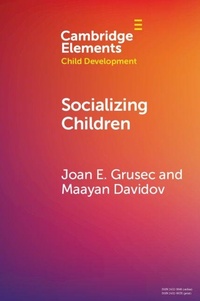
Socializing Children
Published on 27. May 2021
Book
Paperback/Softback
82 pages
978-1-108-82703-4 (ISBN)
Description
Complaints are often made that recommendations about how to rear children are contradictory and, therefore, not helpful. In this Element we survey the history of theory and research relevant to childrearing in an attempt to show how apparent differences can be resolved. We suggest that socialization occurs in different domains, with each domain fostering socialization in a different way. Thus there is no all-purpose principle or mechanism of socialization but, rather, different forms of relationship between child and agent that serve a different function, involve different rules for effecting behavior change, and facilitate different outcomes. Using this framework, we survey research relevant to different domains, including the roles played by parents, siblings, and peers in the socialization process. We follow this with a discussion of how culture and biology make their contribution to an understanding of domains of socialization.
More details
Series
Language
English
Place of publication
Cambridge
United Kingdom
Target group
Professional and scholarly
Product notice
Paperback (trade)
Illustrations
Worked examples or Exercises
Dimensions
Height: 229 mm
Width: 152 mm
Thickness: 5 mm
Weight
134 gr
ISBN-13
978-1-108-82703-4 (9781108827034)
Copyright in bibliographic data and cover images is held by Nielsen Book Services Limited or by the publishers or by their respective licensors: all rights reserved.
Schweitzer Classification
Other editions
Additional editions
Joan E. Grusec
Socializing Children
E-Book
05/2021
Cambridge University Press
€14.49
Available for download
Joan E. Grusec | Maayan Davidov
Socializing Children
E-Book
05/2021
Cambridge University Press
€15.49
Available for download
Persons
Content
1. Introduction; 2. Overview; 3. Approaches to Understanding Socialization: How Did We Get from Freud to Present-Day Formulations?; 4. Putting it All Together: A Domains Approach to Socialization; 5. Parenting Cognitions; 6. Siblings and Peers as Agents of Socialization; 7. Cultural Influences on Socialization; 8. Biological Aspects of Socialization; 9. Some Final Thoughts.