

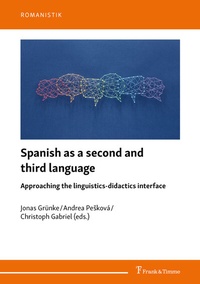
Spanish as a second and third language
Approaching the linguistics-didactics interface
1st Edition
Published on 17. May 2024
Book
Paperback/Softback
298 pages
978-3-7329-0969-8 (ISBN)
Description
Spoken as a foreign language by around 24 million people worldwide, Spanish can be the second language (L2) of monolingually raised learners who acquire it in school. Ever more often it is also the third or a further language (L3) of learners who have previously studied another foreign language (for example Spanish after English in Germany) or who acquired more than one language during early childhood, as is the case with heritage speakers. This book explores the intersections between linguistics and language pedagogy related to the acquisition of L2 and L3 Spanish in various contexts worldwide. Fostering the interdisciplinary dialogue, it combines contributions by linguists and specialists in didactics, which not only examine the interface between basic linguistic and applied research but also develop proposals and materials for concrete teaching situations.
More details
Other editions
Additional editions
Christoph Gabriel | Jonas Grünke | Andrea Pe?ková
Spanish as a second and third language
Approaching the linguistics-didactics interface
E-Book
05/2024
1st Edition
Frank & Timme
€58.00
Available for download
Persons
Jonas Grünke is a postdoctoral researcher in Romance Linguistics at JGU Mainz. Alongside phonetics/phonology and syntax, his work focuses on multilingualism and language acquisition.
Andrea Pesková is a postdoctoral researcher at the Free University of Berlin. Her research interests include language contact and change as well as second language acquisition.
Christoph Gabriel is a full professor of Romance Linguistics at JGU Mainz. His research focuses on phonetics/phonology, multilingualism, and the linguistics-didactics interface.