

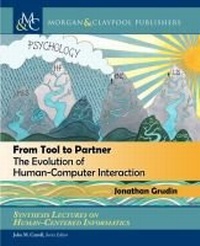
From Tool to Partner
The Evolution of Human-Computer Interaction
Published on 30. January 2017
Book
Hardback
150 pages
978-1-68173-227-5 (ISBN)
Description
This is the first comprehensive history of human-computer interaction (HCI). Whether you are a user-experience professional or an academic researcher, whether you identify with computer science,human factors, information systems, information science, design, or communication, you can discover how your experiences fit into the expanding field of HCI. You can determine where to look for relevant information in other fields-and where you won't find it.
This book describes the different fields that have participated in improving our digital tools.It is organized chronologically, describing major developments across fields in each period. Computer use has changed radically, but many underlying forces are constant. Technology has changed rapidly, human nature very little. An irresistible force meets an immovable object. The exponential rate of technological change gives us little time to react before technology moves on. Patterns and trajectories described in this book provide your best chance to anticipate what could come next.
We have reached a turning point. Tools that we built for ourselves to use are increasingly influencing how we use them, in ways that are planned and sometimes unplanned. The book ends with issues worthy of consideration as we explore the new world that we and our digital partners are shaping.
This book describes the different fields that have participated in improving our digital tools.It is organized chronologically, describing major developments across fields in each period. Computer use has changed radically, but many underlying forces are constant. Technology has changed rapidly, human nature very little. An irresistible force meets an immovable object. The exponential rate of technological change gives us little time to react before technology moves on. Patterns and trajectories described in this book provide your best chance to anticipate what could come next.
We have reached a turning point. Tools that we built for ourselves to use are increasingly influencing how we use them, in ways that are planned and sometimes unplanned. The book ends with issues worthy of consideration as we explore the new world that we and our digital partners are shaping.
More details
Series
Language
English
Place of publication
San Rafael
United States
Dimensions
Height: 235 mm
Width: 190 mm
Weight
825 gr
ISBN-13
978-1-68173-227-5 (9781681732275)
Copyright in bibliographic data and cover images is held by Nielsen Book Services Limited or by the publishers or by their respective licensors: all rights reserved.
Schweitzer Classification
Persons
Content
- Preface
- Acknowledgments
- Preamble: History in a Time of Rapid Change
- Human-Tool Interaction and Information Processing at the Dawn of Computing
- 1945-1955: Managing Vacuum Tubes
- 1955-1965: Transistors, New Vistas
- 1965-1980: HCI Prior to Personal Computing
- Hardware Generations
- 1980-1985: Discretionary Use Comes into Focus
- 1985-1995: Graphical User Interfaces Succeed
- 1995-2005: The Internet Era Arrives and Survives a Bubble
- 2005-2015: Scaling
- Reflection: Cultures and Bridges
- A New Era
- Conclusion: Ubiquitous Human-Computer Interaction
- Appendix A: Personal Observations
- AppendixB A Toolkit for Writing a Conceptual History
- Glossary
- Bibliography
- Author Biography
- Index
- Acknowledgments
- Preamble: History in a Time of Rapid Change
- Human-Tool Interaction and Information Processing at the Dawn of Computing
- 1945-1955: Managing Vacuum Tubes
- 1955-1965: Transistors, New Vistas
- 1965-1980: HCI Prior to Personal Computing
- Hardware Generations
- 1980-1985: Discretionary Use Comes into Focus
- 1985-1995: Graphical User Interfaces Succeed
- 1995-2005: The Internet Era Arrives and Survives a Bubble
- 2005-2015: Scaling
- Reflection: Cultures and Bridges
- A New Era
- Conclusion: Ubiquitous Human-Computer Interaction
- Appendix A: Personal Observations
- AppendixB A Toolkit for Writing a Conceptual History
- Glossary
- Bibliography
- Author Biography
- Index