

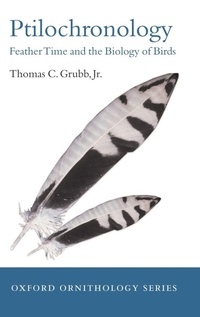
Ptilochronology
Feather time and the biology of birds
Published on 29. June 2006
Book
Hardback
192 pages
978-0-19-929550-0 (ISBN)
Description
This is the first book to summarize the methods, conceptual issues and results of studies using the interpretation of feather growth rates as an index of nutritional condition in birds. The author has coined the term ptilochronology (literally, 'the study of feather time') to describe this technique, which relies on the fact that as a feather grows it produces visible growth bars. Both the technique and its conceptual foundations have been applied worldwide to numerous studies of avian evolution, ecology, and conservation biology. The author reviews this work, chronicles the various criticisms that have been made, and describes how these have influenced the development of ptilochronology. He goes on to suggest experimental methodologies and analytical techniques to safeguard against invalid results. A final chapter summarises this new technique's contribution to avian biology, and suggests potential applications and a future research agenda. An appendix details specific measurements and describes the methodology associated with ptilochronology.
Ptilochronology provides a practical resource as well as a conceptual understanding of how this technique can be used to address important questions in avian biology. It will be of relevance and use to professional avian biologists and ornithologists as well as to graduate students of avian behavioural ecology, evolution and conservation.
Ptilochronology provides a practical resource as well as a conceptual understanding of how this technique can be used to address important questions in avian biology. It will be of relevance and use to professional avian biologists and ornithologists as well as to graduate students of avian behavioural ecology, evolution and conservation.
Reviews / Votes
...this book brings together many published resources and we recommend it. * Annika Samuelsen & Jim Quinn, McMaster University, Ontario. ISBE Newsletter, Volume 19, Issue 1 (Spring 2007) * Ptilochronology: Feather Time and the Biology of Birds could be particularly useful to anyone studying avian nutrition in ecological and evolutionary contexts, as well as those interested in feathers or the history of new methodology development. * Matthew D Shawkey, Quarterly Review of Biology, Vol 82, June 2007 * The book is written in an extremely accessible and non-technical style, which will help open up this area to study to a wide audience. * Peter Moore,Bulletin of the British Ecological Society 2007, 38:1 *More details
Series
Language
English
Place of publication
Oxford
United Kingdom
Target group
Professional and scholarly
Illustrations
3 colour plates, 22 halftones, 47 line drawings
Dimensions
Height: 240 mm
Width: 161 mm
Thickness: 15 mm
Weight
455 gr
ISBN-13
978-0-19-929550-0 (9780199295500)
Copyright in bibliographic data and cover images is held by Nielsen Book Services Limited or by the publishers or by their respective licensors: all rights reserved.
Schweitzer Classification
Person
Thomas C Grubb, Jr. is Professor Emeritus of Zoology at Ohio State University. He has had an interest in field biology since early childhood, when he was what he now calls a "log-turner", one who turns over logs out of curiosity about what might be underneath. He was astounded to discover that one could earn a living as a sophisticated "log-turner" and pursued a career as biologist. His research focuses on responses to forest fragmentation, avian hybridization, and foraging ecology.
Content
PREFACE ; PART I. BASIC PTILOCHRONOLOGY ; 1. Introduction ; 2. Can Reduced Nutritional Condition Really Cause Narrowed Growth Bars? ; 3. Does Any Factor Other Than Nutritional Condition Control Feather Growth? ; PART II. APPLIED PTILOCHRONOLOGY ; 4. Habitat Quality ; 5. Nutritional Consequences of Self-cached Food ; 6. Social Behavior ; 7. Individual Quality ; 8. Reproductive Effort ; 9. Nestling Condition ; 10. Prolonged Brood-Care ; 11. Taking Stock and Looking Ahead ; REFERENCES ; APPENDIX