

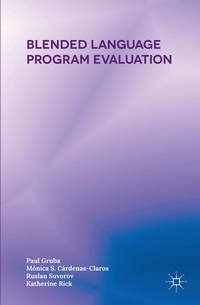
Blended Language Program Evaluation
Description
Advocating an argument-based approach, Blended Language Program Evaluation presents a framework for planning, conducting, and appraising evaluation of blended language learning across three institutional levels, and demonstrates its utility and application in four case studies carried out in diverse international contexts.
Reviews / Votes
"This book makes a major contribution to our understanding of blended language learning, now seen as the contemporary paradigm in language education, and to the neglected art of language program evaluation. It offers a rethink of Kane's (2006) argument-based approach, previously applied to test validation, using it as a methodological framework for evaluating the efficacy of blended language learning initiatives." (Catherine Elder, Associate Professor, University of Melbourne, Australia)
"Finally a publication that presents a clear ontology of blended learning within an evaluation framework that is clearly exemplified with four cases of empirical validation. A must-read for everyone involved in educational engineering." (Jozef Colpaert, Professor, University of Antwerp, Belgium)
"Offering an innovative but practical approach, this book imaginatively reconceptualises program evaluation as a process of planning, evidence gathering, presenting and appraising an argumentthat justifies or questions the implementation of blended learning. This book should be read by all those in language education with an interest in evaluation and the quality of language provision." (Anthony Green, Professor, University of Bedfordshire, UK)
More details
Other editions
Additional editions
Persons
Monica S. Cárdenas-Claros is Adjunct Professor at the Instituto de Literatura y Ciencias del Lenguaje, Pontificia Universidad Católica de Valparaíso, Chile. Her research interests include technology integration in second and foreign language classrooms, blended learning, and computer-based L2 listening.
Ruslan Suvorov is Language Technology Specialist at the Center for Language & Technology, University of Hawaii at M?noa, USA. His research interests lie in the areas of instructional technology and design, computer-assisted language learning and testing, blended and online language education, second language listening, and eye tracking.
Katherine Rick is Vice Dean at the Lincoln Qatief Female College, Saudi Arabia. Her research interests include program evaluation, educational leadership, educational technology, and blended learning.
Content
1. Situating blended language program evaluation
2. Essentials of blended language program evaluation: Towards an argument-based approach
3. Micro-level evaluation
4. Meso-level evaluation
5. Macro-level evaluation
6. A micro-level case study in Chile
7. A meso-level case study in the USA
8. A meso-level case study in Vietnam
9. A macro-level case study in Australia
10. Reflecting on blended language program evaluation