

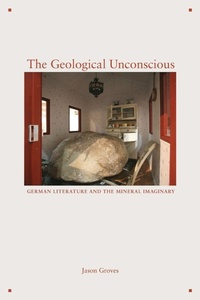
The Geological Unconscious
German Literature and the Mineral Imaginary
Published on 7. July 2020
Book
Paperback/Softback
208 pages
978-0-8232-8809-0 (ISBN)
Description
Already in the nineteenth century, German-language writers were contending with the challenge of imagining and accounting for a planet whose volatility bore little resemblance to the images of the Earth then in circulation. The Geological Unconscious traces the withdrawal of the lithosphere as a reliable setting, unobtrusive backdrop, and stable point of reference for literature written well before the current climate breakdown.
Through a series of careful readings of romantic, realist, and modernist works by Tieck, Goethe, Stifter, Benjamin, and Brecht, Groves elaborates a geological unconscious-unthought and sometimes actively repressed geological knowledge-in European literature and environmental thought. This inhuman horizon of reading and interpretation offers a new literary history of the Anthropocene in a period before it was named.
These close readings show the entanglement of the human and the lithic in periods well before the geological turn of contemporary cultural studies. In those depictions of human-mineral encounters, the minerality of the human and the minerality of the imagination become apparent. In registering libidinal investments in the lithosphere that extend beyond Carboniferous deposits and beyond any carbon imaginary, The Geological Unconscious points toward alternative relations with, and less destructive mobilizations of, the geologic.
Through a series of careful readings of romantic, realist, and modernist works by Tieck, Goethe, Stifter, Benjamin, and Brecht, Groves elaborates a geological unconscious-unthought and sometimes actively repressed geological knowledge-in European literature and environmental thought. This inhuman horizon of reading and interpretation offers a new literary history of the Anthropocene in a period before it was named.
These close readings show the entanglement of the human and the lithic in periods well before the geological turn of contemporary cultural studies. In those depictions of human-mineral encounters, the minerality of the human and the minerality of the imagination become apparent. In registering libidinal investments in the lithosphere that extend beyond Carboniferous deposits and beyond any carbon imaginary, The Geological Unconscious points toward alternative relations with, and less destructive mobilizations of, the geologic.
More details
Edition
New edition
Language
English
Place of publication
New York
United States
Target group
Professional and scholarly
Edition type
New edition
Product notice
Paperback (trade)
Illustrations
5
Dimensions
Height: 229 mm
Width: 152 mm
Thickness: 11 mm
Weight
282 gr
ISBN-13
978-0-8232-8809-0 (9780823288090)
Copyright in bibliographic data and cover images is held by Nielsen Book Services Limited or by the publishers or by their respective licensors: all rights reserved.
Schweitzer Classification
Other editions
Additional editions
E-Book
07/2020
Fordham University Press
€34.49
Available for download
Person
Jason Groves is Assistant Professor of Germanics at the University of Washington. He is cotranslator of Werner Hamacher's Minima Philologica.
Content
Introduction 1
1 Of Other Petrofictions: Reimagining the Mine in German Romanticism 17
2 Goethe's Erratics: Wandering in Deep Time 36
3 Many Stranded Stones: Stifter's Spectral Landscapes 67
4 The Shock of the Earth: Benjamin's Unarticulated Ground 93
Epilogue: Dilapidated 115
Acknowledgments 139
Notes 143
Bibliography 157
Index 171
1 Of Other Petrofictions: Reimagining the Mine in German Romanticism 17
2 Goethe's Erratics: Wandering in Deep Time 36
3 Many Stranded Stones: Stifter's Spectral Landscapes 67
4 The Shock of the Earth: Benjamin's Unarticulated Ground 93
Epilogue: Dilapidated 115
Acknowledgments 139
Notes 143
Bibliography 157
Index 171