

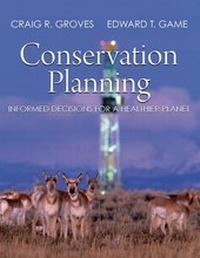
Conservation Planning
Balancing the Needs of People and Nature
Published on 11. December 2015
Book
Paperback/Softback
608 pages
978-1-936221-51-6 (ISBN)
Description
The authors draw on their extensive "hands-on" experience to provide an essential textbook for practitioners, students, or researchers of conservation, natural resource management, or landscape planning and architecture. This title provides the methods, tools, approaches, and case studies to plan a nature conservation project from inception to implementation and monitoring and evaluation. It draws on a wide range of disciplines and literature from conservation biology, landscape architecture, and land-use planning to decision science, natural resource economics, and sustainability.
The book's primary audience is conservation scientists, planners, and practitioners in nongovernmental organizations; natural resource agency biologists and scientists; and professional landscape architects and land-use planners in both developed and developing nations throughout the world. With decades of experience as conservation planners, the authors have combined the fields of spatial planning (establishing priority places for conservation) and strategic planning into one overall planning approach. The book's underlying philosophy is that effective planning is really about making tough choices of where to allocate resources to achieve the conservation outcomes of a project, program, or conservation initiative.
The book's primary audience is conservation scientists, planners, and practitioners in nongovernmental organizations; natural resource agency biologists and scientists; and professional landscape architects and land-use planners in both developed and developing nations throughout the world. With decades of experience as conservation planners, the authors have combined the fields of spatial planning (establishing priority places for conservation) and strategic planning into one overall planning approach. The book's underlying philosophy is that effective planning is really about making tough choices of where to allocate resources to achieve the conservation outcomes of a project, program, or conservation initiative.
More details
Language
English
Place of publication
New York
United States
Publishing group
Macmillan Learning
Target group
Professional and scholarly
Illustrations
608 p.
Dimensions
Height: 235 mm
Width: 155 mm
ISBN-13
978-1-936221-51-6 (9781936221516)
Copyright in bibliographic data and cover images is held by Nielsen Book Services Limited or by the publishers or by their respective licensors: all rights reserved.
Schweitzer Classification
Persons
Craig Groves - Executive Director for the Science for Nature and People Partnership (SNAP, www.snap.is), a collaboration of The Nature Conservancy, the Wildlife Conservation Society, and the National Center for Ecological Analysis and Synthesis at the University of California, Santa Barbara. He also serves as the Series Editor for IUCN's World Commission on Protected Areas Best Practice Guidelines. In his 30-year career in nature conservation, Craig has worked as a conservation scientist and planner for TNC, WCS, and the Idaho Department of Fish and Game.
Edward Game - Lead Scientist with The Nature Conservancy. He has worked on conservation plans in over 15 countries and published more than 30 papers on aspects of conservation decision making. He is author of the manual for the world's most widely used conservation planning software, Marxan, and was the recipient of the Great Barrier Reef Foundation's inaugural prize for innovative concepts to conserve the reef in the face of climate change.
Edward Game - Lead Scientist with The Nature Conservancy. He has worked on conservation plans in over 15 countries and published more than 30 papers on aspects of conservation decision making. He is author of the manual for the world's most widely used conservation planning software, Marxan, and was the recipient of the Great Barrier Reef Foundation's inaugural prize for innovative concepts to conserve the reef in the face of climate change.
Content
Part I: Developing a Conservation Plan1. The Why, Where, How, and What of Conservation Planning.- 2. Getting Started - Foundations and a Roadmap to Planning.- 3. Establishing Objectives and Conservation Features.- 4. Making Objectives Measureable: Targets and Attributes.- 5. Finding and Using Data and Information.- 6. Framing Conservation Planning Problems.- 7. Solving Conservation Planning Problems: Methods and Tools.- 8. Uncertainty and Risks
Part II: Special Topics Planning9. Weathering the Storm: Adapting Plans to Climate Change.- 10. Planning for Ecosystem Services - Making Plans more Relevant to Human Well-being
Part III: Implementation and monitoring of conservation plans11. From Planning to Action and Communication: the Art of Implementation.- 12. Monitoring for Results
Part II: Special Topics Planning9. Weathering the Storm: Adapting Plans to Climate Change.- 10. Planning for Ecosystem Services - Making Plans more Relevant to Human Well-being
Part III: Implementation and monitoring of conservation plans11. From Planning to Action and Communication: the Art of Implementation.- 12. Monitoring for Results