

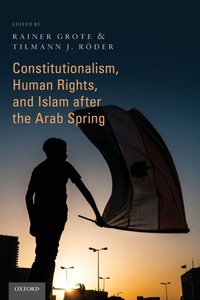
Constitutionalism, Human Rights, and Islam after the Arab Spring
Published on 11. August 2016
Book
Hardback
992 pages
978-0-19-062764-5 (ISBN)
Description
Constitutionalism, Human Rights, and Islam after the Arab Spring offers a comprehensive analysis of the impact that new and draft constitutions and amendments - such as those in Jordan, Morocco, Syria, Egypt, and Tunisia - have had on the transformative processes that drive constitutionalism in Arab countries.
This book aims to identify and analyze the key issues facing constitutional law and democratic development in Islamic states, and offers an in-depth examination of the relevance of the transformation processes for the development and future of constitutionalism in Arab countries. Using an encompassing and multi-faceted approach, this book explores underlying trends and currents that have been pivotal to the Arab Spring, while identifying and providing a forward looking view of constitution
making in the Arab world.
This book aims to identify and analyze the key issues facing constitutional law and democratic development in Islamic states, and offers an in-depth examination of the relevance of the transformation processes for the development and future of constitutionalism in Arab countries. Using an encompassing and multi-faceted approach, this book explores underlying trends and currents that have been pivotal to the Arab Spring, while identifying and providing a forward looking view of constitution
making in the Arab world.
Reviews / Votes
"Constitutionalism, Human Rights, and Islam after the Arab Spring is a herculean effort undertaken by leading authorities in the field of comparative constitutionalism. It draws from a wide variety of voices to give a full account of the contemporary state of constitutionalism throughout the Arab world, managing in a single work to combine seamlessly contributions from world class international heavyweights and local underappreciated figures alike. I am not aware ofa parallel work on Arab constitutionalism that has drawn on such a rich combination of domestic and international scholars to tell this compelling story." - Haider Ala Hamoudi, Associate Dean for Research & Faculty Development; Associate Professor of Law, University of Pittsburgh School of Law "This impressive book provides a uniquely comprehensive description and analysis of the Arab Spring uprisings and of the early phases of post Arab-Spring transformations in the MENA region. The editors, highly respected experts and scholars, have organized the book thematically. In each thematic section, a distinguished group of contributors from within and outside the region, explores developments in a broad cross section of Arab Spring countries. Taken
together, the chapters provide us with a view of the Arab Spring that is notable for both its breadth and depth. It will be of great use to scholars and researchers in a wide variety of fields." - Clark B. Lombardi, UW Law Foundation Professor of Law, Director of Islamic Legal Studies, University of
Washington School of Law "In the midst of chaotic global events, Islamic Law has been quietly undergoing a renaissance from within. This book contributes to that important movement by creating space for Muslim scholars to debate the future of Islamic Law from within its parameters. If yours has been among the chorus of voices asking, Where are the intelligent, informed, moderate voices in todays discussions about Islamic Law? this is the book you have been waiting for." - Christie S.
Warren, Professor of the Practice of International and Comparative Law, Director, Center for Comparative Legal Studies, William and Mary Law School "This superb book approaches constitutional change in the Arab world by taking perspectives from the region seriously. With its mix of scholarly and practitioner perspectives, it will be an important record of the political fallout of the Arab Spring and an invaluable resource for English-language readers who do not have access to many of the internal debates. A sophisticated and important contribution." - Tom Ginsburg, Leo Spitz Professor of International Law,
University of Chicago Law School
More details
Other editions
Additional editions
Rainer Grote | Tilmann J. Röder
Constitutionalism, Human Rights, and Islam after the Arab Spring
E-Book
07/2016
OUP eBook
€83.99
Available for download
Rainer Grote | Tilmann J. Röder
Constitutionalism, Human Rights, and Islam after the Arab Spring
E-Book
07/2016
OUP eBook
€90.49
Available for download
Persons
Rainer Grote is a Senior Research Fellow and head of the project on Constitutions of the Countries of the World at the Max Planck Institute for Comparative Public Law and International Law in Heidelberg and lecturer of law at the University of Heidelberg. He was a Visiting Professor at universities in France (Paris II), Turkey, and Chile and has worked as a legal expert and consultant on law reform projects in Latin America, Africa, and Asia. He
teaches and writes in the fields of constitutional law, comparative law and public international law. Recent publications include Constitutionalism in Islamic Countries: Between Upheaval and Continuity (Oxford University Press, 2012 with Tilmann Roeder) and EMRK/GG: Konkordanzkommentar, second edition (2013 with Oliver
Doerr and Thilo Marauhn). His research areas include constitutional law, comparative law and human rights law.
Tilmann J. Röder is a Managing Director of the Max Planck Foundation for International Peace and the Rule of Law in Heidelberg, Germany. His recent research has focused on the subjects of rule of law and constitution building in Afghanistan, Pakistan, Iraq, Libya, and Kashmir. Together with Rainer Grote he organizes an ongoing series of lectures on Law & Development. He holds a law degree from Humboldt University of Berlin and a doctorate degree from Goethe University
Frankfurt. His recent publications include Constitutionalism in Islamic Countries: Between Upheaval and Continuity (Oxford University Press, 2012 with Rainer Grote) and "Civil-Military Cooperation in Building the Rule of Law" (in Rule of Law Dynamics, 2012). He is a Member of the Advisory Panel on Civilian Crisis Prevention
of the German Federal Government.
teaches and writes in the fields of constitutional law, comparative law and public international law. Recent publications include Constitutionalism in Islamic Countries: Between Upheaval and Continuity (Oxford University Press, 2012 with Tilmann Roeder) and EMRK/GG: Konkordanzkommentar, second edition (2013 with Oliver
Doerr and Thilo Marauhn). His research areas include constitutional law, comparative law and human rights law.
Tilmann J. Röder is a Managing Director of the Max Planck Foundation for International Peace and the Rule of Law in Heidelberg, Germany. His recent research has focused on the subjects of rule of law and constitution building in Afghanistan, Pakistan, Iraq, Libya, and Kashmir. Together with Rainer Grote he organizes an ongoing series of lectures on Law & Development. He holds a law degree from Humboldt University of Berlin and a doctorate degree from Goethe University
Frankfurt. His recent publications include Constitutionalism in Islamic Countries: Between Upheaval and Continuity (Oxford University Press, 2012 with Rainer Grote) and "Civil-Military Cooperation in Building the Rule of Law" (in Rule of Law Dynamics, 2012). He is a Member of the Advisory Panel on Civilian Crisis Prevention
of the German Federal Government.