

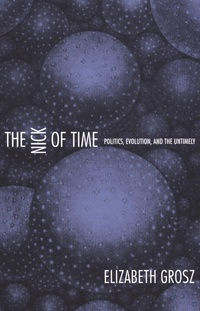
The Nick of Time
Politics, Evolution, and the Untimely
Will be published approx. on 6. December 2004
Book
Hardback
336 pages
978-0-8223-3400-2 (ISBN)
Description
In this pathbreaking philosophical work, Elizabeth Grosz points the way toward a theory of becoming to replace the prevailing ontologies of being in social, political, and biological discourse. Arguing that theories of temporality have significant and underappreciated relevance to the social dimensions of science and the political dimensions of struggle, Grosz engages key theoretical concerns related to the reality of time. She explores the effect of time on the organization of matter and on the emergence and development of biological life. Considering how the relentless forward movement of time might be conceived in political and social terms, she begins to formulate a model of time that incorporates the future and its capacity to supersede and transform the past and present.Grosz develops her argument by juxtaposing the work of three major figures in Western thought: Charles Darwin, Friedrich Nietzsche, and Henri Bergson. She reveals that in theorizing time as an active, positive phenomenon with its own characteristics and specific effects, each of these thinkers had a profound effect on contemporary understandings of the body in relation to time. She shows how their allied concepts of life, evolution, and becoming are manifest in the work of Gilles Deleuze and Luce Irigaray. Throughout The Nick of Time, Grosz emphasizes the political and cultural imperative to fundamentally rethink time: the more clearly we understand our temporal location as beings straddling the past and the future without the security of a stable and abiding present, the more transformation becomes conceivable.
Reviews / Votes
"Elizabeth Grosz traces a timely path through the work of three major thinkers. Darwin, Nietzsche, and Bergson, each in his own way, force a rethinking of duration and transformation at the interchange between nature and culture. The Nick of Time suggestively connects their trajectories, drawing them together into a contemporary dialogue on the politics and philosophy of change."-Brian Massumi, author of Parables for the Virtual: Movement, Affect, Sensation "Elizabeth Grosz's The Nick of Time: Politics, Evolution and the Untimely is a major work. It achieves a richly nuanced and sweeping reconsideration of temporality in the context of contemporary feminist theory, critical theory, and theories of evolution. The considerations of Darwin, Nietzsche, Bergson, Deleuze, and Irigaray are especially impressive. The Nick of Time is essential reading for anyone interested in understanding how memory, historicity, and politics connect to and are reconfigured by temporality."-N. Katherine Hayles, author of How We Became Posthuman: Virtual Bodies in Cybernetics, Literature, and Informatics "Superbly written, deftly executed, and wonderfully instructive, The Nick of Time is a first-class piece of writing and thinking. It is unique in that it is interested in 'philosophy of life' issues not only for their own sake but also because of Elizabeth Grosz's wider theoretical and practical commitments, such as feminism and a radical cultural politics."-Keith Ansell Pearson, author of Germinal Life: The Difference and Repetition of DeleuzeMore details
Language
English
Place of publication
North Carolina
United States
Target group
Professional and scholarly
Product notice
Cloth over boards
Illustrations
3 figures
Dimensions
Height: 239 mm
Width: 152 mm
Thickness: 25 mm
Weight
567 gr
ISBN-13
978-0-8223-3400-2 (9780822334002)
Copyright in bibliographic data and cover images is held by Nielsen Book Services Limited or by the publishers or by their respective licensors: all rights reserved.
Schweitzer Classification
Other editions
Additional editions
E-Book
12/2004
1st Edition
De Gruyter
€208.99
Available for download
Person
Elizabeth Grosz is Professor of Women's and Gender Studies at Rutgers University. She is the author of Architecture from the Outside: Essays on Virtual and Real Space; Space, Time, and Perversion: Essays on the Politics of Bodies; and Volatile Bodies: Toward a Corporeal Feminism. She is the editor of Becomings: Explorations in Time, Memory, and Futures.
Content
Acknowledgments vii
Abbreviations ix
Introduction: To the Untimely 1
Part I. Darwin and Evolution
1. Darwinian Matters: Life, Force, and Change 17
2. Biological Difference 40
3. The Evolution of Sex and Race 64
Part II. Nietzsche and Overcoming
4. Nietzsche's Darwin 95
5. History and the Untimely 113
6. The Eternal Return and the Overman 135
Part III: Bergson and Becoming
7. Bergsonian Difference 155
8. The Philosophy of Life 185
9. Intuition and the Virtual 215
Conclusion: The Future 244
Notes 263
References 297
Index 309
Abbreviations ix
Introduction: To the Untimely 1
Part I. Darwin and Evolution
1. Darwinian Matters: Life, Force, and Change 17
2. Biological Difference 40
3. The Evolution of Sex and Race 64
Part II. Nietzsche and Overcoming
4. Nietzsche's Darwin 95
5. History and the Untimely 113
6. The Eternal Return and the Overman 135
Part III: Bergson and Becoming
7. Bergsonian Difference 155
8. The Philosophy of Life 185
9. Intuition and the Virtual 215
Conclusion: The Future 244
Notes 263
References 297
Index 309