

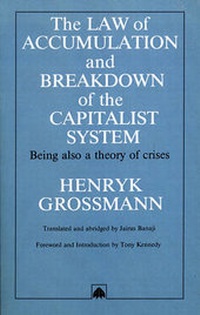
The Law of Accumulation and Breakdown of the Capitalist System
Published on 20. March 1992
Book
Hardback
240 pages
978-0-7453-0458-8 (ISBN)
Description
Henryk Grossmann's influential work provides the key to a fuller understanding of Marx's theory of crisis.
Reviews / Votes
'One of the seminal works of Marxian political economy' -- Science & SocietyMore details
Language
English
Place of publication
London
United Kingdom
Target group
College/higher education
Professional and scholarly
Product notice
Library binding
Dimensions
Height: 215 mm
Width: 135 mm
ISBN-13
978-0-7453-0458-8 (9780745304588)
Copyright in bibliographic data and cover images is held by Nielsen Book Services Limited or by the publishers or by their respective licensors: all rights reserved.
Schweitzer Classification
Person
Henryk Grossman (1881-1950) was born in Cracow and studied law and economics in Cracow and Vienna. In 1925 he joined the Institute of Social Research in Frankfurt. He left Germany in the 1930s and returned to become Professor of Political Economy at Leipzig University in 1949.
Content
Foreword by Tony Kennedy
Henryk Grossmann and the Theory of Capitalist Collapse
Tony Kennedy
Introduction by Henryk Grossmann
1. The Downfall of Capitalism in the Existing Literature
The point at issue
The conception of breakdown in the existing literature
How Kautsky finally abandoned Marx's theory of accumulation and of breakdown
Notes
2. The Law of Capitalist Breakdown
Is there a theory of breakdown in Marx?
Preliminary methodological remarks
The equilibrium theory of the neo-harmonists
The conditions and tasks of schematic analysis
Why was classical economy alarmed by the fall in the rate of
Profit despite an expanding mass of profit?
The views of classical economists on the future of capitalism
The Marxist theory of accumulation and breakdown
Marx's theory of breakdown is also a theory of crises
An anti-critical interlude
The logical and mathematical basis of the law of breakdown
Why the Marxist theory of accumulation and breakdown was misunderstood
The factors of the breakdown and the business cycle
Crises and the theory of underconsumption
The elasticity of accumulation
The restricted development of productive forces under Capitalism
The Marxist theory of imperfect valorisation
Notes
3. Modifying Countertendencies
Introduction
Part 1: Countertendencies Internal to the Mechanism of Capital
Increases in the rate of profit through the expansion of productivity
Reducing the costs of variable capital through increases in productivity
Shortening the turnover time and its impact on the rate of surplus value
The additional money capital required for an expanded scale of production
The conflict between use value and exchange value
The emergence of new spheres of production with a lower Organic composition of capital
The struggle to abolish groundrent
The struggle to eliminate the commercial profit
The economic function of 'third persons'
Expanding the scale of production on the existing technological basis: simple accumulation
The periodic devaluation of capital on the accumulation process
The expansion of share capital
The accumulation of capital and the problem of population
Part 2: Restoring Profitability through World Market Domination
Introduction: The economic function of imperialism
The function of foreign trade under capitalism
Foreign trade and world monopolies
The function of capital exports under capitalism
Notes
Bibliography
Index
Henryk Grossmann and the Theory of Capitalist Collapse
Tony Kennedy
Introduction by Henryk Grossmann
1. The Downfall of Capitalism in the Existing Literature
The point at issue
The conception of breakdown in the existing literature
How Kautsky finally abandoned Marx's theory of accumulation and of breakdown
Notes
2. The Law of Capitalist Breakdown
Is there a theory of breakdown in Marx?
Preliminary methodological remarks
The equilibrium theory of the neo-harmonists
The conditions and tasks of schematic analysis
Why was classical economy alarmed by the fall in the rate of
Profit despite an expanding mass of profit?
The views of classical economists on the future of capitalism
The Marxist theory of accumulation and breakdown
Marx's theory of breakdown is also a theory of crises
An anti-critical interlude
The logical and mathematical basis of the law of breakdown
Why the Marxist theory of accumulation and breakdown was misunderstood
The factors of the breakdown and the business cycle
Crises and the theory of underconsumption
The elasticity of accumulation
The restricted development of productive forces under Capitalism
The Marxist theory of imperfect valorisation
Notes
3. Modifying Countertendencies
Introduction
Part 1: Countertendencies Internal to the Mechanism of Capital
Increases in the rate of profit through the expansion of productivity
Reducing the costs of variable capital through increases in productivity
Shortening the turnover time and its impact on the rate of surplus value
The additional money capital required for an expanded scale of production
The conflict between use value and exchange value
The emergence of new spheres of production with a lower Organic composition of capital
The struggle to abolish groundrent
The struggle to eliminate the commercial profit
The economic function of 'third persons'
Expanding the scale of production on the existing technological basis: simple accumulation
The periodic devaluation of capital on the accumulation process
The expansion of share capital
The accumulation of capital and the problem of population
Part 2: Restoring Profitability through World Market Domination
Introduction: The economic function of imperialism
The function of foreign trade under capitalism
Foreign trade and world monopolies
The function of capital exports under capitalism
Notes
Bibliography
Index