

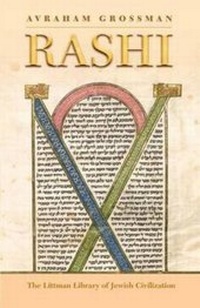
Rashi
Published on 27. September 2012
Book
Hardback
344 pages
978-1-904113-89-8 (ISBN)
Description
To this day, the commentaries on the Bible and Talmud written by the eleventh-century scholar known as Rashi remain unsurpassed. His influence on Jewish thinking was, and still is, significant. His commentary on the Pentateuch was the first Hebrew book to be printed, giving rise to hundreds of supercommentaries. Christian scholars, too, have relied heavily on his explanations of biblical texts.
In this volume Avraham Grossman presents a masterly survey of the social and cultural background to Rashi's work and pulls together the strands of information available on his life, his personality, his reputation during his lifetime, and his influence as a teacher. He discusses each of his main commentaries in turn, including such aspects as his sources, his interpretative method, his innovations, and his style and language. Attention is also given to his halakhic monographs, responsa, and liturgical poems.
Despite Rashi's importance as a scholar and the vast literature published about him, two central questions remain essentially unanswered: what was Rashi's world-view, and was he a conservative or a revolutionary? Professor Grossman considers these points at length, and his in-depth analysis of Rashi's world-view-particularly his understanding of Jewish uniqueness, Jewish values, and Jewish society-leads to conclusions that are likely to stimulate much debate.
In this volume Avraham Grossman presents a masterly survey of the social and cultural background to Rashi's work and pulls together the strands of information available on his life, his personality, his reputation during his lifetime, and his influence as a teacher. He discusses each of his main commentaries in turn, including such aspects as his sources, his interpretative method, his innovations, and his style and language. Attention is also given to his halakhic monographs, responsa, and liturgical poems.
Despite Rashi's importance as a scholar and the vast literature published about him, two central questions remain essentially unanswered: what was Rashi's world-view, and was he a conservative or a revolutionary? Professor Grossman considers these points at length, and his in-depth analysis of Rashi's world-view-particularly his understanding of Jewish uniqueness, Jewish values, and Jewish society-leads to conclusions that are likely to stimulate much debate.
Reviews / Votes
Reviews'Grossman draws heavily from the current Israeli scholarship on Rashi, including his own scholarly works, to present a well-rounded picture of Rashi. It is a work of synthesis; explicating clearly more arcane studies. Gross is a very good teacher, making his arguments clearly and using examples which clarify his own even further. He is especially helpful to explain Rashi's relationship with the midrashic literature whether in the commentary of the Torah or elsewhere. Recommended for libraries with comprehensive undergraduate programmes and any synagogue library.'
Roger S. Kohn, Association for Jewish Libraries Reviews 'The leading authority of his generation in this field.'
Marc Saperstein, European Judaism 'Avraham Grossman, one of the world's foremost scholars of medieval Judaica . . . reads some famous texts very closely in an attempt to make Rashi come to life for twenty-first century readers . . . a tour de force . . . Grossman's book, just like the works of Rashi, can be read with profit and enjoyment by both scholars and amateurs.'
Martin Lockshin, H-Judaic 'Arguably the most learned scholar today writing about the life and works of Rashi . . admirable book . . . the scholarly achievements of Avraham Grossman, to which this book attests on every page.'
Ivan G. Marcus, Jewish Review of Books 'The current volume is largely based on Grossman's earlier and very extensive work, but he has succeeded not only in abbreviating it for present purposes but also in updating various aspects of his impressive scholarship. The result is a volume that will undoubtedly become the standard work in English, for use as much (perhaps, in truth, even more) by scholars as by non-specialists. There is little here that Grossman has not covered . . . his contribution to the topic goes far beyond the thorough and well-sourced provision of sound data and careful assessment. He is also able to offer fresh insights into Rashi the man, the scholar, the rabbi, and the teacher . .. splendid.'
Stefan C. Reif, Journal of Jewish Studies 'An amazing volume that gives the reader a thorough understanding of who Rashi was through his many writings... Grossman's book is an impressive one... very readable, accessible, and fascinating.'
Ben Rothke, Times of Israel
More details
Series
Language
English
Other
Place of publication
Oxford
United Kingdom
Publishing group
Liverpool University Press
Dimensions
Height: 235 mm
Width: 155 mm
Thickness: 36 mm
Weight
680 gr
ISBN-13
978-1-904113-89-8 (9781904113898)
Copyright in bibliographic data and cover images is held by Nielsen Book Services Limited or by the publishers or by their respective licensors: all rights reserved.
Schweitzer Classification
Person
Avraham Grossman is a Professor of Jewish History at the Hebrew University of Jerusalem and a member of the Israeli Academy of Sciences. He was awarded the Bialik Prize in 1997 and the Israel Prize in 2003. His research interests focus on the Jewish rabbis and scholars of the early Middle Ages in Ashkenaz and France, Jewish family, and Jewish society.
Content
Translator's Note
Note on Transliteration
1 The Social and Cultural Background of Rashi's Work
The Jews' Political, Economic, and Social Status * The Troyes Community and the Jewish Centre in Champagne * The Twelfth-Century Renaissance * The Jews' Social Ties to their Surroundings * Jewish--Christian Religious Polemics
2 Rashi: A Biographical Sketch
Rashi's Life * Character Traits * Standing and Fame
3 Rashi's Beit Midrash
Growth of the Beit Midrash * 'The Great Rabbi' * Library and Sources
4 Literary Works: Commentary on the Torah
The Text of Rashi's Commentary on the Torah * Rashi's Interpretative Method * Rashi's Profound Affection for Midrash * General Characteristics of the Commentary
5 Literary Works: Commentaries on the Prophets and the Writings (Nakh)
Language, Grammar, and References to Daily Life * Style of the Commentaries * General Characteristics of the Commentaries
6 Literary Works: Commentary on the Talmud
For Whom Did Rashi Write his Commentary on the Talmud? * Extent of the Commentary * Interpretative Characteristics * Connections with Other Interpretative Traditions * Versions and Editions of the Commentary * Changes and Contradictions * Halakhic Rulings in Rashi's Commentary on the Talmud
7 Literary Works: Rulings, Responsa, Liturgical Poems, and Commentaries on Liturgical Poems
Rulings * Responsa * Liturgical Poems * Commentaries on Liturgical Poems
8 Rashi's World-View: The Uniqueness of the Jewish People
Methodological Introduction * The Election of Israel * The Land of Israel * Miracles * Exile and Redemption * The Nations of the World
9 Rashi's World-View: Values
Torah and Torah Study * Reasons for the Commandments * Prayer * Truth and Humility * Human Dignity * Peace and Factionalism
10 Rashi's World-View: Society
Scholars * Community Leaders * Forced and Voluntary Converts from Judaism * The Status of Women and their Place in Society and the Family
11 Postscript: Between Innovation and Conservatism
Innovation and Mission * How Did Rashi Attain his Historic Status?
Bibliography
Index
Note on Transliteration
1 The Social and Cultural Background of Rashi's Work
The Jews' Political, Economic, and Social Status * The Troyes Community and the Jewish Centre in Champagne * The Twelfth-Century Renaissance * The Jews' Social Ties to their Surroundings * Jewish--Christian Religious Polemics
2 Rashi: A Biographical Sketch
Rashi's Life * Character Traits * Standing and Fame
3 Rashi's Beit Midrash
Growth of the Beit Midrash * 'The Great Rabbi' * Library and Sources
4 Literary Works: Commentary on the Torah
The Text of Rashi's Commentary on the Torah * Rashi's Interpretative Method * Rashi's Profound Affection for Midrash * General Characteristics of the Commentary
5 Literary Works: Commentaries on the Prophets and the Writings (Nakh)
Language, Grammar, and References to Daily Life * Style of the Commentaries * General Characteristics of the Commentaries
6 Literary Works: Commentary on the Talmud
For Whom Did Rashi Write his Commentary on the Talmud? * Extent of the Commentary * Interpretative Characteristics * Connections with Other Interpretative Traditions * Versions and Editions of the Commentary * Changes and Contradictions * Halakhic Rulings in Rashi's Commentary on the Talmud
7 Literary Works: Rulings, Responsa, Liturgical Poems, and Commentaries on Liturgical Poems
Rulings * Responsa * Liturgical Poems * Commentaries on Liturgical Poems
8 Rashi's World-View: The Uniqueness of the Jewish People
Methodological Introduction * The Election of Israel * The Land of Israel * Miracles * Exile and Redemption * The Nations of the World
9 Rashi's World-View: Values
Torah and Torah Study * Reasons for the Commandments * Prayer * Truth and Humility * Human Dignity * Peace and Factionalism
10 Rashi's World-View: Society
Scholars * Community Leaders * Forced and Voluntary Converts from Judaism * The Status of Women and their Place in Society and the Family
11 Postscript: Between Innovation and Conservatism
Innovation and Mission * How Did Rashi Attain his Historic Status?
Bibliography
Index