

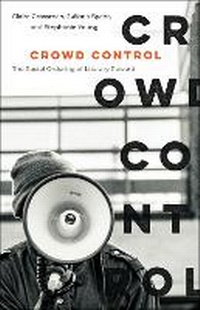
Crowd Control
The Racial Ordering of Literary Reward
Will be published approx. on 29. September 2026
Book
Hardback
264 pages
978-0-231-22217-4 (ISBN)
Description
From the race riots of 1919 to the Black Lives Matter movement, anxieties about Black uprising have influenced literary funding and prestige in the United States. Across many decades, grants and prizes have shaped the broader ecosystem of US literature, working in tandem to reroute Black militancy and define literary excellence as white. Even as the field diversified in the twenty-first century, prestige institutions raised barriers to entry and imposed new constraints on writers of color.
Crowd Control tells the story of how efforts to contain Black resistance led to the invention of American literary excellence. It brings together archival research and comprehensive data on literary prize demographics with readings of works by Claude McKay, Langston Hughes, William Styron, Claudia Rankine, and others to offer a material account of how US literature has imagined-and managed-protest. Because literature was thought to mollify, redirect, or cast public doubt on militant resistance, moments of mass protest consistently have been followed by targeted support for Black writers. Tracing the evolution of the institutions that reward writers across more than a century, this book unveils the hidden connection between literary funding and social control.
Crowd Control tells the story of how efforts to contain Black resistance led to the invention of American literary excellence. It brings together archival research and comprehensive data on literary prize demographics with readings of works by Claude McKay, Langston Hughes, William Styron, Claudia Rankine, and others to offer a material account of how US literature has imagined-and managed-protest. Because literature was thought to mollify, redirect, or cast public doubt on militant resistance, moments of mass protest consistently have been followed by targeted support for Black writers. Tracing the evolution of the institutions that reward writers across more than a century, this book unveils the hidden connection between literary funding and social control.
Reviews / Votes
Richly historicized yet immediate in its social and cultural claims, Crowd Control offers a brilliant diagnostic of the hypocrisies, ambivalences, and evasions of literary culture. As they track that culture through long-enduring prestige networks, Grossman, Spahr, and Young examine with sweep and sensitivity the double-bind of writers who confront in their work and lives the competing imperatives of political commitment and professional success. This is impressive scholarship-a fresh, fascinating account of how literary institutions capture, convert, and redirect potentially radical energies, as well as of how writers themselves struggle toward an impossible autonomy. -- Christopher Kempf, author of <i>Craft Class: The Writing Workshop in American Culture</i> Crowd Control shows how literary philanthropy, cultural policy, and the circuits of literary prestige have combined to sustain patterns of racial exclusion and subjugation for more than a century. Grossman, Spahr, and Young highlight the insidious effects of some of our highest honors and most liberal good intentions. This is a bracing work of institutional critique, aimed at the very heart of the American literary field. -- James English, author of <i>The Economy of Prestige: Prizes, Awards, and the Circulation of Cultural Value</i>More details
Language
English
Place of publication
New York
United States
Target group
Professional and scholarly
Product notice
Trade binding
Illustrations
9 b&w graphs
Dimensions
Height: 216 mm
Width: 140 mm
ISBN-13
978-0-231-22217-4 (9780231222174)
Copyright in bibliographic data and cover images is held by Nielsen Book Services Limited or by the publishers or by their respective licensors: all rights reserved.
Schweitzer Classification
Persons
Claire Grossman is an assistant professor of English at Occidental College. She has written for Cultural Critique and (with Juliana Spahr and Stephanie Young) American Literary History, The Cambridge Companion to the Essay, and Public Books.
Juliana Spahr is Frederick A. Rice Professor at Mills College at Northeastern University. Her most recent book of poems is Ars Poeticas (2025) and her most recent book of scholarship is Du Bois's Telegram: Literary Resistance and State Containment (2018).
Stephanie Young directs the creative writing program at Mills College at Northeastern University and is a member of the Krupskaya Books editorial collective. Her books of poetry and prose include Pet Sounds (2019), which received a Lambda Literary Award.
Juliana Spahr is Frederick A. Rice Professor at Mills College at Northeastern University. Her most recent book of poems is Ars Poeticas (2025) and her most recent book of scholarship is Du Bois's Telegram: Literary Resistance and State Containment (2018).
Stephanie Young directs the creative writing program at Mills College at Northeastern University and is a member of the Krupskaya Books editorial collective. Her books of poetry and prose include Pet Sounds (2019), which received a Lambda Literary Award.