

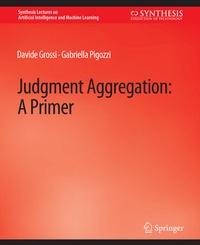
Judgment Aggregation
A Primer
Published on 18. March 2014
Book
Paperback/Softback
XVII, 133 pages
978-3-031-00440-7 (ISBN)
Description
Judgment aggregation is a mathematical theory of collective decision-making. It concerns the methods whereby individual opinions about logically interconnected issues of interest can, or cannot, be aggregated into one collective stance. Aggregation problems have traditionally been of interest for disciplines like economics and the political sciences, as well as philosophy, where judgment aggregation itself originates from, but have recently captured the attention of disciplines like computer science, artificial intelligence and multi-agent systems. Judgment aggregation has emerged in the last decade as a unifying paradigm for the formalization and understanding of aggregation problems. Still, no comprehensive presentation of the theory is available to date. This Synthesis Lecture aims at filling this gap presenting the key motivations, results, abstractions and techniques underpinning it. Table of Contents: Preface / Acknowledgments / Logic Meets Social Choice Theory / Basic Concepts /Impossibility / Coping with Impossibility / Manipulability / Aggregation Rules / Deliberation / Bibliography / Authors' Biographies / Index
More details
Series
Language
English
Place of publication
Cham
Switzerland
Publishing group
Springer International Publishing
Target group
Professional and scholarly
Illustrations
XVII, 133 p.
Dimensions
Height: 235 mm
Width: 191 mm
Thickness: 9 mm
Weight
298 gr
ISBN-13
978-3-031-00440-7 (9783031004407)
DOI
10.1007/978-3-031-01568-7
Schweitzer Classification
Other editions
Additional editions
E-Book
06/2022
Springer
€37.44
Available for download
Persons
Davide Grossi is a Lecturer (Assistant Professor) at the Computer Science Department of the University of Liverpool (UK). He holds a master's degree cum laude in Philosophy from the Scuola Normale Superiore of Pisa (Italy) and a Ph.D. in Computer Science from Utrecht University (the Netherlands). His Ph.D. thesis was nominated for the Christiaan Huygens Prijs 2009 of the Royal Netherlands Academy of Arts and Sciences. Prior to joining the University of Liverpool, he worked as a postdoctoral researcher at the Computer Science and Communications Department of the University of Luxembourg (on a personal grant sponsored by the National Research Fund of Luxembourg) and at the Institute for Logic, Language, and Computation of the University of Amsterdam (on a personal grant sponsored by the Netherlands Organisation for Scientific Research). He is author of over 40 peer-reviewed articles in international journals and conferences in philosophy, logic, artificial intelligence and multi-agent systems. He regularly serves as reviewer for top journals and conferences in his areas of expertise.Gabriella Pigozzi is an Associate Professor in Computer Science at Universite Paris Dauphine (France) and a member of the LAMSADE Lab. After a Ph.D. in Philosophy from the University of Genova (Italy), she held postdoc positions at the Center for Junior Research Fellows of the University of Konstanz (Germany), at the Computer Science Department of King's College London (on a personal postdoctoral fellowship sponsored by the Economic and Social Research Council), and at the Computer Science and Communications Department of the University of Luxembourg. She obtained grants from the Engineering and Physical Sciences Research Council (UK) and the National Agency for Research (France). Her research focuses on judgment aggregation, computational social choice, argumentation theory, and normative multi-agent systems. She published over 40 peer-reviewed articles in international conferences and journals.
Content
Preface.- Acknowledgments.- Logic Meets Social Choice Theory.- Basic Concepts.- Impossibility.- Coping with Impossibility.- Manipulability.- Aggregation Rules.- Deliberation.- Bibliography.- Authors' Biographies.- Index .