

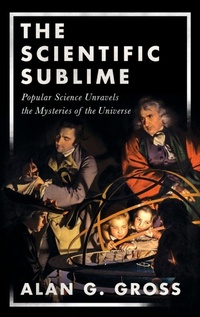
The Scientific Sublime
Popular Science Unravels the Mysteries of the Universe
Published on 2. August 2018
Book
Hardback
328 pages
978-0-19-063777-4 (ISBN)
Description
The sublime evokes our awe, our terror, and our wonder. Applied first in ancient Greece to the heights of literary expression, in the 18th-century the sublime was extended to nature and to the sciences, enterprises that viewed the natural world as a manifestation of God's goodness, power, and wisdom.
In The Scientific Sublime, Alan Gross reveals the modern-day sublime in popular science. He shows how the great popular scientists of our time--Richard Feynman, Stephen Hawking, Steven Weinberg, Brian Greene, Lisa Randall, Rachel Carson, Stephen Jay Gould, Steven Pinker, Richard Dawkins, and E. O. Wilson--evoke the sublime in response to fundamental questions: How did the universe begin? How did life? How did language? These authors maintain a tradition initiated by Joseph Addison, Edmund Burke, Immanuel Kant, and Adam Smith, towering 18th-century figures who adapted the literary sublime first to nature, then to science--though with one crucial difference: religion has been replaced wholly by science.
In a final chapter, Gross explores science's attack on religion, an assault that attempts to sweep permanently under the rug two questions science cannot answer: What is the meaning of life? What is the meaning of the good life?
In The Scientific Sublime, Alan Gross reveals the modern-day sublime in popular science. He shows how the great popular scientists of our time--Richard Feynman, Stephen Hawking, Steven Weinberg, Brian Greene, Lisa Randall, Rachel Carson, Stephen Jay Gould, Steven Pinker, Richard Dawkins, and E. O. Wilson--evoke the sublime in response to fundamental questions: How did the universe begin? How did life? How did language? These authors maintain a tradition initiated by Joseph Addison, Edmund Burke, Immanuel Kant, and Adam Smith, towering 18th-century figures who adapted the literary sublime first to nature, then to science--though with one crucial difference: religion has been replaced wholly by science.
In a final chapter, Gross explores science's attack on religion, an assault that attempts to sweep permanently under the rug two questions science cannot answer: What is the meaning of life? What is the meaning of the good life?
Reviews / Votes
Few readers can have missed the enormous sales of popular science books such as Stephen Hawking's A Brief History of Time or Rachel Carson's Silent Spring. Alan Gross writes about such works with clarity and energy, and his book is succinct and often brilliant. * David E. Nye, University of Minnesota, Charles Babbage Institute, ISIS * ...a very attractively written and interesting book... [it] can serve as a perfect source of information about the best science popularisation works. It may be used to ignite the interest of readers and move them to reading the texts presented in the book in their original form. * Elena Maceviciute, : University of Boras, Information Research * Alan G. Gross is a Science Studies pioneer, with lots of the rest of us standing on his shoulders, and this may be his best work, certainly the most gracefully written, compulsively readable, and wittiest of his books. Decidedly, the most fun. That would be worth the price of admission on its own. But it's not on its own. The Scientific Sublime also gives us portraits of some of our most eloquent scientists and science writers Rachel Carson, E.O. Wilson, Steven Pinker, Richards Feynman and Dawkinswith Gross not only charting out that eloquence but sometimes matching it, in prose that bristles with insights and urbanities, and, on occasion, flares with a take-no-prisoners acerbity that would also be at home with some of those writers. * Randy Harris, University of Waterloo * With clarity and elegance, Alan Gross introduces readers of The Scientific Sublime to contemporary scientists who are prose artists and whose works have introduced the public to phenomena, from quantum mechanics and cosmology to panoramic theories of evolution. Extending the rhetorical concept of the sublime as a form of overwhelming persuasion, Gross points out the effects of his chosen writers' visionary descriptions and theorizing. In doing so he creates a new critical term, the scientific sublime, that will inform future assessments of the science writing of any era. His final chapter is a surprising and bracing retreat from appreciation, as Gross points out the moral and human sublime, beyond the expertise of his model authors, that requires other forms of artistic expression. * Jeanne Fahnestock, University of Maryland * In this beautifully written, engaging and perceptive book, Gross has tracked the idea of the sublime from its origins in pre-modern western culture to the popularizations of science of the last half century. He shows how influential physicists and biologists have united to present a vast epic that attempts to explain the origin and meaning of lifean account that competes with the Biblical narrative. Anyone interested in what modern science tells us about humanitys place in nature must read this book. * Bernard V. Lightman, York University *More details
Language
English
Place of publication
New York
United States
Dimensions
Height: 240 mm
Width: 161 mm
Thickness: 22 mm
Weight
658 gr
ISBN-13
978-0-19-063777-4 (9780190637774)
Copyright in bibliographic data and cover images is held by Nielsen Book Services Limited or by the publishers or by their respective licensors: all rights reserved.
Schweitzer Classification
Other editions
Additional editions
E-Book
06/2018
1st Edition
OUP eBook
€32.99
Available for download
E-Book
06/2018
1st Edition
OUP eBook
€32.99
Available for download
Person
Alan G. Gross is a Professor Emeritus of Communication Studies at the University of Minnesota-Twin Cities and a National Communication Association Distinguished Scholar. His specialty is scientific communication. He is the author of The Rhetoric of Science and co-author of Communicating Science, The Scientific Literature, The Craft of Scientific Communication, Science from Sight to Insight, and The Internet Revolution in the Sciences and Humanities.
Content
Chapter 1: Isn't Science Sublime?
Part I: The Physicists
Chapter 2: Richard Feynman: The Consensual Sublime
Chapter 3: Steven Weinberg: The Conjectural Sublime
Chapter 4. Lisa Randall: The Technological Sublime
Chapter 5. Brian Greene: The Speculative Sublime
Chapter 6. Stephen Hawking: The Scientific Sublime Embodied
Part II: The Biologists
Chapter 7. Rachel Carson: The Ethical Sublime
Chapter 8. Stephen Jay Gould's Books: The Balanced Sublime
Chapter 9. Stephen Jay Gould's Essays: Experiencing the Sublime
Chapter 10. Steven Pinker: The Polymath Sublime
Chapter 11. Richard Dawkins: The Mathematical Sublime
Chapter 12. E. O. Wilson: The Biophilic Sublime
Part III
Chapter 13. Move Over, God
Part I: The Physicists
Chapter 2: Richard Feynman: The Consensual Sublime
Chapter 3: Steven Weinberg: The Conjectural Sublime
Chapter 4. Lisa Randall: The Technological Sublime
Chapter 5. Brian Greene: The Speculative Sublime
Chapter 6. Stephen Hawking: The Scientific Sublime Embodied
Part II: The Biologists
Chapter 7. Rachel Carson: The Ethical Sublime
Chapter 8. Stephen Jay Gould's Books: The Balanced Sublime
Chapter 9. Stephen Jay Gould's Essays: Experiencing the Sublime
Chapter 10. Steven Pinker: The Polymath Sublime
Chapter 11. Richard Dawkins: The Mathematical Sublime
Chapter 12. E. O. Wilson: The Biophilic Sublime
Part III
Chapter 13. Move Over, God