

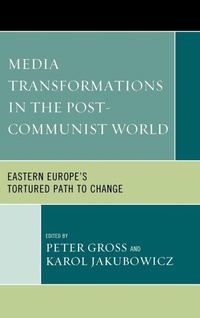
Media Transformations in the Post-Communist World
Eastern Europe's Tortured Path to Change
Published on 18. October 2012
Book
Hardback
236 pages
978-0-7391-7494-4 (ISBN)
Description
Media Transformations in the Post-Communist World: Eastern Europe's Tortured Path to Change, edited by Peter Gross and Karol Jakubowicz, is a collection of analyses of Eastern European media by some of the most distinguished scholars in the field. This in-depth exploration shows how despite positive changes after the fall of Communism, the transformations of societal institutions, including the mass media, have turned out to be slow, uncertain, and unsatisfying to many when measured against the admittedly ambiguous and overly Panglossian expectations.
This collection offers readers a different view of post-Communist media by examining the mass media's evolution in the region from a more holistic perspective. The contributors to this volume respond to essential questions, including: Is the post-Communist transition and transformation over? When can it be considered over? Each chapter contributes to our understanding of these questions by offering theoretical overviews and country-specific studies.
This collection serves as an affirmation that the study of mass media is essential to understanding the nature and workings of democracy in the long-suffering nations of Central and Eastern Europe, with international applications. Media Transformations in the Post-Communist World is an indispensable contribution to the study of Eastern Europe after Communism, and the transformations of mass media in the region.
This collection offers readers a different view of post-Communist media by examining the mass media's evolution in the region from a more holistic perspective. The contributors to this volume respond to essential questions, including: Is the post-Communist transition and transformation over? When can it be considered over? Each chapter contributes to our understanding of these questions by offering theoretical overviews and country-specific studies.
This collection serves as an affirmation that the study of mass media is essential to understanding the nature and workings of democracy in the long-suffering nations of Central and Eastern Europe, with international applications. Media Transformations in the Post-Communist World is an indispensable contribution to the study of Eastern Europe after Communism, and the transformations of mass media in the region.
Reviews / Votes
Edited by two of the most prominent scholars in the field and containing contributions from a stellar cast of emerging and emerged media academics, this collection is essential reading for anyone wishing to come to grips with the changing landscape of post-Communist media systems and structures. -- John Downey, Loughborough UniversityMore details
Language
English
Place of publication
United States
Publishing group
Bloomsbury Publishing Plc
Target group
College/higher education
Illustrations
6 Graphs, 14 Tables
Dimensions
Height: 235 mm
Width: 157 mm
Thickness: 19 mm
Weight
540 gr
ISBN-13
978-0-7391-7494-4 (9780739174944)
Copyright in bibliographic data and cover images is held by Nielsen Book Services Limited or by the publishers or by their respective licensors: all rights reserved.
Schweitzer Classification
Other editions
Additional editions
Peter Gross | Karol Jakubowicz
Media Transformations in the Post-Communist World
Eastern Europe's Tortured Path to Change
E-Book
10/2012
1st Edition
Lexington Books
€108.99
Available for download
Peter Gross | Karol Jakubowicz
Media Transformations in the Post-Communist World
Eastern Europe's Tortured Path to Change
E-Book
10/2012
1st Edition
Lexington Books
€108.99
Available for download
Persons
Peter Gross is director of the School of Journalism and Electronic Media at the University of Tennessee, Knoxville.
Karol Jakubowicz is senior adviser to the chairman of the National Broadcasting Council, the broadcasting regulatory body of Poland.
Karol Jakubowicz is senior adviser to the chairman of the National Broadcasting Council, the broadcasting regulatory body of Poland.
Content
Chapter One. When Will the Transformation be Over?
by Peter Gross and Karol Jakubowicz
Chapter Two. Comparing Media Systems between Eastern and Western Europe
by Daniel C. Hallin and Paolo Mancini
Chapter Three. Freedom without Impartiality: The Vicious Circle of Media Captivity
by Alina Mungiu-Pippidi
Chapter Four. From Political Propaganda to Political Marketing: Changing Media Politics in Post-Communist Democracies
by Peter Bajomi-Lazar
Chapter Five. Media and the Birth of the Post-Communist Consumer
by Nadia Kaneva and Elza Ibroscheva
Chapter Six. The Intersection of Two Revolutions: The Role of New Media in the Development of Post-Socialist Europe in the First Twenty Years
by John Parrish-Sprowl
Chapter Seven. Digital R(e)volutions? Internet, New Media, and Informed Citizenship in Central and Eastern Europe
by Inka Salovaara-Moring
Chapter Eight. Freedom of Mass Information in the Post-Soviet Countries: Two Models of Regulation
by Andrei Richter
Chapter Nine. Russian Media and Democracy
by Hedwig de Smaele
Chapter Ten. Entertaining the People, Serving the Elites: Slovak Mass Media Since 1989
by Owen Johnson
Chapter Eleven. The Paradox of Journalistic Elites in Post-Communist Romania: From Defenders of Freedom of Expression to Corrupt Moguls
by Mihai Coman
Chapter Twelve. Two Decades of Free Media in the Czech Republic: So What? Remarks on the Discourse of Post-1989 Media Transformation
by Jan Jirak and Barbara Koepplova
Chapter Thirteen. "Islands in the Stream": Reflections on Media Development in Belarus
by Oleg Manaev, Natalie Manayeva, and Dmitry Yuran
by Peter Gross and Karol Jakubowicz
Chapter Two. Comparing Media Systems between Eastern and Western Europe
by Daniel C. Hallin and Paolo Mancini
Chapter Three. Freedom without Impartiality: The Vicious Circle of Media Captivity
by Alina Mungiu-Pippidi
Chapter Four. From Political Propaganda to Political Marketing: Changing Media Politics in Post-Communist Democracies
by Peter Bajomi-Lazar
Chapter Five. Media and the Birth of the Post-Communist Consumer
by Nadia Kaneva and Elza Ibroscheva
Chapter Six. The Intersection of Two Revolutions: The Role of New Media in the Development of Post-Socialist Europe in the First Twenty Years
by John Parrish-Sprowl
Chapter Seven. Digital R(e)volutions? Internet, New Media, and Informed Citizenship in Central and Eastern Europe
by Inka Salovaara-Moring
Chapter Eight. Freedom of Mass Information in the Post-Soviet Countries: Two Models of Regulation
by Andrei Richter
Chapter Nine. Russian Media and Democracy
by Hedwig de Smaele
Chapter Ten. Entertaining the People, Serving the Elites: Slovak Mass Media Since 1989
by Owen Johnson
Chapter Eleven. The Paradox of Journalistic Elites in Post-Communist Romania: From Defenders of Freedom of Expression to Corrupt Moguls
by Mihai Coman
Chapter Twelve. Two Decades of Free Media in the Czech Republic: So What? Remarks on the Discourse of Post-1989 Media Transformation
by Jan Jirak and Barbara Koepplova
Chapter Thirteen. "Islands in the Stream": Reflections on Media Development in Belarus
by Oleg Manaev, Natalie Manayeva, and Dmitry Yuran