

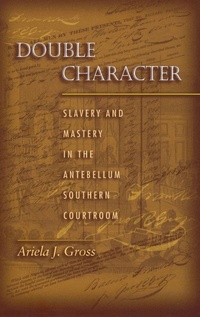
Double Character
Slavery and Mastery in the Antebellum Southern Courtroom
Published on 19. November 2000
Book
Hardback
280 pages
978-0-691-05957-0 (ISBN)
Description
In a groundbreaking study of the day-to-day law and culture of slavery, Ariela Gross investigates the local courtrooms of the Deep South where ordinary people settled their disputes over slaves. Buyers sued sellers for breach of warranty when they considered slaves to be physically or morally defective; owners sued supervisors who whipped or neglected slaves under their care. Double Character seeks to explain how communities dealt with an important dilemma raised by these trials: how could slaves who acted as moral agents be treated as commodities? Because these cases made the character of slaves a central legal question, slaves' moral agency intruded into the courtroom, often challenging the character of slaveholders who saw themselves as honorable masters. Gross looks at the stories about white and black character that witnesses and litigants put forth in court. She not only reveals the role of law in constructing "race" but also offers a portrait of the culture of slavery, one that addresses historical debates about law, honor, and commerce in the American South.
Gross maintains that witnesses and litigants drew on narratives available in the culture at large to explain the nature and origins of slaves' character, such as why slaves became runaways. But the legal process also shaped their expressions of racial ideology by favoring certain explanations over others. Double Character brings to life the law as a dramatic ritual in people's daily lives, looking at trials from the perspective of litigants, lawyers, doctors, and the slaves themselves. The author's approach combines the methods of cultural anthropology, quantitative social history, and critical race theory.
Gross maintains that witnesses and litigants drew on narratives available in the culture at large to explain the nature and origins of slaves' character, such as why slaves became runaways. But the legal process also shaped their expressions of racial ideology by favoring certain explanations over others. Double Character brings to life the law as a dramatic ritual in people's daily lives, looking at trials from the perspective of litigants, lawyers, doctors, and the slaves themselves. The author's approach combines the methods of cultural anthropology, quantitative social history, and critical race theory.
Reviews / Votes
"A nuanced and elegant interpretation of antebellum Southern law."--Virginia Quarterly Review "Double Character is an exemplar of how detailed research and theoretical sophistication can be combined. Few writers are as at home as Gross with handling both large databases and complex cultural theories."--Philip Abbott, The HistorianMore details
Language
English
Place of publication
New Jersey
United States
Target group
Professional and scholarly
College/higher education
Product notice
Trade binding
Illustrations
17 halftones, 11 tables
Dimensions
Height: 240 mm
Width: 161 mm
Thickness: 21 mm
Weight
632 gr
ISBN-13
978-0-691-05957-0 (9780691059570)
Copyright in bibliographic data and cover images is held by Nielsen Book Services Limited or by the publishers or by their respective licensors: all rights reserved.
Schweitzer Classification
Other editions
Additional editions
E-Book
09/2021
1st Edition
Princeton University Press
€118.99
Available for download
Person
Ariela J. Gross is Associate Professor of Law at the University of Southern California Law School. She received her Ph.D. in History from Stanford University and her J.D. from Stanford Law School.
Content
Acknowledgments ix Introduction 3 Chapter One: Court and Market 22 Chapter Two: Honor and Dishonor 47 Chapter Three: Slaves' Character 72 Chapter Four: Masters' Character 98 Chapter Five: Body and Mind 122 Epilogue 153 Appendix: Note on Sources and Methods 159 Notes 167 Bibliography 231 Index 251