

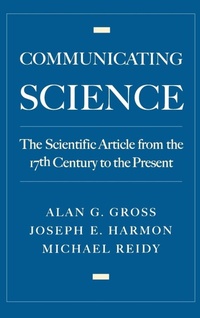
Communicating Science
The Scientific Article from the 17th Century to the Present
Published on 25. April 2002
Book
Hardback
280 pages
978-0-19-513454-4 (ISBN)
Description
This book describes the development of the scientific article from its modest beginnings to the global phenomenon that it has become today. Their analysis of a large sample of texts in French, English, and German focuses on the changes in the style, oganization, and argumentative structure of scientific communication over time. They also speculate on the future currency of the scientific article, as it enters the era of the World Wide Web. This book is an outstanding resource text in the rhetoric of science, and will stand as the definitive study on the topic.
Reviews / Votes
The book succeeds in meticulously unpacking the argumentative strategies that have evolved over the centuries in attempts to express an increasingly complex set of knowledge claims, the statements science makes about reality. * Communication *More details
Language
English
Place of publication
New York
United States
Target group
Professional and scholarly
Illustrations
numerous tables and figures
Dimensions
Height: 235 mm
Width: 157 mm
Thickness: 21 mm
Weight
609 gr
ISBN-13
978-0-19-513454-4 (9780195134544)
Copyright in bibliographic data and cover images is held by Nielsen Book Services Limited or by the publishers or by their respective licensors: all rights reserved.
Schweitzer Classification
Other editions
Additional editions
Alan G. Gross | Joseph E. Harmon | Michael S. Reidy
Communicating Science
The Scientific Article from the 17th Century to the Present
E-Book
04/2002
1st Edition
OUP eBook
€135.99
Available for download
Alan G. Gross | Joseph E. Harmon | Michael S. Reidy
Communicating Science
The Scientific Article from the 17th Century to the Present
E-Book
04/2002
1st Edition
OUP eBook
€135.99
Available for download