

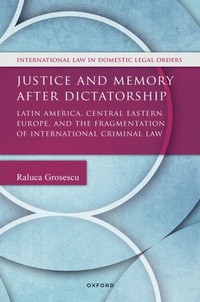
Justice and Memory after Dictatorship
Latin America, Central Eastern Europe, and the Fragmentation of International Criminal Law
Published on 1. March 2024
Book
Hardback
288 pages
978-0-19-287034-6 (ISBN)
Description
After the fall of military and communist dictatorships at the end of the 1980s, Latin American and Eastern European countries had to reckon with atrocities perpetrated by these Cold War regimes. Judges, prosecutors, and human rights campaigners across the two regions constructed novel readings of international criminal law to fight impunity and realize justice for gross human rights violations.
Justice and Memory after Dictatorship: Latin America, Central Eastern Europe and the Fragmentation of International Criminal Law provides a groundbreaking socio-historical account of the global transformation of international criminal law from these two semi-peripheries of the world system. Based on ethnographic observation and analyses of jurisprudence, Raluca Grosescu dissects the narratives that were fundamentally shaped by the relationship of law and politics.
Using paradigmatic cases and personal interviews with lawyers and judicial officials from Latin America and Eastern Europe, Grosescu uncovers how legal actors and organizations were instrumental in questioning an international order that marginalized the political violence that had unfolded in the two regions during the Cold War. Justice and Memory after Dictatorship is a significant volume in modern international criminal and human rights law and an important read for scholars, students, and legal practitioners alike.
Justice and Memory after Dictatorship: Latin America, Central Eastern Europe and the Fragmentation of International Criminal Law provides a groundbreaking socio-historical account of the global transformation of international criminal law from these two semi-peripheries of the world system. Based on ethnographic observation and analyses of jurisprudence, Raluca Grosescu dissects the narratives that were fundamentally shaped by the relationship of law and politics.
Using paradigmatic cases and personal interviews with lawyers and judicial officials from Latin America and Eastern Europe, Grosescu uncovers how legal actors and organizations were instrumental in questioning an international order that marginalized the political violence that had unfolded in the two regions during the Cold War. Justice and Memory after Dictatorship is a significant volume in modern international criminal and human rights law and an important read for scholars, students, and legal practitioners alike.
Reviews / Votes
By offering a novel perspective on impunity-fighting tactics in (re)emerging democracies that share historical and political similarities, Justice and Memory after Dictatorship represents a fresh addition to the international criminal law literature. In presenting the different models of reconciliation with past dictatorships, it shows how political ideologies and judicial arguments intertwine. Finally, as a case study of emerging, peripheral democracies, this book is also an important contribution to the transitional justice literature. * Celina Ferent, The European Legacy *More details
Series
Language
English
Place of publication
Oxford
United Kingdom
Target group
Professional and scholarly
Product notice
sewn/stitched
Cloth over boards
Dimensions
Height: 236 mm
Width: 165 mm
Thickness: 24 mm
Weight
603 gr
ISBN-13
978-0-19-287034-6 (9780192870346)
Copyright in bibliographic data and cover images is held by Nielsen Book Services Limited or by the publishers or by their respective licensors: all rights reserved.
Schweitzer Classification
Other editions
Additional editions
Raluca Grosescu
Justice and Memory after Dictatorship
Latin America, Central Eastern Europe, and the Fragmentation of International Criminal Law
E-Book
01/2024
1st Edition
OUP eBook
€89.99
Available for download
Raluca Grosescu
Justice and Memory after Dictatorship
Latin America, Central Eastern Europe, and the Fragmentation of International Criminal Law
E-Book
12/2023
1st Edition
OUP eBook
€89.99
Available for download
Person
Raluca Grosescu is a lecturer in politics at the National University of Political Science and Public Administration in Bucharest. After a PhD in political science at the University of Nanterre, she worked in different universities and research institutes across Europe, including Exeter University, the Paris Institute for Advanced Studies, and the Imre Kertesz Kolleg in Jena. She was the Principal Investigators of various international projects, including the ERC-Consolidator Grant Transnational Advocacy Networks and Corporate Accountability for Major International Crimes and the Romanian Research Council Grant State Socialist Contributions to the Development of International Criminal and Humanitarian Law after 1945.
Content
1: International Criminal Law from Semi-Periphery: A Socio-Historical Approach
2: Towards a Flexible Reading of Non-Retroactivity
3: Broadening the International Definition of Genocide
4: Strategies for Internationalizing Justice
5: Resisting the Duty to Prosecute
Epilogue
2: Towards a Flexible Reading of Non-Retroactivity
3: Broadening the International Definition of Genocide
4: Strategies for Internationalizing Justice
5: Resisting the Duty to Prosecute
Epilogue