

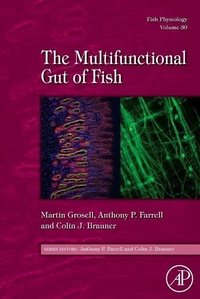
Fish Physiology: The Multifunctional Gut of Fish: Volume 30
Volume 30
Published on 21. October 2010
Book
Hardback
460 pages
978-0-12-374982-6 (ISBN)
Description
The Multifunctional Gut of Fish provides a comprehensive synthesis and an integrative overview of the range of gut functions and their implications for organismal physiology. The highly diversified anatomy and functions of the gut, including nutrient uptake, immune barrier function, salt and water homeostasis and respiration, as well as neuroendocrine actions and control are covered in detail by leading authors. In addition, this volume explores the pronounced implications of gut function for whole animal integrative physiology and compensatory demands for non-gastrointestinal organs. As the first comprehensive reference to discuss the diverse morphological and functional adaptations of the gut, this volume provides an excellent resource for comparative physiologists, aquaculturists and biomedical researchers employing fish as model organisms for mammalian physiology.
More details
Series
Language
English
Place of publication
San Diego
United States
Publishing group
Elsevier Science Publishing Co Inc
Target group
Professional and scholarly
Fish biologist, aquaculture researchers, biomedical researchers employing fish as model systems, comparative physiologists
Product notice
Unsewn / adhesive bound
Paper over boards
Dimensions
Height: 237 mm
Width: 159 mm
Thickness: 29 mm
Weight
917 gr
ISBN-13
978-0-12-374982-6 (9780123749826)
Copyright in bibliographic data and cover images is held by Nielsen Book Services Limited or by the publishers or by their respective licensors: all rights reserved.
Schweitzer Classification
Other editions
Additional editions
Anthony P. Farrell | Colin J. Brauner | Martin Grosell
The Multifunctional Gut of Fish
The Multifunctional Gut of Fish
E-Book
05/2014
Academic Press
€86.95
Available for download
Persons
RSMAS, University of Miami, Florida, Division of Marine Biology and Fisheries, Rosentiel school of Marine and Atmospheric Sciences, University of Miami, USA Dr. Tony Farrell is a Professor Emeritus in the Department of Zoology & Faculty of Land and Food Systems at the University of British Columbia and a Fellow of the Royal Society of Canada. His research had provided an understanding of fish cardiorespiratory systems and has applied this knowledge to salmon migratory passage, fish stress handling and their recovery, sustainable aquaculture and aquatic toxicology. He has over 490 research publications in peer-reviewed scientific journals and an h-factor of 92. He has co-edited of 30 volumes of the Fish Physiology series, as well as an award-winning Encyclopedia of Fish Physiology. As part of his application of physiology to aquaculture, he has studied the sub-lethal impacts of sea lice and piscine orthoreovirus on the physiology of juvenile salmon. Dr. Farrell has received multiple awards, including the Fry Medal, which is the highest honour to a scientist from the Canadian Society of Zoologists, the Beverton Medal, which is the highest honour to a scientist from the Fisheries Society of the British Isles, the Award of Excellence, which is the highest honour of the American Fisheries Society and the Murray A. Newman Awards both for Research and for Conservation from the Vancouver Marine Sciences Centre. He is a former President of the Society of Experimental Biologists and a former Editor-in-Chief for the Journal of Fish Biology. He served as a member of the Minister's Aquaculture Advisory Committee on Finfish Aquaculture for British Columbia and was a member of the Federal Independent Expert Panel on Aquaculture Science. Dr. Colin Brauner was educated in Canada at the University of British Columbia (Ph D), followed by a Post-doctoral fellowship at Aarhus University and the University of Southern Denmark, and was a Research Associate at McMaster University. He is a Professor of Zoology, UBC and Director of the UBC Aquatics Facility. He has been a Co-Editor of the Fish Physiology series since 2006. His research investigates environmental adaptations (both mechanistic and evolutionary) in relation to gas-exchange, acid-base balance and ion regulation in fish, integrating responses from the molecular, cellular and organismal level. The ultimate goal is to understand how evolutionary pressures have shaped physiological systems among vertebrates and to determine the degree to which physiological systems can adapt/acclimate to natural and anthropogenic environmental changes. This information is crucial for basic biology and understanding the diversity of biological systems, but much of his research conducted to date can also be applied to issues of aquaculture, toxicology and water quality criteria development, as well as fisheries management. His achievements have been recognized by the Society for Experimental Biology, UK (President's medal) and the Canadian Conference for Fisheries Research (J.C. Stevenson Memorial Lecturer) and the Vancouver Marine Sciences Centre (Murray A. Newman Award for Aquatic Research). He is a former President of the Canadian Society of Zoologists.
Content
Diversity in morphology, anatomy and histology of the gastrointestinal tract in relation to phylogeny, feeding habits and environment; Feeding, digestion and absorption of nutrient, micronutrients and minerals; Barrier function and immunology; The role of the gastrointestinal tract in salt and water balance; The role of feeding in salt and water balance; Implications of GI function for gas exchange, acid-base balance and nitrogen metabolism; The GI tract as an endocrine/neuroendocrine/paracrine organ; The enteric nervous system; Mesenteric circulation and respiration of the GI tract; The GI tract in air breathing and nitrogen excretion