

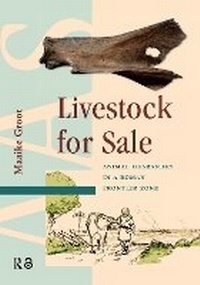
Livestock for Sale
Animal Husbandry in a Roman Frontier Zone
1st Edition
Will be published approx. on 1. December 2025
Book
Paperback/Softback
262 pages
978-1-041-18220-7 (ISBN)
Description
The civitas Batavorum was a settlement on the north-western frontier of the Roman Empire, and it is now the site of numerous archaeological excavations. This book offers the most up-to-date look yet at what has been discovered, using the newest archaeological techniques, about the town and its economy, its military importance, and the religious and domestic buildings it held. It will be essential reading for anyone studying the economy of the Roman provincial countryside or the details of food supply for the Roman army and town.
More details
Series
Language
English
Place of publication
London
United Kingdom
Publishing group
Taylor & Francis Ltd
Target group
Professional and scholarly
Academic
Dimensions
Height: 297 mm
Width: 210 mm
Weight
480 gr
ISBN-13
978-1-041-18220-7 (9781041182207)
Copyright in bibliographic data and cover images is held by Nielsen Book Services Limited or by the publishers or by their respective licensors: all rights reserved.
Schweitzer Classification
Other editions
Additional editions
E-Book
10/2025
Routledge
€0.00
Available for download
E-Book
10/2025
Routledge
€0.00
Available for download
Book
06/2016
Amsterdam University Press
€166.50
Shipment within 15-20 days
Person
Maaike Groot specialises in zooarchaeology and lectures at the Archaeological Centre of the VU University Amsterdam.
Content
FOREWORD 1 INTRODUCTION 1.1 Framework, scope and research questions 1.2 The Dutch River Area in the Roman period 1.3 Economic networks and food provisioning 1.4 Farming in a market economy 2 ARCHAEOLOGICAL SITES: BACKGROUND 2.1 Data and methods 2.2 Classification of sites 2.3 Site background 3 ZOOARCHAEOLOGICAL BACKGROUND 3.1 Species proportions 3.2 Age and sex 3.3 Skeletal elements 3.4 Butchery 3.5 Biometrical analysis 4 METHODS 4.1 Taphonomy 4.2 Species proportions 4.3 Mortality profiles 4.4 Skeletal elements 4.5 Butchery 4.6 Biometrical analysis 4.7 Archaeobotany 5 rRURAL SETTLEMENTS: ANIMAL HUSBANDRY AND CONSUMPTION 5.1 Farming in the Late Iron Age 5.2 Taphonomy 5.3 Species proportions 5.4 Exploitation of livestock 5.5 Skeletal element distribution 5.6 Butchery 5.7 Biometrical analysis 5.8 Arable farming 5.9 Discussion 6 CONSUMERS: URBAN, MILITARY AND TEMPLE SITES 6.1 Taphonomy 6.2 Military sites 6.3 Urban/military sites 6.4 Urban sites 6.5 Temples 6.6 Discussion 7 INTERACTION BETWEEN PRODUCERS AND CONSUMERS 7.1 Species proportions 7.2 Exploitation of livestock 7.3 Skeletal elements: leather and joints of meat 7.4 Butchery 7.5 Biometrics 7.6 Archaeobotany 7.7 Discussion 8 FINAL THOUGHTS 8.1 Food supply 8.2 Changes in farming 8.3 Scale of production 8.4 What did the Romans do for us? Exploitation versus opportunity BIBLIOGRAPHY INDEX