

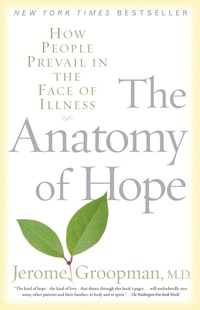
The Anatomy of Hope
How People Prevail in the Face of Illness
Published on 11. January 2005
Book
Paperback/Softback
272 pages
978-0-375-75775-4 (ISBN)
Description
Why do some people find and sustain hope during difficult circumstances, while others do not? What can we learn from those who do, and how is their example applicable to our own lives? The Anatomy of Hope is a journey of inspiring discovery, spanning some thirty years of Dr. Jerome Groopman's practice, during which he encountered many extraordinary people and sought to answer these questions.
This profound exploration begins when Groopman was a medical student, ignorant of the vital role of hope in patients' lives-and it culminates in his remarkable quest to delineate a biology of hope. With appreciation for the human elements and the science, Groopman explains how to distinguish true hope from false hope-and how to gain an honest understanding of the reach and limits of this essential emotion.
This profound exploration begins when Groopman was a medical student, ignorant of the vital role of hope in patients' lives-and it culminates in his remarkable quest to delineate a biology of hope. With appreciation for the human elements and the science, Groopman explains how to distinguish true hope from false hope-and how to gain an honest understanding of the reach and limits of this essential emotion.
More details
Language
English
Place of publication
New York
United States
Publishing group
Random House USA Inc
Product notice
Paperback (trade)
Dimensions
Height: 205 mm
Width: 133 mm
Thickness: 19 mm
Weight
222 gr
ISBN-13
978-0-375-75775-4 (9780375757754)
Copyright in bibliographic data and cover images is held by Nielsen Book Services Limited or by the publishers or by their respective licensors: all rights reserved.
Schweitzer Classification
Other editions
Additional editions
E-Book
12/2003
Random House
€14.99
Available for download
Person
Jerome Groopman, M.D., holds the Dina and Raphael Recanati Chair of Medicine at the Harvard Medical School and is the chief of experimental medicine at the Beth Israel Deaconess Medical Center in Boston. His research has focused on the basic mechanisms of blood disease, cancer, and AIDS. He is a staff writer in medicine and biology for The New Yorker and is the author of two popular books, The Measure of Our Days and Second Opinions, which were the inspiration for the television series Gideon’s Crossing. In 2000 he was elected to the Institute of Medicine of the National Academy of Sciences. He lives with his wife and three children in Brookline, Massachusetts.