

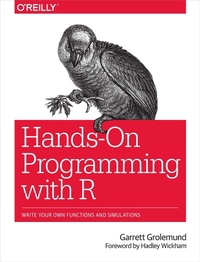
Hands-On Programming with R
Write Your Own Functions and Simulations
1st Edition
Published on 26. August 2014
Book
Paperback/Softback
247 pages
978-1-4493-5901-0 (ISBN)
Description
Learn how to program by diving into the R language, and then use your newfound skills to solve practical data science problems. With this book, you'll learn how to load data, assemble and disassemble data objects, navigate R's environment system, write your own functions, and use all of R's programming tools.
RStudio Master Instructor Garrett Grolemund not only teaches you how to program, but also shows you how to get more from R than just visualizing and modeling data. You'll gain valuable programming skills and support your work as a data scientist at the same time.
* Work hands-on with three practical data analysis projects based on casino games
* Store, retrieve, and change data values in your computer's memory
* Write programs and simulations that outperform those written by typical R users
* Use R programming tools such as if else statements, for loops, and S3 classes
* Learn how to write lightning-fast vectorized R code
* Take advantage of R's package system and debugging tools
* Practice and apply R programming concepts as you learn them
More details
Other editions
Additional editions
E-Book
06/2014
1st Edition
O'Reilly
€33.99
Available for download
E-Book
06/2014
1st Edition
O'Reilly
€27.99
Available for download
Person
Garrett Grolemund is a statistician, teacher and R developer who currently works for RStudio. He sees data analysis as a largely untapped fountain of value for both industry and science. Garrett received his Ph.D at Rice University in Hadley Wickham's lab, where his research traced the origins of data analysis as a cognitive process and identified how attentional and epistemological concerns guide every data analysis.