

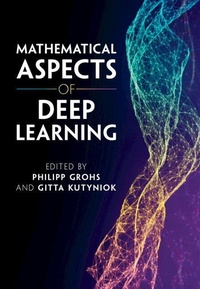
Mathematical Aspects of Deep Learning
Published on 22. December 2022
Book
Hardback
492 pages
978-1-316-51678-2 (ISBN)
Description
In recent years the development of new classification and regression algorithms based on deep learning has led to a revolution in the fields of artificial intelligence, machine learning, and data analysis. The development of a theoretical foundation to guarantee the success of these algorithms constitutes one of the most active and exciting research topics in applied mathematics. This book presents the current mathematical understanding of deep learning methods from the point of view of the leading experts in the field. It serves both as a starting point for researchers and graduate students in computer science, mathematics, and statistics trying to get into the field and as an invaluable reference for future research.
More details
Language
English
Place of publication
Cambridge
United Kingdom
Target group
College/higher education
Illustrations
Worked examples or Exercises
Dimensions
Height: 250 mm
Width: 175 mm
Thickness: 31 mm
Weight
1020 gr
ISBN-13
978-1-316-51678-2 (9781316516782)
Copyright in bibliographic data and cover images is held by Nielsen Book Services Limited or by the publishers or by their respective licensors: all rights reserved.
Schweitzer Classification
Other editions
Additional editions
Philipp Grohs | Gitta Kutyniok
Mathematical Aspects of Deep Learning
E-Book
12/2022
Cambridge University Press
€86.49
Available for download
Persons
Content
1. The modern mathematics of deep learning Julius Berner, Philipp Grohs, Gitta Kutyniok and Philipp Petersen; 2. Generalization in deep learning Kenji Kawaguchi, Leslie Pack Kaelbling, and Yoshua Bengio; 3. Expressivity of deep neural networks Ingo Guehring, Mones Raslan and Gitta Kutyniok; 4. Optimization landscape of neural networks Rene Vidal, Zhihui Zhu and Benjamin D. Haeffele; 5. Explaining the decisions of convolutional and recurrent neural networks Wojciech Samek, Leila Arras, Ahmed Osman, Gregoire Montavon and Klaus-Robert Mueller; 6. Stochastic feedforward neural networks: universal approximation Thomas Merkh and Guido Montufar; 7. Deep learning as sparsity enforcing algorithms A. Aberdam and J. Sulam; 8. The scattering transform Joan Bruna; 9. Deep generative models and inverse problems Alexandros G. Dimakis; 10. A dynamical systems and optimal control approach to deep learning Weinan E, Jiequn Han and Qianxiao Li; 11. Bridging many-body quantum physics and deep learning via tensor networks Yoav Levine, Or Sharir, Nadav Cohen and Amnon Shashua.