

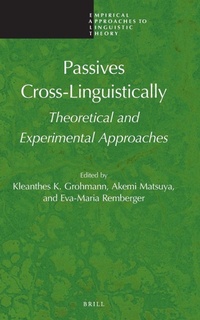
Passives Cross-Linguistically
Theoretical and Experimental Approaches
Published on 4. February 2021
Book
Hardback
454 pages
978-90-04-42823-2 (ISBN)
Description
The chapters collected in the volume Passives Cross-Linguistically provide analyses of passive constructions across different languages and populations from the interface perspectives between syntax, semantics, and pragmatics. The contributions are, in principle, all based on the background of generative grammatical theory. In addition to the theoretical contributions of the first part of this volume, all solidly built on rich empirical bases, some experimental works are presented, which explore passives from a psycholinguistic perspective based on theoretical insights. The languages/language families covered in the contributions include South Asian languages (Odia/Indo-Aryan and Telugu/Dravidian, but also Kharia/Austro-Asiatic), Japanese, Arabic, English, German, Modern Greek, and several modern Romance varieties (Catalan, Romanian, and especially southern Italian dialects) as well as Vedic Sanskrit and Ancient Greek.
More details
Series
Language
English
Place of publication
Leiden
Netherlands
Target group
Professional and scholarly
Product notice
sewn/stitched
Cloth over boards
Dimensions
Height: 234 mm
Width: 155 mm
Thickness: 25 mm
Weight
807 gr
ISBN-13
978-90-04-42823-2 (9789004428232)
Copyright in bibliographic data and cover images is held by Nielsen Book Services Limited or by the publishers or by their respective licensors: all rights reserved.
Schweitzer Classification
Persons
Kleanthes K. Grohmann, Ph.D. (2000), University of Maryland at College Park, is Professor of Biolinguistics at the University of Cyprus and the Director of the CAT Lab. He has published widely and is founding editor of the open-access journal Biolinguistics.
Akemi Matsuya, Ph.D. (2000), University of Maryland at College Park, is Professor of Linguistics at Takachiho University. She has publications in formal and applied linguistics and is one of the editors of Linguistic Journal.
Eva-Maria Remberger, Ph.D. (2003), Free University Berlin, is Professor of Romance Linguistics at the University of Vienna in Austria. Her research and publications concern grammar theoretical questions as they arise from Romance data in a comparative synchronic and diachronic view.
Akemi Matsuya, Ph.D. (2000), University of Maryland at College Park, is Professor of Linguistics at Takachiho University. She has publications in formal and applied linguistics and is one of the editors of Linguistic Journal.
Eva-Maria Remberger, Ph.D. (2003), Free University Berlin, is Professor of Romance Linguistics at the University of Vienna in Austria. Her research and publications concern grammar theoretical questions as they arise from Romance data in a comparative synchronic and diachronic view.
Content
Editorial Foreword
List of Figures and Tables
Notes on Contributors
Introduction
?Akemi Matsuya and Kleanthes K. Grohmann
1 Long-Distance Passives by Structure Removal
?Gereon Mueller
2 On Passive and Perfect Participles
?Peter Hallman
3 On Deontic Passives
?Eva-Maria Remberger
4 Indirect Object Want-Passives in Southern Italy
?Adam Ledgeway
5 Unexpected Passive Structures from Prepositional Verbs in Catalan
?Isabel Crespi
6 Two Types of Passive? Voice Morphology and "Low Passives" in Vedic Sanskrit and Ancient Greek
?Laura Grestenberger
7 Non-active Voices in South Asian Languages
?Pritha Chandra, Gurmeet Kaur and Anindita Sahoo
8 A More Articulated Approach to Causativity Alternation
?Mohamed Naji
9 Semantic and Pragmatic Implications of Passives
?Akemi Matsuya
10 The Source of Passive Sentence Difficulty: Task Effects and Predicate Semantics, Not Argument Order
?Caterina L. Paolazzi, Nino Grillo and Andrea Santi
11 Synthetic Passives in Early and Impaired Grammar: The View from Greek Reflexive Verbs
?Arhonto Terzi
12 The Mirage of "Impaired Passives" and the Locus Preservation Hypothesis
?Kleanthes K. Grohmann, Maria Kambanaros and Evelina Leivada
Index
List of Figures and Tables
Notes on Contributors
Introduction
?Akemi Matsuya and Kleanthes K. Grohmann
1 Long-Distance Passives by Structure Removal
?Gereon Mueller
2 On Passive and Perfect Participles
?Peter Hallman
3 On Deontic Passives
?Eva-Maria Remberger
4 Indirect Object Want-Passives in Southern Italy
?Adam Ledgeway
5 Unexpected Passive Structures from Prepositional Verbs in Catalan
?Isabel Crespi
6 Two Types of Passive? Voice Morphology and "Low Passives" in Vedic Sanskrit and Ancient Greek
?Laura Grestenberger
7 Non-active Voices in South Asian Languages
?Pritha Chandra, Gurmeet Kaur and Anindita Sahoo
8 A More Articulated Approach to Causativity Alternation
?Mohamed Naji
9 Semantic and Pragmatic Implications of Passives
?Akemi Matsuya
10 The Source of Passive Sentence Difficulty: Task Effects and Predicate Semantics, Not Argument Order
?Caterina L. Paolazzi, Nino Grillo and Andrea Santi
11 Synthetic Passives in Early and Impaired Grammar: The View from Greek Reflexive Verbs
?Arhonto Terzi
12 The Mirage of "Impaired Passives" and the Locus Preservation Hypothesis
?Kleanthes K. Grohmann, Maria Kambanaros and Evelina Leivada
Index