

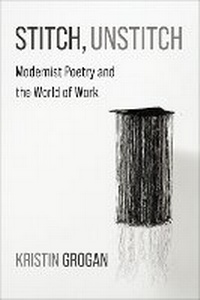
Stitch, Unstitch
Modernist Poetry and the World of Work
Published on 26. August 2025
Book
Hardback
304 pages
978-0-231-21963-1 (ISBN)
Description
The labor of literature is often thought of as a specialized craft, distinct from everyday work. In Stitch, Unstitch, Kristin Grogan traces an alternative vision of writing and the writer, arguing that modernist poetry was deeply shaped by ordinary labor and the people who performed it. This relationship provoked powerful political and aesthetic experiments-and allowed modernist poets to imagine ways of life beyond the demand to earn a living.
Poetic form, Grogan shows, offers ways to reflect on the meaning and worth of labor, particularly types of gendered labor that are typically unseen and undervalued. Her fine-grained readings locate modernist poetry within sites of social reproduction, factory work, craft labor, and other forms of manual labor, placing literary texts alongside objects such as constructivist posters and set design, household notes, and homemade books. Grogan considers Ezra Pound's ideology of craft and artisanal labor; Lola Ridge's immersion in the New York garment industry; Langston Hughes's encounter with Soviet workers' theater; Gertrude Stein's gendered and queer domestic labors; and Lorine Niedecker's employment as a hospital cleaner. Blending Marxist and feminist theory with attentive close readings, Stitch, Unstitch is a revelatory materialist account of the values of poetry.
Poetic form, Grogan shows, offers ways to reflect on the meaning and worth of labor, particularly types of gendered labor that are typically unseen and undervalued. Her fine-grained readings locate modernist poetry within sites of social reproduction, factory work, craft labor, and other forms of manual labor, placing literary texts alongside objects such as constructivist posters and set design, household notes, and homemade books. Grogan considers Ezra Pound's ideology of craft and artisanal labor; Lola Ridge's immersion in the New York garment industry; Langston Hughes's encounter with Soviet workers' theater; Gertrude Stein's gendered and queer domestic labors; and Lorine Niedecker's employment as a hospital cleaner. Blending Marxist and feminist theory with attentive close readings, Stitch, Unstitch is a revelatory materialist account of the values of poetry.
Reviews / Votes
How is writing poetry like labor? Kristin Grogan's Stitch, Unstitch looks at this enduring question with fresh eyes. Focusing on literary modernism and its long afterlife, she demonstrates how a wide range of twentieth-century poets devised nimble poetic strategies for understanding the conditions of work that avoided blind celebrations of technology and uncritical nostalgia for imagined pasts. Stitch, Unstitch is a truly clarifying study of an ancient analogy. -- Christopher Nealon, author of <i>Infinity for Marxists: Essays on Poetry and Capital</i> Through brilliant, expansive readings and careful archival analysis, Stitch, Unstitch illuminates the ways modernist texts investigate the varied sites and meanings of labor, including the work of poetry itself. Placing new interpretive focus on elements of social reproduction and unwaged work as central to modernist aesthetic and political horizons, Grogan offers an indispensable account of modernist poetry's continuing potential for imagining life within and beyond waged work. -- Margaret Ronda, author of <i>Remainders: American Poetry at Nature's End</i> Stitch, Unstitch brings into focus forms of value obscured by capitalism's imperative to work for a living. Through beautiful readings and ingenious arguments, Grogan uncovers a new history of modernist poetry's engagements with the everyday life of labor to offer glimpses of a world beyond the lockstep demands of work. -- Brian Glavey, author of <i>The Wallflower Avant-Garde: Modernism, Sexuality, and Queer Ekphrasis</i> With unstinting research and careful attention, Grogan details modernist poetry's self-conscious takes on labor, from Ezra Pound's dangerously abstracted conceptions of poetry as craft to Lorine Niedecker's revaluation of women's work as apparently 'unproductive' labor, not unlike the writing of poetry. Offering us rewarding new lenses for reading canonical figures like Langston Hughes and Gertrude Stein while also pulling the understudied Lola Ridge into focus, this book recasts the work of poetry and the poetry of work. -- Evie Shockley, Zora Neale Hurston Distinguished Professor of English, Rutgers UniversityMore details
Series
Language
English
Place of publication
New York
United States
Target group
College/higher education
Product notice
Trade binding
Illustrations
12 black-and-white photographs
Dimensions
Height: 229 mm
Width: 152 mm
ISBN-13
978-0-231-21963-1 (9780231219631)
Copyright in bibliographic data and cover images is held by Nielsen Book Services Limited or by the publishers or by their respective licensors: all rights reserved.
Schweitzer Classification
Other editions
Additional editions
E-Book
08/2025
1st Edition
Columbia University Press
€34.99
Available for download
Person
Kristin Grogan is an assistant professor of English at Rutgers University.
Content
List of Figures
Acknowledgments
Introduction
1. Ezra Pound's Work Ethic
2. The Social Life of Sewing: Lola Ridge
3. Langston Hughes's Constructivist Poetics
4. Reproducing Gertrude Stein
5. Lorine Niedecker and the Work of Restraint
Coda: Drafting Modernism
Notes
Bibliography
Index
Acknowledgments
Introduction
1. Ezra Pound's Work Ethic
2. The Social Life of Sewing: Lola Ridge
3. Langston Hughes's Constructivist Poetics
4. Reproducing Gertrude Stein
5. Lorine Niedecker and the Work of Restraint
Coda: Drafting Modernism
Notes
Bibliography
Index