

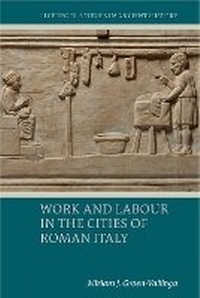
Work and Labour in the Cities of Roman Italy
Published on 1. November 2024
Book
Paperback/Softback
368 pages
978-1-83553-848-7 (ISBN)
Description
Work and labour are fundamental to an understanding of Roman society. In a world where reliable information was scarce and economic insecurity loomed large, social structures and networks of trust were of paramount importance to the way work was provided and filled in. Taking its cue from New Institutional Economics, this book deals with the wide range of factors shaping work and labour in the cities of Roman Italy under the early empire, from families and familial structures, to labour collectives, slavery, education and apprenticeship.
To illuminate the complexity of the market for labour, this monograph offers a new analysis of the occupational inscriptions and reliefs from Roman Italy, placing them in the wider context by means of documentary evidence like apprenticeship contracts, legal sources, and material remains. This synthesis therefore provides a comprehensive analysis of the ancient sources on work and labour in Roman urban society, leading to a novel interpretation of the market for work, and a fuller understanding of the daily lives of nonelite Romans. For some of them, work was indeed a source of pride, whereas for others it was merely a means to an end or a necessity of life.
To illuminate the complexity of the market for labour, this monograph offers a new analysis of the occupational inscriptions and reliefs from Roman Italy, placing them in the wider context by means of documentary evidence like apprenticeship contracts, legal sources, and material remains. This synthesis therefore provides a comprehensive analysis of the ancient sources on work and labour in Roman urban society, leading to a novel interpretation of the market for work, and a fuller understanding of the daily lives of nonelite Romans. For some of them, work was indeed a source of pride, whereas for others it was merely a means to an end or a necessity of life.
Reviews / Votes
'With the traditional bias in our sources towards urban, free, skilled male workers, this book brings to the fore those individuals traditionally excluded from accounts of ancient work, such as women and children, whether free or enslaved, alongside male unskilled workers to reveal how the ever-changing market forces led to varied economic strategies among individuals, families, and labor collectives.' Lauren Hackworth Petersen, Bryn Mawr Classical Review 'The book's approach reflects a welcome attempt to use Roman evidence to think about questions that global historians of labor are also contemplating. The result is a valuable study that illuminates Roman work with a currency that also offers utility to those thinking about other premodern societies. Roman historians and especially historians of labor in other periods would do well to take notice' Seth Bernard, American Historical ReviewMore details
Series
Language
English
Place of publication
Liverpool
United Kingdom
Target group
Professional and scholarly
Illustrations
1 Illustrations, black and white
Dimensions
Height: 234 mm
Width: 156 mm
ISBN-13
978-1-83553-848-7 (9781835538487)
Copyright in bibliographic data and cover images is held by Nielsen Book Services Limited or by the publishers or by their respective licensors: all rights reserved.
Schweitzer Classification
Person
Miriam J. Groen-Vallinga is Associate Professor in Ancient History, Department of History, Art History and Classics, Radboud University Nijmegen.
Content
Introduction: Aims, Methods and Sources
Labour and Labour Market Theories
Family Economics: Non-elite Households
Family Economics: The Elite Domus
Non-familial Labour Collectives: The Economics of Association
Conclusion: Social Structures and Urban Labour in Roman Italy
Appendices
Appendix 1: Catalogue of Job Titles
Appendix 2: Apprenticeship Contracts
Appendix 3: Taxonomy of Labour Relations
Labour and Labour Market Theories
Family Economics: Non-elite Households
Family Economics: The Elite Domus
Non-familial Labour Collectives: The Economics of Association
Conclusion: Social Structures and Urban Labour in Roman Italy
Appendices
Appendix 1: Catalogue of Job Titles
Appendix 2: Apprenticeship Contracts
Appendix 3: Taxonomy of Labour Relations