

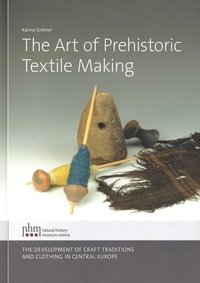
The Art of Prehistoric Textile Making
The Development of craft traditions and clothing in Central Europe
1st Edition
Published in February 2016
Book
Hardback
533 pages
978-3-902421-94-4 (ISBN)
Description
Traditional textile crafts such as spinning, weaving, and sewing have accompanied humanity since the Stone Age. Until a few hundred years ago, textile crafts occupied a huge portion of the daily workload in addition to the acquisition of food.
Textile crafts, and weaving in particular, have contributed much to the overall evelopment of technology. Looms were invented in the Neolithic and represent the first 'machines' of human history. Essential goods for daily use, especially clothing, as well as utilitarian textiles, ostentatious objects for display and luxury items were produced with this craft.
Textiles were valuable, as can be inferred from the recycling of fabrics. Worn out garments were used as binders, packaging and even as a dressing material in prehistoric times. Clothing, however, not only offered protection against the elements - even in prehistoric times textiles and jewellery were more than just simply means to dress - they are an essential feature of every culture. In the past as well as today, clothing represents an important non-verbal means of communication and conveys aspects of identity about the wearer such as age, gender, social status and group memberships.
This book is dedicated to historians, costume designers, archaeologists, and anyone interested in handcraft and artisanship. The temporal and geographical scope of this investigation is the Neolithic to Late Iron Age of Central Europe, which is the period before the introduction of writing. The book ends with the Roman occupation in Central Europe.
Austrian finds and sites as well as those of neighbouring countries are the primary focus.
Textile crafts, and weaving in particular, have contributed much to the overall evelopment of technology. Looms were invented in the Neolithic and represent the first 'machines' of human history. Essential goods for daily use, especially clothing, as well as utilitarian textiles, ostentatious objects for display and luxury items were produced with this craft.
Textiles were valuable, as can be inferred from the recycling of fabrics. Worn out garments were used as binders, packaging and even as a dressing material in prehistoric times. Clothing, however, not only offered protection against the elements - even in prehistoric times textiles and jewellery were more than just simply means to dress - they are an essential feature of every culture. In the past as well as today, clothing represents an important non-verbal means of communication and conveys aspects of identity about the wearer such as age, gender, social status and group memberships.
This book is dedicated to historians, costume designers, archaeologists, and anyone interested in handcraft and artisanship. The temporal and geographical scope of this investigation is the Neolithic to Late Iron Age of Central Europe, which is the period before the introduction of writing. The book ends with the Roman occupation in Central Europe.
Austrian finds and sites as well as those of neighbouring countries are the primary focus.
More details
Series
Language
English
Place of publication
Wien
Austria
Target group
Professional and scholarly
Edition type
New edition
Product notice
Paper over boards
Unsewn / adhesive bound
sewn/stitched
Dimensions
Height: 27 cm
Width: 12 cm
Weight
2040 gr
ISBN-13
978-3-902421-94-4 (9783902421944)
Schweitzer Classification