

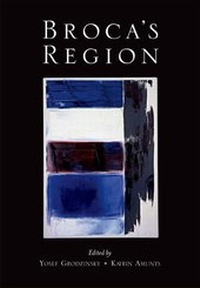
Broca's Region
Published on 25. May 2006
Book
Hardback
440 pages
978-0-19-517764-0 (ISBN)
Description
Broca's region has been in the news ever since scientists realized that particular cognitive functions could be localized to parts of the cerebral cortex. Its discoverer, Paul Broca, was one of the first researchers to argue for a direct connection between a concrete behavior--in this case, the use of language--and a specific cortical region. Today, Broca's region is perhaps the most famous part of the human brain, and for over a century, has persisted as the focus of intense research and numerous debates. The name has even penetrated mainstream culture through popular science and the theater. Broca's region is famous for a good reason: As language is one of the most distinctive human traits, the cognitive mechanisms that support it and the tissues in which these mechanisms are housed are also quite complex, and so have the potential to reveal a lot not only about how words, phrases, sentences, and grammatical rules are instantiated in neural tissue, but also, and more broadly, about how brain function relates to behavior. Paul Broca's discoveries were an important, driving force behind the more general effort to relate complex behavior to particular parts of the cerebral cortex, which, significantly, produced the first brain maps.
These early studies also, however, suffered from the use of crude techniques, definitions, and distinctions, as well as from ill founded and misdirected assumptions. Although much has been discovered since Broca's work, even today, these problems have not been completely solved. Nonetheless, particularly as a result of important advances made in neuroimaging during the past two decades, Broca's region and all language areas are currently being investigated from every angle. Indeed, as the volume of research into the relations between brain and language has created several communities, each with its own concepts, methods, and considerations, it seemed that it was time to stop, get together, and reflect on the state of the art.
This book is the result of that collective reflection, which took place primarily at the Broca's Region Workshop, held in Juelich and Aachen, Germany, in June 2004. In it, Yosef Grodzinsky and Katrin Amunts tried to accomplish a nearly impossible task: to mix intellectual traditions and cultures, and juxtapose rather disparate bodies of knowledge, styles of reasoning, and forms of argumentation. Participants were scientists with diverse backgrounds; each invited to contribute his/her particular take, with the hope that a coherent, perhaps even novel, picture would emerge. All of the participants have a special interest in Broca's Region, and represent the myriad angles from which we currently approach it: neuroanatomy, physiology, evolutionary biology, cognitive psychology, clinical neurology, functional imaging, speech and language research, computational biology, and psycho-, neuro-, and theoretical linguistics. The book's main chapters are the contributions of the Workshop's participants and their research teams. Parts of the discussion during the Workshop are included to underscore the richness of viewpoints, and to give readers an idea of the level of interaction that took place.
As Broca's region is such an historically significant concept and rich area, this book contains a collection of classic and recent-yet-classic papers. Along with cutting-edge science, Grodzinsky and Amunts want to remind readers of the celebrated past from which much can be learned. The historical chapters include the first two papers written by Paul Broca, as well some work by two of the most important neurologists of the nineteenth century, Ludwig Lichtheim and John Hughlings-Jackson. Also included are parts of twentieth century papers by Korbinian Brodmann, Roman Jakobson, Norman Geschwind, Harold Goodglass, and Jay Mohr. Because this book both reflects the state of the art in Broca's-region research and contains a tribute to its celebrated past, it will be a valuable resource for student and professional researchers. It will also stimulate further interdisciplinary research, which is a significant contribution, as the project called "Broca's region," encompassing the study of brain/language relations, is far from finished.
These early studies also, however, suffered from the use of crude techniques, definitions, and distinctions, as well as from ill founded and misdirected assumptions. Although much has been discovered since Broca's work, even today, these problems have not been completely solved. Nonetheless, particularly as a result of important advances made in neuroimaging during the past two decades, Broca's region and all language areas are currently being investigated from every angle. Indeed, as the volume of research into the relations between brain and language has created several communities, each with its own concepts, methods, and considerations, it seemed that it was time to stop, get together, and reflect on the state of the art.
This book is the result of that collective reflection, which took place primarily at the Broca's Region Workshop, held in Juelich and Aachen, Germany, in June 2004. In it, Yosef Grodzinsky and Katrin Amunts tried to accomplish a nearly impossible task: to mix intellectual traditions and cultures, and juxtapose rather disparate bodies of knowledge, styles of reasoning, and forms of argumentation. Participants were scientists with diverse backgrounds; each invited to contribute his/her particular take, with the hope that a coherent, perhaps even novel, picture would emerge. All of the participants have a special interest in Broca's Region, and represent the myriad angles from which we currently approach it: neuroanatomy, physiology, evolutionary biology, cognitive psychology, clinical neurology, functional imaging, speech and language research, computational biology, and psycho-, neuro-, and theoretical linguistics. The book's main chapters are the contributions of the Workshop's participants and their research teams. Parts of the discussion during the Workshop are included to underscore the richness of viewpoints, and to give readers an idea of the level of interaction that took place.
As Broca's region is such an historically significant concept and rich area, this book contains a collection of classic and recent-yet-classic papers. Along with cutting-edge science, Grodzinsky and Amunts want to remind readers of the celebrated past from which much can be learned. The historical chapters include the first two papers written by Paul Broca, as well some work by two of the most important neurologists of the nineteenth century, Ludwig Lichtheim and John Hughlings-Jackson. Also included are parts of twentieth century papers by Korbinian Brodmann, Roman Jakobson, Norman Geschwind, Harold Goodglass, and Jay Mohr. Because this book both reflects the state of the art in Broca's-region research and contains a tribute to its celebrated past, it will be a valuable resource for student and professional researchers. It will also stimulate further interdisciplinary research, which is a significant contribution, as the project called "Broca's region," encompassing the study of brain/language relations, is far from finished.
Reviews / Votes
"Every chapter has something of interest and value, and some are notable."--PsycCRITIQUES"Every chapter has something of interest and value, and some are notable."--PsycCRITIQUES
More details
Language
English
Place of publication
New York
United States
Target group
Professional and scholarly
Researchers and students in psychology, neurology, anatomy and linguistics
Illustrations
70 line illustrations and 31 black & white photographs
Dimensions
Height: 183 mm
Width: 254 mm
Thickness: 28 mm
Weight
1001 gr
ISBN-13
978-0-19-517764-0 (9780195177640)
Copyright in bibliographic data and cover images is held by Nielsen Book Services Limited or by the publishers or by their respective licensors: all rights reserved.
Schweitzer Classification
Other editions
Additional editions
GRODZINSKY YOSEF
Broca's Region
E-Book
05/2006
1st Edition
Oxford University Press
€115.59
Available for download
Yosef Grodzinsky | Katrin Amunts
Broca's Region
E-Book
04/2006
1st Edition
OUP eBook
€76.49
Available for download
Persons
Yosef Grodzinsky is Professor of Linguistics and Canada Research Chair in Neurolinguistics at McGill University, and Associate Member of the Department of Neurology/Neurosurgery. He is also Adjunct Professor of Neurology at Boston University School of Medicine. Grodzinsky is interested in the neurological instantiation of formal syntactic and semantic knowledge, which he has been studying both in health and in disease.
Katrin Amunts is Professor of Structural-Functional Brain Mapping at Aachen University and the Institute of Medicine at the Research Center Juelich. She completed her postdoctoral work and was a lecturer in anatomy at the C. and O. Vogt Institute for Brain Research of the Heinrich Heine University Duesseldorf. In 1999, she moved to Juelich and set up a new research unit for brain mapping. Her current research project is to create, along with Karl Zilles, the first
probabilistic, cytoarchitectonic atlas of the human brain. Amunts is particularly interested in the neuroanatomy underlying language processing.
Katrin Amunts is Professor of Structural-Functional Brain Mapping at Aachen University and the Institute of Medicine at the Research Center Juelich. She completed her postdoctoral work and was a lecturer in anatomy at the C. and O. Vogt Institute for Brain Research of the Heinrich Heine University Duesseldorf. In 1999, she moved to Juelich and set up a new research unit for brain mapping. Her current research project is to create, along with Karl Zilles, the first
probabilistic, cytoarchitectonic atlas of the human brain. Amunts is particularly interested in the neuroanatomy underlying language processing.
Author
Professor of LinguisticsProfessor of Linguistics, McGill University, Canada
Professor of Structural-Functional Brain Mapping at Aachen University and the Institute of Medicine at the Research Center JulichProfessor of Structural-Functional Brain Mapping at Aachen University and the Institute of Medicine at the Research Center Julich, Germany
Content
PART 1: MATTERS ANATOMICAL; PART 2: MATTERS LINGUISTIC; PART 3: MOTOR ASPECTS AND SIGN LANGUAGE; PART 4: PSYCHOLINGUISTIC INVESTIGATION; PART 5: HISTORICAL ARTICLES, INTRODUCTION