

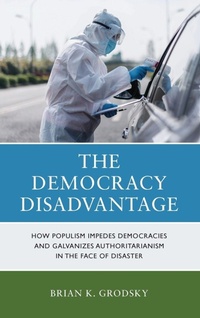
The Democracy Disadvantage
How Populism Impedes Democracies and Galvanizes Authoritarianism in the Face of Disaster
Published on 1. February 2024
Book
Hardback
302 pages
978-1-5381-9210-8 (ISBN)
Description
Populists are conventionally maligned as impediments to effective policymaking. They tend to undermine state institutions, exercise personalistic rule, and offer simplistic solutions to complex societal problems. But is populism always a hindrance to good governance? In this book, Brian Grodsky argues that the interplay between populism and regime type can upend expected levels of political responsiveness based on regime considerations alone. The result can be a reversal of the so-called "democratic advantage," according to which public accountability in democratic regimes drives action beyond what is typically expected under authoritarianism. Grodsky explores the government policy response to the COVID-19 pandemic in three populist states: the United States (a democracy); China (a non-democracy); and Russia (a hybrid regime). This insightful, exploratory analysis is essential reading for students and scholars of comparative politics, populism, and disaster management.
Reviews / Votes
Citizens of the world are increasingly exposed to a range of disasters. What type of institutional arrangements and governing styles are best suited to address them? In The Democracy Disadvantage, Brian K. Grodsky challenges the conventional thinking that democracies can better mitigate the human toll of disasters and that populists are doomed to fail in this regard. Rather, Grodsky combines these two dimensions into a compelling proposition: populists undercut the presumed advantage of democratic institutions but overcome authoritarian regimes' putative deficiencies. Undergirding this argument is a theory of power and time. Disasters encourage populists in democracies to pursue quick, but sup-optimal, fixes because they lack both the power and the time to get it right. Yet for autocrats with power and time on their side, disasters provide a jolt that spurs public policies to benefit a broad swath of the citizenry. In-depth case studies of the incumbent leaders in the United States, China, and Russia during the COVID-19 pandemic probe the plausibility of these claims. The result is a significant contribution to our understanding of the politics of disasters. The Democracy Disadvantage gives theoreticians and students alike much to consider. -- Ryan E. Carlin, Georgia State UniversityMore details
Language
English
Place of publication
United States
Publishing group
Bloomsbury Publishing Plc
Target group
Professional and scholarly
Dimensions
Height: 235 mm
Width: 157 mm
Thickness: 22 mm
Weight
644 gr
ISBN-13
978-1-5381-9210-8 (9781538192108)
Copyright in bibliographic data and cover images is held by Nielsen Book Services Limited or by the publishers or by their respective licensors: all rights reserved.
Schweitzer Classification
Other editions
Additional editions
Brian K. Grodsky
The Democracy Disadvantage
How Populism Impedes Democracies and Galvanizes Authoritarianism in the Face of Disaster
E-Book
02/2024
1st Edition
Rowman & Littlefield Publishers
€33.99
Available for download
Brian K. Grodsky
The Democracy Disadvantage
How Populism Impedes Democracies and Galvanizes Authoritarianism in the Face of Disaster
E-Book
02/2024
1st Edition
Rowman & Littlefield
€33.99
Available for download
Person
Brian K. Grodsky is a former U.S. diplomat and reporter, and current professor of comparative and international politics at University of Maryland, Baltimore County. He is also a practitioner in the disaster sphere, having worked for more than two decades on local and national fire, rescue, and emergency medical teams. His three most recent books, The Democratization Disconnect, Social Movements and the New State, and The Costs of Justice, all explore challenges in democratizing states.
Content
Preface
Acknowledgements
Chapter 1: Power, Populism, and Policy in the Face of Danger
Chapter 2: The Perils and Promises of Populism
Chapter 3: Populist Face COVID-19: The First Year of the Pandemic in China, Russia, and the United States
Chapter 4: The Advantages of Populist Authoritarianism? China's COVID Fight
Chapter 5: Populists Stuck in the Middle: How Russia Struggled to Control COVID
Chapter 6: The United States: The Abyss of Democratic Populism
Chapter 7: Beyond the Cases: Populism, COVID, and the Broader World
Bibliography
About the Author
Acknowledgements
Chapter 1: Power, Populism, and Policy in the Face of Danger
Chapter 2: The Perils and Promises of Populism
Chapter 3: Populist Face COVID-19: The First Year of the Pandemic in China, Russia, and the United States
Chapter 4: The Advantages of Populist Authoritarianism? China's COVID Fight
Chapter 5: Populists Stuck in the Middle: How Russia Struggled to Control COVID
Chapter 6: The United States: The Abyss of Democratic Populism
Chapter 7: Beyond the Cases: Populism, COVID, and the Broader World
Bibliography
About the Author