

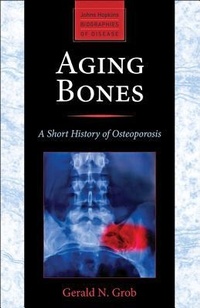
Aging Bones
A Short History of Osteoporosis
Published on 10. June 2014
Book
Paperback/Softback
304 pages
978-1-4214-1318-1 (ISBN)
Description
In the middle of the twentieth century, few physicians could have predicted that the modern diagnostic category of osteoporosis would emerge to include millions of Americans, predominantly older women. Before World War II, popular attitudes held that the declining physical and mental health of older persons was neither preventable nor reversible and that older people had little to contribute. Moreover, the physiological processes that influenced the health of bones remained mysterious. In Aging Bones, Gerald N. Grob makes a historical inquiry into how this one aspect of aging came to be considered a disease. During the 1950s and 1960s, as more and more people lived to the age of 65, older people emerged as a self-conscious group with distinct interests, and they rejected the pejorative concept of senescence. But they had pressing health needs, and preventing age-related decline became a focus for researchers and clinicians alike.
In analyzing how the normal aging of bones was transformed into a medical diagnosis requiring treatment, historian of medicine Grob explores developments in medical science as well as the social, intellectual, economic, demographic, and political changes that transformed American society in the post-World War II decades. Though seemingly straightforward, osteoporosis and its treatment are shaped by illusions about the conquest of disease and aging. These illusions, in turn, are instrumental in shaping our health care system. While bone density tests and osteoporosis treatments are now routinely prescribed, aggressive pharmaceutical intervention has produced results that are inconclusive at best. The fascinating history in Aging Bones will appeal to students and scholars in the history of medicine, health policy, gerontology, endocrinology, and orthopedics, as well as anyone who has been diagnosed with osteoporosis.
In analyzing how the normal aging of bones was transformed into a medical diagnosis requiring treatment, historian of medicine Grob explores developments in medical science as well as the social, intellectual, economic, demographic, and political changes that transformed American society in the post-World War II decades. Though seemingly straightforward, osteoporosis and its treatment are shaped by illusions about the conquest of disease and aging. These illusions, in turn, are instrumental in shaping our health care system. While bone density tests and osteoporosis treatments are now routinely prescribed, aggressive pharmaceutical intervention has produced results that are inconclusive at best. The fascinating history in Aging Bones will appeal to students and scholars in the history of medicine, health policy, gerontology, endocrinology, and orthopedics, as well as anyone who has been diagnosed with osteoporosis.
Reviews / Votes
A well-written and compelling book that should convince academic, student, lay and professional audiences alike that immersion in the history of a disease is indispensable to treating it. Social History of Medicine [ Aging Bones] illustrate[s] the disparate yet powerful components of chronic disease for understanding medical practices and policies in the twentieth and twenty-first centuries. Journal of the History of Medicine and Allied Sciences Grob's account is well written, clear and comprehensive in scope...should prove useful to any historian of medicine and will be especially valuable to historians interested in gerontology and women's health. IsisMore details
Series
Language
English
Place of publication
Baltimore, MD
United States
Target group
Professional and scholarly
Product notice
Paperback (trade)
Dimensions
Height: 220 mm
Width: 140 mm
Thickness: 19 mm
Weight
367 gr
ISBN-13
978-1-4214-1318-1 (9781421413181)
DOI
10.1353/book.28757
Copyright in bibliographic data and cover images is held by Nielsen Book Services Limited or by the publishers or by their respective licensors: all rights reserved.
Schweitzer Classification
Other editions
Additional editions
E-Book
06/2014
Johns Hopkins University Press
€18.99
Available for download
Person
Gerald N. Grob is the Henry E. Sigerist Professor of the History of Medicine Emeritus at Rutgers University and a senior research associate in psychiatry at Weill Cornell Medical College. He is the author of eleven books, including The Deadly Truth: A History of Disease in America.
Content
Foreword, by Charles E. Rosenberg
Preface
List of Abbreviations
1. History and Demography
2. The Origins of a Diagnosis
3. The Transformation of Osteoporosis
4. Popularizing a Diagnosis
5. Internationalizing Osteoporosis
6. Therapeutic Expansion
7. Osteoporosis Triumphant?
Notes
Index
Preface
List of Abbreviations
1. History and Demography
2. The Origins of a Diagnosis
3. The Transformation of Osteoporosis
4. Popularizing a Diagnosis
5. Internationalizing Osteoporosis
6. Therapeutic Expansion
7. Osteoporosis Triumphant?
Notes
Index