

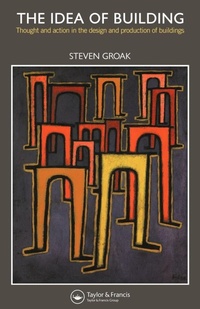
The Idea of Building
Thought and Action in the Design and Production of Buildings
1st Edition
Published on 2. July 1992
Book
Paperback/Softback
268 pages
978-0-419-17830-9 (ISBN)
Description
This book is unique in its attempt to explore the many ways we have of thinking about buildings. In particular it raises questions about the kinds of knowledge we have and will need in designing, making and enjoying our buildings. At the very least this book provides an overview of the fragmented construction industry, making it a vital purchase for all construction related students. However, the author has written for a wider audience making the book an essential guide for those interested in the form of buildings or the deliberate ways in which people build them.
Reviews / Votes
'One of the few genuinely thoughtful books about the intellectual and physical actions involved in building.' - Architecture Today'This book is like a good gale with a turbulence of whirlwinds to give fresh ideas on the whole process of building. It is stimulating and throught provoking...and should be read by all in the industry. - Chartered Builder
More details
Language
English
Place of publication
London
United Kingdom
Publishing group
Taylor & Francis Ltd
Target group
College/higher education
Dimensions
Height: 216 mm
Width: 140 mm
Thickness: 15 mm
Weight
342 gr
ISBN-13
978-0-419-17830-9 (9780419178309)
Copyright in bibliographic data and cover images is held by Nielsen Book Services Limited or by the publishers or by their respective licensors: all rights reserved.
Schweitzer Classification
Other editions
Additional editions
Book
02/2016
1st Edition
CRC Press
€253.40
Shipment within 10-20 days
E-Book
09/2002
1st Edition
Taylor & Francis
€78.99
Available for download
E-Book
09/2002
1st Edition
Taylor & Francis
€78.99
Available for download
Person
Steven Groak
Content
Preface. Foreword. Preliminaries. Book one: the flight from equilibrium. Buildings as unstable systems in dynamic environments. Flows of matter and energy. Uncertainty in the industrial environment. The decline of technical precedent. The social demand for buildings. Interlude. Some polemical remarks. Book two: building knowledge and building experience. Historical concepts of building science. The analysis of sensations. The analysis of energy. Building engineering. Building pathology and its lessons. Intelligent buildings and intelligent sites. The building process. Systems and conventions. What industry follows function? Representation and regularity. Technology transfer. Who is the builder? The idea of technology, and its critics. Book three: another critical position. The typical detail. Building details in structure and form. The buildings of Alvar Aalto. In conclusion. Index.