

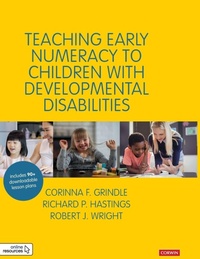
Teaching Early Numeracy to Children with Developmental Disabilities
1st Edition
Published on 16. November 2020
Book
Hardback
176 pages
978-1-5264-8754-4 (ISBN)
Description
This practical guide for teaching numeracy to children with a developmental disability is based on core concepts from the landmark Mathematics Recovery (R) text Teaching Number (aka 'the green book') that have been adapted for children with developmental disabilities.
It sets out key principles of teaching and learning underpinning an evidence-based teaching approach and provides clear guidance on how educators can plan and implement a structured teaching program so that every child can be given a positive experience in learning numeracy and achieve significant outcomes, maximizing their potential.
The book is supported by a comprehensive set of online resources for use in the classroom, including 90+ lesson plans carefully tailored to provide sequenced learning experiences for children and school students who may need them most...
It sets out key principles of teaching and learning underpinning an evidence-based teaching approach and provides clear guidance on how educators can plan and implement a structured teaching program so that every child can be given a positive experience in learning numeracy and achieve significant outcomes, maximizing their potential.
The book is supported by a comprehensive set of online resources for use in the classroom, including 90+ lesson plans carefully tailored to provide sequenced learning experiences for children and school students who may need them most...
Reviews / Votes
This very useful book adapts the Maths Recovery Programme to suit the learning needs of students with a developmental disability. It provides an extensive and detailed approach to assessment, learning and teaching that embodies evidence-based best practice. -- Charlotte Madine This much needed book is an essential read not only for educators but for educational leaders everywhere. The plea to maintain high aspirations when teaching numeracy to children with developmental disabilities resonates throughout each chapter as the authors skilfully challenge misconceptions and offer practical solutions. This book is a vital tool in maximising the numeracy potential of all children and I wish somebody had given this to me when I became a maths teacher more than 15 years ago. -- Professor Adam BoddisonMore details
Series
Language
English
Place of publication
London
United Kingdom
Publishing group
SAGE Publications Ltd
Target group
Professional and scholarly
Dimensions
Height: 241 mm
Width: 196 mm
Thickness: 14 mm
Weight
534 gr
ISBN-13
978-1-5264-8754-4 (9781526487544)
Copyright in bibliographic data and cover images is held by Nielsen Book Services Limited or by the publishers or by their respective licensors: all rights reserved.
Schweitzer Classification
Other editions
Additional editions
Corinna Grindle | Richard Hastings | Robert J. Wright
Teaching Early Numeracy to Children with Developmental Disabilities
Book
11/2020
1st Edition
Corwin UK
€81.90
Shipment within 15-20 days
Corinna Grindle | Richard Hastings | Robert J. Wright
Teaching Early Numeracy to Children with Developmental Disabilities
E-Book
10/2020
1st Edition
Corwin UK
€59.99
Available for download
Corinna Grindle | Richard Hastings | Robert J. Wright
Teaching Early Numeracy to Children with Developmental Disabilities
E-Book
10/2020
1st Edition
Corwin UK
€59.99
Available for download
Corinna Grindle | Richard Hastings | Robert J. Wright
Teaching Early Numeracy to Children with Developmental Disabilities
E-Book
10/2020
1st Edition
Corwin UK
€59.99
Available for download
Persons
Dr Corinna F. Grindle is an associate professor at the Centre for Educational Development Appraisal and Research (CEDAR), University of Warwick, UK. Corinna obtained her undergraduate degree at the University of Warwick, and her PhD at the University of Southampton, in 2004. She has over 25 years' experience working with children and adults with autism and related developmental disabilities. Corinna has taught university courses for teachers and specialists regarding autism, developmental disabilities, curriculum design and effective instruction. She has been invited to present at national and international conferences regarding educational, behavioural and communicative issues relating to children and young people with developmental disabilities. Corinna's research interests include early intervention, challenging behaviour, and fostering academic learning for students with moderate and severe developmental disabilities. Her research has been published in several peer-reviewed journals including the Journal of Autism and Developmental Disabilities and Research in Developmental Disabilities.
Richard P. Hastings is a Professor of Psychology and Education in the Centre for Educational Development Appraisal and Research at the University of Warwick, UK, and Monash Warwick Professor in the Centre for Developmental Psychiatry and Psychology at Monash University, Australia. Richard is an internationally leading researcher focused on children and adults with developmental disabilities (especially intellectual disability and/or autism) and their families, and one of the highest cited special education researchers internationally. His research interests include mental health and well-being in schools, and developing and testing academic interventions for children with special educational needs in both mainstream and special education settings.
Dr Robert J. (Bob) Wright holds Bachelor's and Master's degrees in mathematics from the University of Queensland (Australia) and a doctoral degree in mathematics education from the University of Georgia. He is an adjunct professor in mathematics education at Southern Cross University in New South Wales. Bob is an inter-nationally recognized leader in assessment and instruction relating to children's early arithmetical knowledge and strategies, publishing six books, and many articles and papers in this field. His work over the last 25 years has included the development of the Mathematics Recovery Program, which focuses on providing specialist training for teachers to advance the numeracy levels of young children assessed as low-attainers. In Australia and New Zealand, Ireland, the UK, the USA, Canada, Mexico, South Africa and elsewhere, this programme has been implemented widely, and applied extensively to classroom teaching and to average and able learners as well as low-attainers. Bob has conducted several research projects funded by the Australian Research Council including the most recent project focusing on assessment and intervention in the early arithmetical learning of low-attaining 8- to 10-year-olds.
Richard P. Hastings is a Professor of Psychology and Education in the Centre for Educational Development Appraisal and Research at the University of Warwick, UK, and Monash Warwick Professor in the Centre for Developmental Psychiatry and Psychology at Monash University, Australia. Richard is an internationally leading researcher focused on children and adults with developmental disabilities (especially intellectual disability and/or autism) and their families, and one of the highest cited special education researchers internationally. His research interests include mental health and well-being in schools, and developing and testing academic interventions for children with special educational needs in both mainstream and special education settings.
Dr Robert J. (Bob) Wright holds Bachelor's and Master's degrees in mathematics from the University of Queensland (Australia) and a doctoral degree in mathematics education from the University of Georgia. He is an adjunct professor in mathematics education at Southern Cross University in New South Wales. Bob is an inter-nationally recognized leader in assessment and instruction relating to children's early arithmetical knowledge and strategies, publishing six books, and many articles and papers in this field. His work over the last 25 years has included the development of the Mathematics Recovery Program, which focuses on providing specialist training for teachers to advance the numeracy levels of young children assessed as low-attainers. In Australia and New Zealand, Ireland, the UK, the USA, Canada, Mexico, South Africa and elsewhere, this programme has been implemented widely, and applied extensively to classroom teaching and to average and able learners as well as low-attainers. Bob has conducted several research projects funded by the Australian Research Council including the most recent project focusing on assessment and intervention in the early arithmetical learning of low-attaining 8- to 10-year-olds.
Content
Chapter 1: Introduction
Chapter 2: Mathematics Recovery
Chapter 3: Adapting Mathematics Recovery
Chapter 4: Motivating students with developmental disabilities to learn
Chapter 5: Discrete-trial teaching
Chapter 6: Using prompts in teaching
Chapter 7: Ensuring learning lasts
Chapter 8: Preparing to teach
Chapter 2: Mathematics Recovery
Chapter 3: Adapting Mathematics Recovery
Chapter 4: Motivating students with developmental disabilities to learn
Chapter 5: Discrete-trial teaching
Chapter 6: Using prompts in teaching
Chapter 7: Ensuring learning lasts
Chapter 8: Preparing to teach