

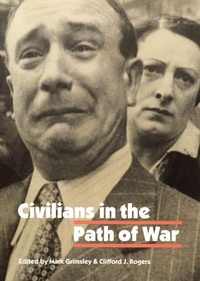
Civilians in the Path of War
Published on 1. December 2008
Book
Paperback/Softback
280 pages
978-0-8032-2065-2 (ISBN)
Description
"War," wrote Gen. William T. Sherman, "is cruelty, and you cannot refine it." Throughout history, noncombatants have always been among the victims of war's violence. In this book, nine distinguished historians examine twenty-five hundred years of human conflicts and their varied impacts on civilian society. Each case study examines not only what military forces did to noncombatants in the area of their operations, but why they did it and how they justified their actions. The focus, however, remains firmly on the practical realities of war, not on normative theories or the prescriptions of the "laws of war." The patterns that emerge from the nine case studies are not simple ones. Some of the same factors and pressures appear again and again, though the balance among them and the ultimate outcome vary greatly. We see how often devastation has served as a tool of coercive diplomacy, but also how logistic considerations have greatly affected the calculus of pillage versus restraint. The importance of precedent, of culture, of ideology or morality, and of morale become clear.
This book addresses crucial issues in an era in which historians have come to appreciate that a full understanding of war must address its victims as well as its victors, and when policymakers are perhaps more concerned than ever with minimizing the impact of war on civilian society.
This book addresses crucial issues in an era in which historians have come to appreciate that a full understanding of war must address its victims as well as its victors, and when policymakers are perhaps more concerned than ever with minimizing the impact of war on civilian society.
Reviews / Votes
"Contributes much to the study of how armed conflicts and military forces affect the larger societies they serve and/or threaten. That the volume is so well integrated is a tribute to the hard work and skills of editors Mark Grimsley and Clifford J. Rogers. . . . This book is one that scholars, students, and concerned citizens should study with care, because only the dead have seen the end of war, and there will, sadly, be a next time."-Nicholas Evan Sarantakes, State of North Carolina Department of Natural Resources "This edited collection nobly aims to engage scholars in a discussion of how warfare, soldiers, and decisions made by military and political leaders affected civilians in a number of wars throughout history. . . . Each of the authors provide interesting insights and ably balance the need to assign blame for wartime atrocities without anachronistically criticizing the past based on twenty-first century standards."-David E. Settje, Northwest Ohio Quarterly "The essays make for gripping reading. They demonstrate that decisions to attact or spare civilians have historically been guided above all by instrumental calculations-the question whether military operations would be better served by brutality or forbearance."-Roger Chickering, War in HistoryMore details
Series
Language
English
Place of publication
Lincoln
United States
Target group
College/higher education
Product notice
Paperback (trade)
Dimensions
Height: 229 mm
Width: 152 mm
Thickness: 18 mm
Weight
458 gr
ISBN-13
978-0-8032-2065-2 (9780803220652)
Copyright in bibliographic data and cover images is held by Nielsen Book Services Limited or by the publishers or by their respective licensors: all rights reserved.
Schweitzer Classification
Persons
Mark Grimsley is an associate professor of history at Ohio State University. He is the author of The Hard Hand of War: Union Military Policy toward Southern Civilians, 1861-1865 and coauthor of The Collapse of the Confederacy (Nebraska 2001). Clifford J. Rogers is an associate professor of history at the United States Military Academy. He is the author of War Cruel and Sharp: English Strategy under Edward III, 1327-1360 and editor of The Military Revolution Debate: Reading on the Military Transformation of Early Modern Europe.
Content
List of Maps; Acknowledgements Introduction - Mark Grimsley and Clifford J. Rogers; 1. Justice and Necessity: The Conduct of the Spartans and the Athenians in the Peloponnesian War - Paul A. Rahe; 2. By Fire and Sword: Bellum Hostile and "Civilians" in the Hundred Years' War - Clifford J. Rogers; 3. A Brutal Necessity? The Devastation of the Palatinate, 1688-1689 - John A. Lynn; 4. Liberation or Occupation? Theory and Practice in the French Revolutionaries' Treatment of Civilians outside France - T. C. W. Blanning; 5. "Rebels" and "Redskins": U.S. Military Conduct toward White Southerners and Native Americans in Comparative Perspective - Mark Grimsley; 6. The Immorality of Expediency: The German Military from Ludendorff to Hitler - Holger H. Herwig; 7. Yeline: A Case Study in the Partisan War, 1942 - Truman O. Anderson; 8. "Contrary to Our National Ideals": American Strategic Bombing of Civilians in World War II - Conrad C. Crane; 9. Not Enough Collateral Damage: Moral Ambiguities in the Gulf War - Williamson Murray List of Contributors; Index