

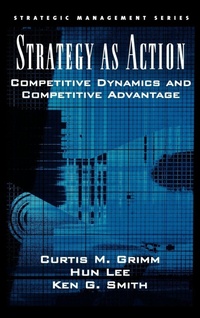
Strategy As Action
Competitive Dynamics and Competitive Advantage
Published on 29. September 2005
Book
Hardback
288 pages
978-0-19-516144-1 (ISBN)
Description
Strategy as Action presents an action plan for how firms can build, improve, and defend their competitive advantage at every stage of their life cycle. For start-up firms entering a market, it provides a model for exploiting competitve uncertainty and blind spots; for growth firms who have established some market advantages, it provides an action plan for exploiting relative resources; for mature firms, it explains how to exploit market position; finally, for firms that have no decisive resource advantage, it provides an action plan based on firm co-operative reactions.
More details
Series
Language
English
Place of publication
New York
United States
Target group
Professional and scholarly
Managers and business school students
Illustrations
Numerous tables and line drawings
Dimensions
Height: 235 mm
Width: 157 mm
Thickness: 22 mm
Weight
628 gr
ISBN-13
978-0-19-516144-1 (9780195161441)
Copyright in bibliographic data and cover images is held by Nielsen Book Services Limited or by the publishers or by their respective licensors: all rights reserved.
Schweitzer Classification
Other editions
Additional editions
Curtis M. Grimm | Hun Lee | Ken G. Smith
Strategy As Action
Competitive Dynamics and Competitive Advantage
E-Book
08/2005
1st Edition
OUP eBook
€65.99
Available for download
Curtis M. Grimm | Hun Lee | Ken G. Smith
Strategy As Action
Competitive Dynamics and Competitive Advantage
E-Book
08/2005
1st Edition
OUP eBook
€65.99
Available for download
Persons
Curtis M. Grimm, Professor of Supply Chain and Strategy, Robert H. Smith School of Business, University of Maryland, Hun Lee, Associate Professor, School of Management, George Mason University, and Ken G. Smith, Dean's Chaired Professor of Strategy, Robert H. Smith School of Business, University of Maryland
Author
Professor of Supply Chain and Strategy, Robert H. Smith School of BusinessProfessor of Supply Chain and Strategy, Robert H. Smith School of Business, University of Maryland
Associate Professor, School of ManagementAssociate Professor, School of Management, George Mason University
Dean's Chaired Professor of Strategy, Robert H. Smith School of BusinessDean's Chaired Professor of Strategy, Robert H. Smith School of Business, University of Maryland
Content
Part I. The New Competitive Advantage
1: Disruptive Competition: Intensifying Actions and Reactions in the Twenty-First Century
Part II. Strategic Paradigms of Competitive Advantage
2: Economic Theories of Competition and Competitive Advantage: Neoclassical, Industrial Organization Economics, Game Theory, Schumpeterian, and Evolutionary Economics
3: Knowing Your Relative Market Position
4: Knowing Your Relative Resource Position
Part III. Action-Based Dynamic Model of Competitive Advantage
5: An Action-Reaction Framework for Building Competitive Advantage
6: Avoiding Rivals with Entrepreneurial Actions: Exploiting Competitive Uncertainty and Blind Spots
7: Engaging Rivals with Ricardian Actions: Exploiting Ownership of Superior Resources
8: Defending against Rivals as a Dominant Firm: The Role of Deterrent Actions
9: Winning the Peace
10: Using the Action Model: Predicting the Behavior of Rivals
11: Strategy as Action: Integration and Evolution of Resource Positions
Notes
Index
1: Disruptive Competition: Intensifying Actions and Reactions in the Twenty-First Century
Part II. Strategic Paradigms of Competitive Advantage
2: Economic Theories of Competition and Competitive Advantage: Neoclassical, Industrial Organization Economics, Game Theory, Schumpeterian, and Evolutionary Economics
3: Knowing Your Relative Market Position
4: Knowing Your Relative Resource Position
Part III. Action-Based Dynamic Model of Competitive Advantage
5: An Action-Reaction Framework for Building Competitive Advantage
6: Avoiding Rivals with Entrepreneurial Actions: Exploiting Competitive Uncertainty and Blind Spots
7: Engaging Rivals with Ricardian Actions: Exploiting Ownership of Superior Resources
8: Defending against Rivals as a Dominant Firm: The Role of Deterrent Actions
9: Winning the Peace
10: Using the Action Model: Predicting the Behavior of Rivals
11: Strategy as Action: Integration and Evolution of Resource Positions
Notes
Index