

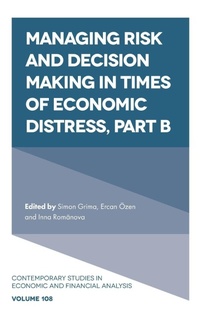
Managing Risk and Decision Making in Times of Economic Distress
Published on 28. March 2022
Book
Hardback
256 pages
978-1-80262-972-9 (ISBN)
Description
Managing Risk and Decision Making in Times of Economic Distress: Part B adds much needed scholarly analysis of the fledgling decision/control approach, arguing the merits of its empirical content to shed light on the structure of capital contracts and rationale for diversity of objectives.
Underpinning the book's central arguments are questions surrounding the identification and realisation of opportunities during periods of distress or disruption. Although such questions have been the focus of corporate finance, risk management, and financial management studies and literature, within the context of COVID-19 gaps remain unresolved.
Continuity should be a proactive living plan to return to the norm we know, and continuity planning forms an integral part of a risk management strategy. With the future set to be shaped by these many disruptions and humanity's responses to it, critical insights are more important than ever, to ensure and determine progress towards the Sustainable Development Goals and recovering from these economic and social challenges.
Contemporary Studies in Economic and Financial Analysis publishes a series of current and relevant themed volumes within the fields of economics and finance. Both disciplinary and interdisciplinary studies are welcome.
Underpinning the book's central arguments are questions surrounding the identification and realisation of opportunities during periods of distress or disruption. Although such questions have been the focus of corporate finance, risk management, and financial management studies and literature, within the context of COVID-19 gaps remain unresolved.
Continuity should be a proactive living plan to return to the norm we know, and continuity planning forms an integral part of a risk management strategy. With the future set to be shaped by these many disruptions and humanity's responses to it, critical insights are more important than ever, to ensure and determine progress towards the Sustainable Development Goals and recovering from these economic and social challenges.
Contemporary Studies in Economic and Financial Analysis publishes a series of current and relevant themed volumes within the fields of economics and finance. Both disciplinary and interdisciplinary studies are welcome.
More details
Series
Language
English
Place of publication
Bingley
United Kingdom
Target group
Professional and scholarly
Dimensions
Height: 235 mm
Width: 157 mm
Thickness: 18 mm
Weight
526 gr
ISBN-13
978-1-80262-972-9 (9781802629729)
Copyright in bibliographic data and cover images is held by Nielsen Book Services Limited or by the publishers or by their respective licensors: all rights reserved.
Schweitzer Classification
Other editions
Additional editions
Simon Grima | Ercan Ozen | Inna Romanova
Managing Risk and Decision Making in Times of Economic Distress
E-Book
03/2022
1st Edition
Emerald Publishing Limited
€112.99
Available for download
Persons
Simon Grima is the Head of the Insurance Department, Deputy Dean of the Faculty of Economics, Management and Accountancy and an Associate Professor at the University of Malta.
Ercan OEzen is Head of the Finance and Banking Department and Deputy Dean in Faculty of Applied Sciences at the University of Usak, Turkey.
Inna Romanova is a Professor of Finance and the Vice-Dean of the Faculty of Business, Management and Economics at the University of Latvia.
Ercan OEzen is Head of the Finance and Banking Department and Deputy Dean in Faculty of Applied Sciences at the University of Usak, Turkey.
Inna Romanova is a Professor of Finance and the Vice-Dean of the Faculty of Business, Management and Economics at the University of Latvia.
Content
Chapter 1. Macroprudential Policy Contribution to the Post Covid-19 Pandemic Economic Recovery; Victoria Cociug and Larisa Mistrean
Chapter 2. Sustainable Tourism in the Current European Context; Adriana Scriosteanu, Catalin Mihail Barbu, and Maria Magdalena Criveanu
Chapter 3. The Path towards International Non-financial Reporting Framework; Daniel Zdolsek, Vita Jagric, Tjasa Strukelj, and Sabina Taskar Beloglavec
Chapter 4. Public Policy and Entrepreneurial Activity: Do We have a Winning Tandem? Channels and Conduits; Vatavu Sorana, Teodorescu Delia, Nicolescu Ana-Cristina, Florin Costea, and Lobon? Oana-Ramona
Chapter 5. The Importance of Human Resources Competencies in Organizational Cyber Risk Management; Anca Bandoi, Catalina Sitnikov, Daniela Danciulescu, Lucian Mandache, and Ionut Riza
Chapter 6. Sustainability Development assessment and indicators; Claudiu George Bocean, Lumini?a Popescu, and Adrian-Florin Budica-Iacob
Chapter 7. The Credit Market for Small and Medium Enterprises in the Republic of Moldova; Mistrean Larisa, Bu?machiu Eugenia, and Staver Liliana
Chapter 8. The Role of Digitalization in Reducing Risks and Bridging Regional Economic Welfare Gaps Within a Sustainable Development Framework: The Case of Romania; Gratiela Georgiana Noja, Mirela Cristea, Nicoleta Sirghi, and Ioana Vadasan
Chapter 9. The Impact of Information Technologies on Business During the Covid 19 Pandemic Outbreak; Luan Vardari; Qendrim Bytyqi; Ardelin Lumi
Chapter 10. Examining the Effects of Sustainable HRM on Work Wellbeing: The Role of Voice Behaviour and Trust In Management; Rathinasamy Prince, Nitin Simha Vihari, and M.Kameshwar Rao
Chapter 11. Changing Consumer Behaviour During the Pandemic Period: The Rise of Digital Transformation; Bilge Villi
Chapter 12. Estimating the Financial Cycle under Limited Data Availability: Alternative Methods; Kristina Bojare
Chapter 13. An Assessment of the Borsa Istanbul Insurance Index Return Structure: The Markov Regime Switching Model; Ender Baykut and Ercan OEzen
Chapter 14. Portfolio Performance of Public Sector General Insurance Companies in India: A Comparative Analysis; Kiran Sood, Navneet Seth, and Simon Grima
Chapter 2. Sustainable Tourism in the Current European Context; Adriana Scriosteanu, Catalin Mihail Barbu, and Maria Magdalena Criveanu
Chapter 3. The Path towards International Non-financial Reporting Framework; Daniel Zdolsek, Vita Jagric, Tjasa Strukelj, and Sabina Taskar Beloglavec
Chapter 4. Public Policy and Entrepreneurial Activity: Do We have a Winning Tandem? Channels and Conduits; Vatavu Sorana, Teodorescu Delia, Nicolescu Ana-Cristina, Florin Costea, and Lobon? Oana-Ramona
Chapter 5. The Importance of Human Resources Competencies in Organizational Cyber Risk Management; Anca Bandoi, Catalina Sitnikov, Daniela Danciulescu, Lucian Mandache, and Ionut Riza
Chapter 6. Sustainability Development assessment and indicators; Claudiu George Bocean, Lumini?a Popescu, and Adrian-Florin Budica-Iacob
Chapter 7. The Credit Market for Small and Medium Enterprises in the Republic of Moldova; Mistrean Larisa, Bu?machiu Eugenia, and Staver Liliana
Chapter 8. The Role of Digitalization in Reducing Risks and Bridging Regional Economic Welfare Gaps Within a Sustainable Development Framework: The Case of Romania; Gratiela Georgiana Noja, Mirela Cristea, Nicoleta Sirghi, and Ioana Vadasan
Chapter 9. The Impact of Information Technologies on Business During the Covid 19 Pandemic Outbreak; Luan Vardari; Qendrim Bytyqi; Ardelin Lumi
Chapter 10. Examining the Effects of Sustainable HRM on Work Wellbeing: The Role of Voice Behaviour and Trust In Management; Rathinasamy Prince, Nitin Simha Vihari, and M.Kameshwar Rao
Chapter 11. Changing Consumer Behaviour During the Pandemic Period: The Rise of Digital Transformation; Bilge Villi
Chapter 12. Estimating the Financial Cycle under Limited Data Availability: Alternative Methods; Kristina Bojare
Chapter 13. An Assessment of the Borsa Istanbul Insurance Index Return Structure: The Markov Regime Switching Model; Ender Baykut and Ercan OEzen
Chapter 14. Portfolio Performance of Public Sector General Insurance Companies in India: A Comparative Analysis; Kiran Sood, Navneet Seth, and Simon Grima