

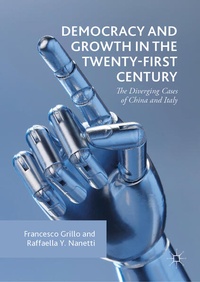
Democracy and Growth in the Twenty-first Century
Description
The cases of China and Italy form the research focus as two extremes in growth performance. China is the star of globalisation in the East, while Italy is the laggard of globalisation in the West and a laboratory of creeping political meltdown now shared by other major Western economies. But is this forever? Introducing the 'innovation paradox' as the main challenge to the West and the notion of 'knowledge democracy' as key to sustainable growth, this book presents a new side to the debate on theFourth Industrial Revolution (or fifth as the authors argue). It is a vital reading for all those questioning what kind of democracy positively impacts innovation as the force whose speed and direction transforms societies and economies.
Reviews / Votes
"This book offers an interesting view on how societies manage or mismanage innovation strategies in practice and how the wider political and institutional context acts as the intermediary in converting the stated policy goals into actual outcomes. Francesco Grillo and Raffaella Nanetti show how liberal democracies could learn from other regimes in this conversion process without at the same time compromising their core principles. Solutions to such fundamental problems are never simple, but the comparison of the Chinese and Italian case outlined in this book makes it apparent where one could start." (Mihkel Solvak, Institute of Political Studies, University of Tartu, Estonia) "All social and political systems need to evolve so as to survive and thrive, adapting to changing times and technologies. Francesco Grillo and Raffaella Nanetti pose the right questions about our overly-rigid liberal democracies, while illuminating the challenge through a powerful comparison between their own sclerotic Italy and the currently more adaptive authoritarian China." (Bill Emmott, former Editor of The Economist and author of The Fate of the West)
"By now the literature on China is huge, yet this book stands out in terms of originality and quality. China's economic and technological advancement is systematically linked to its political system. The comparison with Italy is useful to understand what Western democracies may learn from China's case." (Romano Prodi, former Prime Minister of Italy and President of the European Commission, Italy)
"This book compares China and Italy, providing a novel perspective. The Chinese people need to find the future direction to maintain sustainable innovation and growth after 40 years of economic success. China may draw some lessons from Italy on how to keep the balance between democratic governance and innovation. Can we have Democracy promoting innovation and innovation promoting democratic governance at the same time?" (Liu Jianxiong, Institute of Economics, Chinese Academy of Social Sciences, China)
"When considering matters of innovation and growth, great value comes from comparing case studies that differ significantly from one another. Patterns that may be invisible in one single context can pop into view when carefully contrasted and compared. This book occupies valuable terrain between long-term structural features, and medium-to-short-term adjustments subject to politics and policy manipulation. It confirms Francesco Grillo's and his coauthor's unique capability to master different academic approaches to make sense of a problem which is going to be fundamental. Their four-sided approach to explaining innovation is eminently applicable in these and other settings where stakeholders seek to advance innovation." (Ernest Wilson, Dean of the Annenberg School of Communication, Los Angeles, USA and visiting fellow at Stanford University, USA)
More details
Other editions
Additional editions
Persons
Raffaella Y. Nanetti is Professor Emerita of Urban Planning and Policy in the College of Urban Planning and Public Affairs, University of Illinois at Chicago, USA, and part of the core team of the Economic and Social Cohesion Laboratory in London, UK. She is an Associate of Italy's National Research Council (CNR) in Rome. Her main research areas are policy and programme evaluation, research design and methodology, and territorial development policies.