

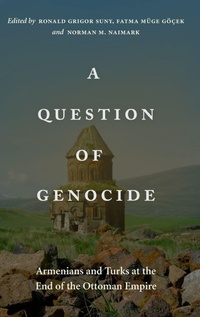
A Question of Genocide
Armenians and Turks at the End of the Ottoman Empire
Published on 10. March 2011
Book
Hardback
464 pages
978-0-19-539374-3 (ISBN)
Description
One hundred years after the deportations and mass murder of Armenians, Assyrians, and other peoples in the final years of the Ottoman Empire, the history of the Armenian Genocide remains a victim of historical distortion, state-sponsored falsification, and the deep divisions between Armenians and Turks. Working together for the first time, Turkish, Armenian, and other scholars present here the most accurate reconstruction of what happened and why. This book is the product of a decade of scholarly encounters that launched intense investigations by historians and other social scientists dedicated to honest exploration of one of history's greatest tragedies.
While the word "genocide" still divides communities, there is no longer any serious doubt that the Young Turk government ordered and carried out in 1915-1916 mass deportations and massacres targeted toward designated ethnoreligious groups. This volume includes reviews of the historical debates surrounding these events, portraits of the perpetrators, detailed accounts of the massacres themselves, and reflections on the broader implications of what happened then on what might happen now. Here history is not only the stories that we tell about the past but the foundation on which might be built new understandings of the present and possible futures.
While the word "genocide" still divides communities, there is no longer any serious doubt that the Young Turk government ordered and carried out in 1915-1916 mass deportations and massacres targeted toward designated ethnoreligious groups. This volume includes reviews of the historical debates surrounding these events, portraits of the perpetrators, detailed accounts of the massacres themselves, and reflections on the broader implications of what happened then on what might happen now. Here history is not only the stories that we tell about the past but the foundation on which might be built new understandings of the present and possible futures.
Reviews / Votes
The collection is uniformly measured, provocative and important. * Times Literary Supplement * This is a ground-breaking work on multiple levels ... inspiring project aimed at finding a genuine solution to the historical differences which separate the Turkish and Armenian Republics ... The fact that A Question of Genocide represents a continuing enterprise leaves open the possibility for future insights and breakthroughs. * Ryan Gingeras, English Historical Review *More details
Language
English
Place of publication
New York
United States
Illustrations
19 hts
Dimensions
Height: 240 mm
Width: 161 mm
Thickness: 29 mm
Weight
860 gr
ISBN-13
978-0-19-539374-3 (9780195393743)
Copyright in bibliographic data and cover images is held by Nielsen Book Services Limited or by the publishers or by their respective licensors: all rights reserved.
Schweitzer Classification
Other editions
Additional editions
Ronald Grigor Suny | Fatma Müge Göçek | Norman M. Naimark
A Question of Genocide
Armenians and Turks at the End of the Ottoman Empire
E-Book
02/2011
1st Edition
OUP eBook
€25.49
Available for download
Fatma Muge Gocek Norman M. Naimark Ronald Grigor Suny
Question of Genocide
Armenians and Turks at the End of the Ottoman Empire
E-Book
01/2011
1st Edition
Oxford University Press, USA
€100.49
Available for download
Persons
Ronald Grigor Suny is Charles Tilly Collegiate Professor of History at the University of Michigan. Fatma Muege Goecek is Associate Professor of Sociology at the University of Michigan. Norman M. Naimark is Robert and Florence McDonnell Professor in East European Studies at Stanford University.
Editor
Charles Tilly Collegiate Professor of Social and Political HistoryCharles Tilly Collegiate Professor of Social and Political History, University of Michigan
Associate Professor of SociologyAssociate Professor of Sociology, University of Michigan
Robert and Florence McDonnell Professor of East European StudiesRobert and Florence McDonnell Professor of East European Studies, Stanford University
Content
Preface- Norman M. Naimark ; Introduction: Leaving It to the Historians-Ronald Grigor Suny and Fatma Muge Gocek ; Part I Historiographies of the Genocide ; Ch 1. Writing Genocide: The Fate of the Ottoman Armenians in Western Historiographies- Ronald Grigor Suny ; Ch 2. Reading Genocide: Turkish Historiography on the Armenian Ethnic Cleansing- Fatma Muge Gocek ; Part II On the Eve of Catastrophe ; Ch3. The Silence of the Land: Agrarian Relations, Ethnicity, and Power- Stephan H. Astourian ; Ch 4. What was Revolutionary about Armenian Political Parties in the Ottoman Empire?- Gerald J. Libaridian ; Ch 5. Non-Muslims in the Ottoman Army and the Ottoman Defeat in the Balkan War of 1912-1913- Fikret Adanir ; Ch 6. From Patriotism to Mass Murder: Dr. Mehmed Reshid (1873-1919)- Hans-Lukas Kieser ; Part III Genocide in International Context ; Ch 7. The Politics and Practice of the Russian Occupation of Armenia, 1915-February 1917- Peter Holquist ; Ch 8. Germany and the Young Turks: Revolutionaries into Statesmen- Eric D. Weitz ; Ch 9. Who Still Talked about the Extermination of the Armenians? German Talk and German Silences- Margaret Lavinia Anderson ; Part IV Genocide in Local Context ; Ch 10. Zeytun and the Commencement of the Armenian Genocide- Aram Arkun ; Ch 11. The Ottoman Treatment of the Assyrians- David Gaunt ; Ch 12. The First World War and the Development of the Armenian Genocide- Donald Bloxham ; Ch 13. Pouring a People into the Desert: The "Definitive Solution" of the Unionists to the Armenian Question- Fuat Dundar ; Part V Continuties ; Ch 14. "Turkey for the Turks": Demographic Engineering in Eastern Anatolia, 1914-1945- Ugur Umit Ungor ; Ch 15. Renewal and Silence: Unionist Policies After World War I- Erik Jan Zurcher