

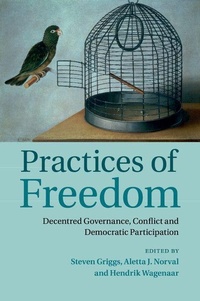
Practices of Freedom
Decentred Governance, Conflict and Democratic Participation
Published on 28. April 2016
Book
Paperback/Softback
332 pages
978-1-107-62832-8 (ISBN)
Description
The shift from government to governance has become a starting point for many studies of contemporary policy-making and democracy. Practices of Freedom takes a different approach, calling into question this dominant narrative and taking the variety, hybridity and dispersion of social and political practices as its focus of analysis. Bringing together leading scholars in democratic theory and critical policy studies, it draws upon new understandings of radical democracy, practice and interpretative analysis to emphasise the productive role of actors and political conflict in the formation and reproduction of contemporary forms of democratic governance. Integrating theoretical dialogues with detailed empirical studies, this book examines spaces for democratisation, institutional design, democratic criteria and learning, whilst mobilising the frameworks of agonistic and aversive democracy, informality and decentred legitimacy in cases from youth engagement to the Israeli-Palestinian conflict.
Reviews / Votes
'This landmark collection brings together the very best theoretical work on local and global governance in relation to democratic participation on the one hand and carefully reconstructed case studies on the other. It is precisely the kind of theoretical and practical work needed to understand the complex modes of governance and practices of freedom in which we are entangled today.' James Tully, University of Victoria, Canada 'This book is an important contribution to our understanding of the new forms of democratic practice which are emerging in our societies. It offers rich conceptual discussion and examples of applications in urban and environmental situations. It is not just for academics, but also provides inspiration to the many who are struggling to create more appropriately democratic polities for our futures.' Patsy Healey, School of Architecture, Planning and Landscape, Newcastle University 'This book offers a series of first rate essays on the controversial topic of governance. By questioning conventional assumptions, its authors provide a deeper assessment of the meaning of governance as decentered political practice. They examine the inevitability of conflict under conditions of radical pluralism and explore ways of dealing with it through more agonistic practices of discursive democracy. Both theorists of governance and its sceptics have much to learn from this critical analysis.' Frank Fischer, Rutgers University, New JerseyMore details
Language
English
Place of publication
Cambridge
United Kingdom
Target group
Professional and scholarly
Product notice
Paperback (trade)
Illustrations
5 Tables, unspecified; 5 Tables, black and white; 4 Halftones, unspecified; 1 Line drawings, unspecified
Dimensions
Height: 229 mm
Width: 152 mm
Thickness: 18 mm
Weight
482 gr
ISBN-13
978-1-107-62832-8 (9781107628328)
Copyright in bibliographic data and cover images is held by Nielsen Book Services Limited or by the publishers or by their respective licensors: all rights reserved.
Schweitzer Classification
Other editions
Additional editions
Steven Griggs | Aletta J. Norval | Hendrik Wagenaar
Practices of Freedom
Decentred Governance, Conflict and Democratic Participation
Book
04/2014
Cambridge University Press
€131.70
Shipment within 15-20 days
Steven Griggs | Aletta J. Norval | Hendrik Wagenaar
Practices of Freedom
Decentred Governance, Conflict and Democratic Participation
E-Book
03/2014
1st Edition
Cambridge University Press
€29.49
Available for download
Persons
Steven Griggs is a Reader in Local Governance in the Department of Politics and Public Policy at De Montfort University. His work draws on political discourse theory, examining environmental policy, community participation and local governance. His publications include The Politics of Airport Expansion (with David Howarth, 2013), as well as articles in the British Journal of Politics and International Relations and the Journal of Political Ideologies. He is co-editor of Critical Policy Studies. Aletta J. Norval is a Professor of Political Theory in the Department of Government at the University of Essex. A leading democratic theorist, she draws inspiration from the agonistic tradition, as well as from a wider range of theorists, to understand and analyse processes of the articulation of democratic demands, the formation of democratic subjectivities and the institutionalization of a democratic ethos. Her publications include Aversive Democracy (Cambridge, 2007) as well as articles in the American Political Science Review and Ethics and Global Politics. She is Consulting Editor of Political Theory. Hendrik Wagenaar is a Professor of Town and Regional Planning in the Department of Town and Regional Planning at the University of Sheffield. He publishes in the areas of urban governance, citizen participation, prostitution policy, administrative practice, complexity theory and interpretive policy analysis. His publications include Deliberative Policy Analysis (with Maarten A. Hajer, Cambridge, 2003) and Meaning in Action (2011).
Content
1. Introduction: democracy, conflict and participation in decentred governance Steven Griggs, Aletta J. Norval and Hendrik Wagenaar; 2. Governance-driven democratisation Mark E. Warren; 3. Beyond deliberation: agonistic and aversive grammars of democracy: the question of criteria Aletta J. Norval; 4. Designing democratic institutions for decentred governance: the Council of Europe's acquis Vivien Lowndes and Lawrence Pratchett; 5. Assessing the democratic anchorage of governance networks Eva Sorenson and Jacob Torfing; 6. Learning through contested governance: the practice of agonistic intersubjectivity John Forester; 7. Decentred legitimacy in the new community governance Steven Connelly; 8. Designing 'the political' in (and out) of neighbourhood governance Helen Sullivan; 9. Participatory governance in practice Therese O'Toole and Richard Gale; 10. The agonistic experience: informality, hegemony, and the prospects for democratic governance Hendrik Wagenaar; 11. Insurgent citizenship: radicalism, co-optation, and neighbourhood geopolitics among the Palestinian citizens of Haifa, Israel Joseph Leibovitz.