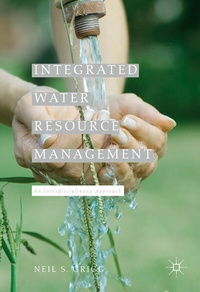
This book addresses the enormous global challenge of providing balanced and sustainable solutions to urgent water problems. The author explores our dependence on access to safe water and other water-related services and how driving forces of the human and natural worlds are degrading this access. The greatest challenges involve conflicts between people and interest groups across all countries, as well as the economic and political difficulties in finding solutions through infrastructure development. The book takes an interdisciplinary approach to Integrated Water Resources Management or IWRM, which provides a set of tools for policy development, planning and organization, assessment, systems analysis, finance, and regulation. The author suggests that IWRM is challenging because of the human element, but that no other process can reconcile the conflicting agendas involved with water management. The broad range of topics covered here, as well as 25 case summaries, will be of interest toscientists, engineers, practitioners, and advanced level students interested in the integrated management of water as a resource.
Reviews / Votes
"Neil Grigg does it again! Brilliantly written, this book provides a masterful and much-needed interdisciplinary and integrated perspective on water resources management. Comprehensive and authoritative, each of the chapters is a gem, and together they offer a standalone text for educators and students, and an invaluable resource for practitioners and policy-makers. This book is essential and quintessential." (Anne Steinemann, Professor, The University of Melbourne, Australia)
"In this excellent book, Professor Neil S. Grigg, a world-class expert on water infrastructure, argues in favour of "science-to-practice" approach to Integrated Water Resources Management (IWRM). He reminds us that water supply is the highest priority service and that the lack of safe drinking water is the most pressing water issue globally. Water managers can promote good water governance by effective management practices and proper relationships among stakeholders. Integration begins when water and wastewater are operated as one utility. The management of water systems requires sound decisions, while public involvement is also essential. Water resources and services are parts of social systems that extend beyond technology, requiring a balance between competing social and political views. Although access to water is a basic human right, paying for services is also essential. Furthermore, water acts as a connector for security; for food production, environment, economy, and health." (Tapio S. Katko, UNESCO Chairholder, Adjunct Professor, Tampere University of Technology, Finland)
Edition
Language
Place of publication
Target group
Professional and scholarly
Illustrations
55 s/w Abbildungen
XXII, 497 p. 55 illus.
Dimensions
Height: 216 mm
Width: 153 mm
Thickness: 33 mm
Weight
ISBN-13
978-1-137-57614-9 (9781137576149)
DOI
10.1057/978-1-137-57615-6
Schweitzer Classification
Neil S. Grigg is a Professor of Civil and Environmental Engineering at Colorado State University, USA, where he teaches a course on water resources management. He has also held positions as a department head, government environmental official, and consulting engineer, as well as military officer in the U.S. Army Corps of Engineers.
Chapter 1: Water as a connector among societal needs.- Chapter 2: Framework and scenarios of IWRM.- Chapter 3: Purposes and systems of water management.- Chapter 4: Planning for integrative problem-solving.- Chapter 5: IWRM and water governance.- Chapter 6: Systems thinking as an IWRM tool.- Chapter 7: Watersheds as social-ecological systems.- Chapter 8: Integrated urban water systems.- Chapter 9: Water conflicts, compacts, and treaties.- Chapter 10: Hydrology of water supply and natural systems.- Chapter 11: Demand for water, water services, and ecosystem services.- Chapter 12: Water infrastructure and equipment.- Chapter 13: Water infrastructure planning process.- Chapter 14: Models, data and monitoring in IWRM.- Chapter 15: Water laws and regulations.- Chapter 16: Economic and decision tools for IWRM.- Chapter 17: Social aspects of water management.- Chapter 18: Water resources and environmental assessment.- Chapter 19: Finance in water management.- Chapter 20: Water security,disasters and risk assessment.- Chapter 21: Capacity-building for IWRM: education, training and research.- Chapter 22: Case studies of IWRM archetypes.- Appendix to Chapter: Case presentations.- Presentation of case summaries.