

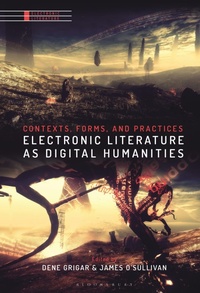
Electronic Literature as Digital Humanities
Contexts, Forms, and Practices
Published on 25. August 2022
Book
Paperback/Softback
392 pages
978-1-5013-7389-3 (ISBN)
Description
Electronic Literature as Digital Humanities: Contexts, Forms & Practices is an open access volume of essays that provides a detailed account of born-digital literature by artists and scholars who have contributed to its birth and evolution. Rather than offering a prescriptive definition of electronic literature, this book takes an ontological approach through descriptive exploration, treating electronic literature from the perspective of the digital humanities (DH)--that is, as an area of scholarship and practice that exists at the juncture between the literary and the algorithmic.
The domain of DH is typically segmented into the two seemingly disparate strands of criticism and building, with scholars either studying the synthesis between cultural expression and screens or the use of technology to make artifacts in themselves. This book regards electronic literature as fundamentally DH in that it synthesizes these two constituents. Electronic Literature as Digital Humanities provides a context for the development of the field, informed by the forms and practices that have emerged throughout the DH moment, and finally, offers resources for others interested in learning more about electronic literature.
The ebook editions of this book are available open access under a CC BY-NC-ND 3.0 licence on www.bloomsburycollections.com.
The domain of DH is typically segmented into the two seemingly disparate strands of criticism and building, with scholars either studying the synthesis between cultural expression and screens or the use of technology to make artifacts in themselves. This book regards electronic literature as fundamentally DH in that it synthesizes these two constituents. Electronic Literature as Digital Humanities provides a context for the development of the field, informed by the forms and practices that have emerged throughout the DH moment, and finally, offers resources for others interested in learning more about electronic literature.
The ebook editions of this book are available open access under a CC BY-NC-ND 3.0 licence on www.bloomsburycollections.com.
Reviews / Votes
This book connects, indeed makes inextricable, the cutting-edge fields of electronic literature and digital humanities. Situating work by pioneers in the field of electronic literature alongside emergent artists and scholars from around the world, the book draws a transversal and provides new ways of approaching born-digital literature through a focus on contexts (social, institutional, theoretical), forms (aesthetic, poetic, medial), and practices (pedagogy, preservation, publishing). This is a book that can be used for teaching students of all levels interested in understanding the current state of literary studies. * Jessica Pressman, Associate Professor of English and Comparative Literature, San Diego State University, USA * As digital humanities scholarship becomes increasingly involved with digital arts and culture, this publication offers a treasure trove of examples of the integration of these fields. In their collection, Electronic Literature as Digital Humanities: Contexts, Forms, and Practices, Dene Grigar and James O'Sullivan have assembled a variety of scholarly approaches to the natural relationship between electronic literature and digital humanities. The essays expand on traditional strategies in humanities research such as deep history, tracing both the print and computer origins of e-lit, and the extent of global presence. The works also examine remarkable instances of digital practice and form. The scope and the specificity of the book make it an excellent resource for researchers. * M.D. Coverley, author of Califia (2000)//Marjorie Coverley Luesebrink, Electronic Literature Organization, USA * After Goethe imagined a world literature in formation, Karl Marx predicted its rise, and Franco Moretti mapped its whereabouts, is such a thing realizable at last in digital environments? Is electronic literature, ignored by English Departments and all but a few Creative Writing Programs, ready to be integrated into the Digital Humanities? There is certainly no shortage of candidates for an emerging world literature in this gathering of multi-national talents by Dene Grigar and James O'Sullivan; no shortage of languages, cultural backgrounds, heritage and creative contexts. Emerging genres like Interactive Fiction are said to express a multivariate world mode (Montfort), one that could well replace national one-sidedness and resituate local literatures. We are beginning now to look at literary works written in the form of a computer program. Recombinant, database, codework and network fictions (Seaman, Manovich, Marino, Ciccoricco); collective imaginaries (Pullinger and Armstrong); aesthetic animism (Jhave); nonlinear, nonconscious, affective, and emergent significations (Hayles, Rettberg and Coover); sound no less than sighted texts (Luers). We have here, in this volume, sustained scholarly engagement with locative media, spatial narratives, augmented realities that display an aesthetic, geographical, and linguistic diversity never so apparent in earlier formations of the "Humanities." At the least, there will be (as there have always been) literary suggestions of "some world other than the one we inhabit" (Moulthrop). * Joseph Tabbi, Professor of American Literature, University of Bergen, Norway *More details
Series
Language
English
Place of publication
New York
United States
Publishing group
Bloomsbury Publishing Plc
Target group
College/higher education
Illustrations
22 bw illus
Dimensions
Height: 229 mm
Width: 152 mm
Thickness: 22 mm
Weight
566 gr
ISBN-13
978-1-5013-7389-3 (9781501373893)
Copyright in bibliographic data and cover images is held by Nielsen Book Services Limited or by the publishers or by their respective licensors: all rights reserved.
Schweitzer Classification
Persons
Dene Grigar is an Associate Professor and Director of The Creative Media & Digital Culture Program at Washington State University Vancouver, USA. With Stuart Moulthrop, she is the recipient of a 2013 NEH Start Up grant for a digital preservation project for early electronic literature that culminated into an open source, multimedia book for scholars entitled Pathfinders, and a book of criticism entitled Traversals. She was President of the Electronic Literature Organization (2013-2019) and Associate Editor of Leonardo Reviews.
James O'Sullivan lectures in digital arts and humanities at University College Cork, Ireland. His research has been published in a variety of venues, including Digital Scholarship in the Humanities. He is the author of Towards a Digital Poetics (2019), as well as the editor of several volumes including Electronic Literature as Digital Humanities (with Grigar, 2021).
James O'Sullivan lectures in digital arts and humanities at University College Cork, Ireland. His research has been published in a variety of venues, including Digital Scholarship in the Humanities. He is the author of Towards a Digital Poetics (2019), as well as the editor of several volumes including Electronic Literature as Digital Humanities (with Grigar, 2021).
Content
About the Editors
Electronic Literature as Digital Humanities: An Introduction
Dene Grigar
Section I Contexts
1. The Origins of Electronic Literature: An Overview
Giovanna di Rosario, Nohelia Meza, and Kerri Grimaldi
2. Third-Generation Electronic Literature
Leonardo Flores
3. Toys and Toons: From Hispanic Literary Traditions to a Global E-Lit Landscape
Elika Ortega and Alex Saum-Pascual
4. Community, Institution, Database: Tracing the Development of an International Field through ELO, ELMCIP, and CELL
Davin Heckman
5. The E-Poetry Festivals: Celebration, Art, and Imagination in Community
Loss Pequeno Glazier
6. Cyberfeminist Literary Space: Performing the Electronic Manifesto
Carolyn Guertin
7. Bodies in E-Lit
Astrid Ensslin, Carla Rice, Sarah Riley, Christine Wilks, Megan Perram, Hannah Fowlie, Lauren Munro and K. Alysse Bailey
Section II Forms
8. Ambient Art and Electronic Literature
Jim Bizzocchi
9. Electronic Literature and Sound
John F. Barber
10. Augmented Reality
Anne Karhio
11. Artistic and Literary Bots
Leonardo Flores
12. Consuming the Database: The Reading Glove as a Case Study of Combinatorial Narrative
Theresa Jean Tanenbaum and Karen Tanenbaum
13. Hypertext Fiction Ever After
Stuart Moulthrop
14. Place Taking Place: Temporary Poetic Theaters
Judd Morrissey
15. Kinetic Poetry
Alvaro Seica
16. Kinepoeia in Animated Poetry
Dene Grigar
17. Mobile Electronic Literature
Jeneen Naji
18. The Voice of the Polyrhetor: Physical Computing and the (e-)Literature of Things
Helen J. Burgess
19. Having Your Story and Eating It Too: Affect and Narrative in Recombinant Fiction
Will Luers
Section III Practices
20. Challenges to Archiving and Documenting Born-Digital Literature: What Scholars, Archivists, and Librarians Need to Know
Dene Grigar
21. Holes as a Collaborative Project
Graham Allen
22. Publishing Electronic Literature
James O'Sullivan
23. E-Lit after Flash: The Rise (and Fall) of a "Universal" Language
Anastasia Salter and John Murray
24. Learning as You Go: Inventing Pedagogies for Electronic Literature
Davin Heckman
Section IV Artist Interventions
25. My cODEwORk ARTicle
Michael J. Maguire
26. Locative Narrative
Jeremy Hight
27. Come Play Netprov!: Recipes for an Evolving Practice
Rob Wittig and Mark C. Marino
28. A Collective Imaginary: A Published Conversation
Kate Pullinger and Kate Armstrong
29. Addressing Torture in Iraq through Critical Digital Media Art-Hearts and Minds: The Interrogations Project
Roderick Coover, Scott Rettberg, Daria Tsoupikova and Arthurh Nishimoto
30. Poetic Playlands: Poetry, Interface, and Video Game Engines
Jason Nelson
31. A Way Is Open: Allusion, Authoring System, Identity, and Audience in Early Text-Based Electronic Literature
Judy Malloy
Index
Electronic Literature as Digital Humanities: An Introduction
Dene Grigar
Section I Contexts
1. The Origins of Electronic Literature: An Overview
Giovanna di Rosario, Nohelia Meza, and Kerri Grimaldi
2. Third-Generation Electronic Literature
Leonardo Flores
3. Toys and Toons: From Hispanic Literary Traditions to a Global E-Lit Landscape
Elika Ortega and Alex Saum-Pascual
4. Community, Institution, Database: Tracing the Development of an International Field through ELO, ELMCIP, and CELL
Davin Heckman
5. The E-Poetry Festivals: Celebration, Art, and Imagination in Community
Loss Pequeno Glazier
6. Cyberfeminist Literary Space: Performing the Electronic Manifesto
Carolyn Guertin
7. Bodies in E-Lit
Astrid Ensslin, Carla Rice, Sarah Riley, Christine Wilks, Megan Perram, Hannah Fowlie, Lauren Munro and K. Alysse Bailey
Section II Forms
8. Ambient Art and Electronic Literature
Jim Bizzocchi
9. Electronic Literature and Sound
John F. Barber
10. Augmented Reality
Anne Karhio
11. Artistic and Literary Bots
Leonardo Flores
12. Consuming the Database: The Reading Glove as a Case Study of Combinatorial Narrative
Theresa Jean Tanenbaum and Karen Tanenbaum
13. Hypertext Fiction Ever After
Stuart Moulthrop
14. Place Taking Place: Temporary Poetic Theaters
Judd Morrissey
15. Kinetic Poetry
Alvaro Seica
16. Kinepoeia in Animated Poetry
Dene Grigar
17. Mobile Electronic Literature
Jeneen Naji
18. The Voice of the Polyrhetor: Physical Computing and the (e-)Literature of Things
Helen J. Burgess
19. Having Your Story and Eating It Too: Affect and Narrative in Recombinant Fiction
Will Luers
Section III Practices
20. Challenges to Archiving and Documenting Born-Digital Literature: What Scholars, Archivists, and Librarians Need to Know
Dene Grigar
21. Holes as a Collaborative Project
Graham Allen
22. Publishing Electronic Literature
James O'Sullivan
23. E-Lit after Flash: The Rise (and Fall) of a "Universal" Language
Anastasia Salter and John Murray
24. Learning as You Go: Inventing Pedagogies for Electronic Literature
Davin Heckman
Section IV Artist Interventions
25. My cODEwORk ARTicle
Michael J. Maguire
26. Locative Narrative
Jeremy Hight
27. Come Play Netprov!: Recipes for an Evolving Practice
Rob Wittig and Mark C. Marino
28. A Collective Imaginary: A Published Conversation
Kate Pullinger and Kate Armstrong
29. Addressing Torture in Iraq through Critical Digital Media Art-Hearts and Minds: The Interrogations Project
Roderick Coover, Scott Rettberg, Daria Tsoupikova and Arthurh Nishimoto
30. Poetic Playlands: Poetry, Interface, and Video Game Engines
Jason Nelson
31. A Way Is Open: Allusion, Authoring System, Identity, and Audience in Early Text-Based Electronic Literature
Judy Malloy
Index