

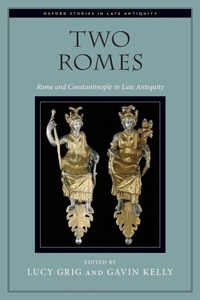
Two Romes
Rome and Constantinople in Late Antiquity
Published on 25. June 2015
Book
Paperback/Softback
496 pages
978-0-19-024108-7 (ISBN)
Description
The city of Constantinople was named New Rome or Second Rome very soon after its foundation in AD 324; over the next two hundred years it replaced the original Rome as the greatest city of the Mediterranean. In this unified essay collection, prominent international scholars examine the changing roles and perceptions of Rome and Constantinople in Late Antiquity from a range of different disciplines and scholarly perspectives. The seventeen chapters cover both the comparative development and the shifting status of the two cities. Developments in politics and urbanism are considered, along with the cities' changing relationships with imperial power, the church, and each other, and their evolving representations in both texts and images. These studies present important revisionist arguments and new interpretations of significant texts and events. This comparative perspective allows the neglected subject of the relationship between the two Romes to come into focus while avoiding the teleological distortions common in much past scholarship.
An introductory section sets the cities, and their comparative development, in context. Part Two looks at topography, and includes the first English translation of the Notitia of Constantinople. The following section deals with politics proper, considering the role of emperors in the two Romes and how rulers interacted with their cities. Part Four then considers the cities through the prism of literature, in particular through the distinctively late antique genre of panegyric. The fifth group of essays considers a crucial aspect shared by the two cities: their role as Christian capitals. Lastly, a provocative epilogue looks at the enduring Roman identity of the post-Heraclian Byzantine state. Thus, Two Romes not only illuminates the study of both cities but also enriches our understanding of the late Roman world in its entirety.
An introductory section sets the cities, and their comparative development, in context. Part Two looks at topography, and includes the first English translation of the Notitia of Constantinople. The following section deals with politics proper, considering the role of emperors in the two Romes and how rulers interacted with their cities. Part Four then considers the cities through the prism of literature, in particular through the distinctively late antique genre of panegyric. The fifth group of essays considers a crucial aspect shared by the two cities: their role as Christian capitals. Lastly, a provocative epilogue looks at the enduring Roman identity of the post-Heraclian Byzantine state. Thus, Two Romes not only illuminates the study of both cities but also enriches our understanding of the late Roman world in its entirety.
Reviews / Votes
Two Romes is an important book, and the chapters are uniformly excellent discussions of their particular topics from the later Roman empire. * Bryn Mawr Classical Review * A thoughtful, valuable, and useful introduction to a new field of study. Highly recommended. * CHOICE * This is an important and welcome volume. Lucy Grig and Gavin Kelly are to be congratulated for commissioning such a lively and challenging collection of papers on Rome and Constantinople, the two great metropoleis of late antiquity. Their comparative approach and forceful arguments bring a new and fresh perspective to the culture, ceremonial and physical development of the two cities, as well as new interpretations of some central sources. * Averil Cameron, University of Oxford* New, and at times surprisingly provocative, perspectives on the old Rome and its Greek successor, with several contributions destined for classic status. * Michael Kulikowski, Penn State
* Together, these seventeen well-edited entries hence offer promising new approaches to both familiar and less often viewed material and reveal some of the rich insights that can be gained from looking afresh at the two capitals.... Two Romes, then, is a truly enjoyable, informative and inspiring read. It is highly recommended not only to historians of late-antique Rome and Constantinople, but to anyone interested in the history, culture and religion of Late Antiquity. * Muriel Moser, H-Soz-u-Kult * On the whole this volume represents a significant contribution for the understanding of the role of the two most important cities of the Empire, especially during the fourth and fifth centuries. This valuable and specialized collection is also fluidly written and edited, making it a pleasure to read. * Massimiliano Vitiello, Sehepunkte * Two Romes is an important book, and the chapters are uniformly excellent discussions of their particular topics from the later Roman empire. * Bryn Mawr Classical Review * A thoughtful, valuable, and useful introduction to a new field of study. Highly recommended. * CHOICE * This is an important and welcome volume. Lucy Grig and Gavin Kelly are to be congratulated for commissioning such a lively and challenging collection of papers on Rome and Constantinople, the two great metropoleis of late antiquity. Their comparative approach and forceful arguments bring a new and fresh perspective to the culture, ceremonial and physical development of the two cities, as well as new interpretations of some central sources. * Averil Cameron, University of Oxford
* New, and at times surprisingly provocative, perspectives on the old Rome and its Greek successor, with several contributions destined for classic status. * Michael Kulikowski, Penn State
* Together, these seventeen well-edited entries hence offer promising new approaches to both familiar and less often viewed material and reveal some of the rich insights that can be gained from looking afresh at the two capitals.... Two Romes, then, is a truly enjoyable, informative and inspiring read. It is highly recommended not only to historians of late-antique Rome and Constantinople, but to anyone interested in the history, culture and religion of Late Antiquity. * Muriel Moser, H-Soz-u-Kult * On the whole this volume represents a significant contribution for the understanding of the role of the two most important cities of the Empire, especially during the fourth and fifth centuries. This valuable and specialized collection is also fluidly written and edited, making it a pleasure to read. * Massimiliano Vitiello, Sehepunkte *
More details
Series
Language
English
Place of publication
New York
United States
Target group
College/higher education
Illustrations
30 illus.
Dimensions
Height: 234 mm
Width: 156 mm
Thickness: 28 mm
Weight
814 gr
ISBN-13
978-0-19-024108-7 (9780190241087)
Copyright in bibliographic data and cover images is held by Nielsen Book Services Limited or by the publishers or by their respective licensors: all rights reserved.
Schweitzer Classification
Other editions
Additional editions
Book
05/2012
Oxford University Press Inc
€191.70
Shipment within 15-20 days
E-Book
03/2012
1st Edition
OUP eBook
€40.49
Available for download
Persons
Lucy Grig is Senior Lecturer in Classics at Edinburgh University and author of Making Martyrs in Late Antiquity
Gavin Kelly is Reader in Classics at Edinburgh University and author of Ammianus Marcellinus: The Allusive Historian.
Gavin Kelly is Reader in Classics at Edinburgh University and author of Ammianus Marcellinus: The Allusive Historian.
Content
Preface ; Contributors ; Figures ; Part I. Introduction: Rome and Constantinople in context ; 1. Introduction: from Rome to Constantinople, Lucy Grig and Gavin Kelly ; 2. Competing Capitals, Competing Representations: Late Antique Cityscapes in Words and Pictures, Lucy Grig ; 3. The Rise of Constantinople: Old and New Rome Compared, Bryan Ward-Perkins ; Part II. Urban Space and Urban Development in Comparative Perspective ; 4. The Notitia Urbis Constantinopolitanae, John Matthews ; 5. "It would be abominable for the inhabitants of this Beautiful City to be compelled to purchase water." Water and Late Antique Constantinople, James Crow ; 6. Aristocratic Houses and the Making of Late Antique Rome and Constantinople, Carlos Machado ; Part III. Emperors in the City ; 7. Valentinian III and the City of Rome (425-455): Patronage, Politics, Power, Mark Humphries ; 8. Playing the Ritual Game in Constantinople (379-457), Peter Van Nuffelen ; Part IV. Panegyric ; 9. Bright lights, Big City: Pacatus and the Panegyrici Latini, Roger Rees ; 10. A Tale of Two Cities: Themistius on Rome and Constantinople, John Vanderspoel ; 11. Claudian and Constantinople, Gavin Kelly ; 12. Epic Panegyric and Political Communication in the Fifth-Century West, Andrew Gillett ; Part V. Christian Capitals? ; 13. There But Not There: Constantinople in the Itinerarium Burdigalense, Benet Salway ; 14. Virgilizing Christianity in Late Antique Rome, John Curran ; 15. "Two Romes, Beacons of the Whole World": Canonizing Constantinople, Neil McLynn ; 16. Between Petrine Ideology and Realpolitik: The See of Constantinople in Roman Geo-Ecclesiology after the End of the Acacian Schism (518-523), Philippe Blaudeau ; Part VI. Epilogue ; 17. From Rome to New Rome, from Empire to Nation State: Reopening the Question of Byzantium's Roman Identity, Anthony Kaldellis ; Bibliography ; Index ; Index Locorum