


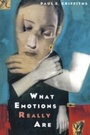
What Emotions Really Are
The Problem of Psychological Categories
Will be published approx. on 1. October 1997
Book
Hardback
293 pages
978-0-226-30871-5 (ISBN)
Description
This study argues that much research of the emotions has been misguided. It attempts to show that "emotion" encompasses psychological states of very different, and thus not comparable, kinds. Some emotions, such a brief flaring up of anger in response to some experience, are evolutionary ancient, reflex-like responses which appear insensitive to culture. Others, like moral guilt, differ importantly across cultures, despite their long history in humans, and affinity to behaviour seen in other species. Yet other emotions appear to be the acting-out of today's psychological myths, as ghost possession acted out the metaphysical myths of past centuries. These three kinds of responses have different evolutionary origins, different adaptive functions, different biological bases, and different roles in human psychology. The concept that binds them together, emotion, plays no useful role, since there is no object of scientific knowledge that corresponds to it. A detailed overview of the relevant theoretical approaches is provided in this text, assessing the relative merits of three main theoretical approaches: affect programme theory, evolutionary psychology, and social constructionism.
More details
Series
Language
English
Place of publication
Chicago
United States
Publishing group
The University of Chicago Press
Target group
Professional and scholarly
Dimensions
Height: 24 mm
Width: 16 mm
Thickness: 2 mm
Weight
595 gr
ISBN-13
978-0-226-30871-5 (9780226308715)
Copyright in bibliographic data and cover images is held by Nielsen Book Services Limited or by the publishers or by their respective licensors: all rights reserved.
Schweitzer Classification
Other editions
Additional editions
E-Book
04/2008
1st Edition
University of Chicago Press
€38.09
Available for download
Content
Acknowledgments 1: Introduction 2: Philosophy and Emotion--The Poverty of Conceptual Analysis 3: The Psychoevolutionary Approach to Emotion 4: Affect Programs and Emotion Modules 5: The Higher Cognitive Emotions: Some Research Programs 6: The Social Construction of Emotion 7: Natural Kinds and Theoretical Concepts 8: Natural Kinds in Biology and Psychology 9: What Emotions Really Are 10: Coda - Mood and Emotion References Index