

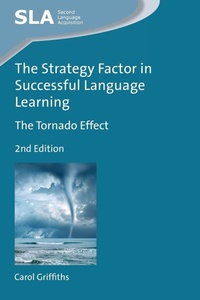
The Strategy Factor in Successful Language Learning
The Tornado Effect
2nd Edition
Published on 28. March 2018
Book
Paperback/Softback
280 pages
978-1-78309-973-3 (ISBN)
Description
This book addresses fundamental questions regarding the relationships between successful language learning and strategy use and development, according to learner, situational or target variables. It considers strategy effectiveness from an individual point of view and discusses pedagogical issues, especially relating to teacher perceptions and training, classroom and learner factors, methodology and content. This new edition has been reworked and revised to include an extensive review, analysis and re-interpretation of the existing literature and an update on the theoretical debate surrounding language learning strategies. The research methodology section has been considerably extended and detailed explanations are now given for how to analyse data from research studies. Rather than focusing on strategies divorced from the 'real world' of the classroom, this book explores the issues from the teaching/learning point of view and will be of interest to students, teachers, trainee teachers, teacher educators and researchers alike.
Reviews / Votes
Griffiths expertly navigates through 40 flourishing, and at times turbulent, years of research into language learning strategies to provide the reader with this comprehensive overview. The book skilfully melds old ideas with the new, core concepts with the peripheral, and traditional research approaches with calls for future innovation. * Heath Rose, University of Oxford, UK * I was immediately hooked by the title of this book and read the whole thing avidly. The author successfully presents the relationship between language learning strategies and success depending on the level of the learner. She also observes that cause and effect remain problematic in the issues related to language learning strategies. * Birsen Tan Tutunis, Istanbul Kultur University, Turkey * The second edition of Griffiths' book provides an excellent, state-of-the-art overview of the field of language learning strategies, adeptly reconciling theoretical, empirical and pedagogical perspectives. This treasure trove of useful information and fresh ideas is a must-read for anyone interested in the field, whether they are researchers, teacher trainers or practitioners. * Miroslaw Pawlak, Adam Mickiewicz University, Kalisz, Poland; State University of Applied Sciences, Konin, Poland * What is impressive about the book is its scope of coverage. It includes many differentstances and beliefs on learning, a range of behaviours and attributes that might best lead to efficacy of agency in learning. -- Nick Marsden, Unitec * TESOLANZ Journal, Vol. 26, 2018 *
More details
Series
Edition
2nd edition
Language
English
Place of publication
Bristol
United Kingdom
Publishing group
Channel View Publications Ltd
Target group
College/higher education
Dimensions
Height: 234 mm
Width: 156 mm
Thickness: 15 mm
Weight
430 gr
ISBN-13
978-1-78309-973-3 (9781783099733)
DOI
10.21832/GRIFFI9740
Copyright in bibliographic data and cover images is held by Nielsen Book Services Limited or by the publishers or by their respective licensors: all rights reserved.
Schweitzer Classification
Other editions
Additional editions
Book
03/2018
2nd Edition
Multilingual Matters
€171.00
Shipment within 10-20 days
E-Book
03/2018
2nd Edition
Multilingual Matters
€24.49
Available for download
Person
Carol Griffiths has many years' experience as teacher, manager and teacher trainer in the field of English Language Teaching. She completed a PhD researching language learning strategies at the University of Auckland, New Zealand, and learner issues continue to be her main research interest. Carol has most recently worked in Istanbul, Turkey, having previously worked in New Zealand, Indonesia, Japan, China, North Korea and the UK.
Content
Introduction
1. A Conceptual Perspective
2. A Quantitative Perspective
3. A Qualitative Perspective
4. A Pedagogical Perspective
5. Overview
Glossary
Bibliography
Appendix 1
Appendix 2
Appendix 3
Appendix 4
Index
1. A Conceptual Perspective
2. A Quantitative Perspective
3. A Qualitative Perspective
4. A Pedagogical Perspective
5. Overview
Glossary
Bibliography
Appendix 1
Appendix 2
Appendix 3
Appendix 4
Index